
For outdoor pickleball, the best lens colors are Rose/Coral (supreme all-around contrast for isolating optic yellow and neon balls against blue and green courts) and Amber/Copper (bright direct sunlight). For indoor gymnasiums, choose Clear or Pale Yellow anti-fog lenses with an anti-reflective coating to neutralize overhead fluorescent glare.
Above all, choose non-polarized lenses: polarization eliminates horizontal glare waves, which flattens 3D depth perception and alters perceived ball trajectory at the non-volley zone. Ensure your frames carry certified ASTM F803 or ANSI Z87.1+ impact ratings with optical-grade polycarbonate lenses to protect against 50 mph projectile eye trauma.
1. The Pickleball Optics Dilemma: Why Everyday Sunglasses Fail on the Court
Standing at the non-volley zone line, exactly seven feet from the net, you face an opponent winding up for a speed-up drive. When that 26-gram perforated plastic ball leaves a modern thermoformed carbon pro tour paddle face at 50 to 55 miles per hour, it crosses the 14-foot distance separating you in approximately 0.18 to 0.22 seconds. That is faster than the human blink reflex (roughly 300 to 400 milliseconds).
In that microscopic window, your visual cortex must perform three instantaneous computational tasks—requiring sharp visual tracking synchronized with lateral deceleration and agility reaction footwork: identify the ball’s rotation angle (topspin dip versus backspin float), calculate its spatial deceleration rate, and project its exact contact point relative to your paddle edge. Standard casual sunglasses—the kind picked up from a fashion rack or gas station carousel—actively sabotage every one of those calculations.
Everyday lifestyle shades are built around a single engineering objective: reducing total light volume. They typically utilize dark neutral grey or smoke-tinted lenses (10% to 15% Visual Light Transmission) designed to darken the entire visual field uniformly. While this prevents squinting while driving down an open highway, on a pickleball court it introduces severe optical deficits:
- Wavelength Compression: Dark grey lenses mute the specific 500nm to 560nm wavelengths that optic yellow, neon green, and fluorescent yellow balls emit. Against dark green asphalt or faded blue acrylic court coatings, the ball fades into the background texture instead of snapping into sharp focus.
- Pupillary Lag & Shadow Blindness: In mixed lighting—such as late-afternoon shadow creep from perimeter fencing or tree canopies—dark lifestyle lenses cause pupils to dilate excessively. When a hard drive suddenly bursts from dark shade into direct sun, the eye suffers transient retinal bleaching, causing you to lose the ball completely during transition zone drops.
- Peripheral Intrusion & Frame Leakage: Casual acetate and acrylic frames lack wrap geometry. Peripheral light leaks around the temple arms create internal lens back-reflections, producing ghosting artifacts that deceive your peripheral vision during overhead smashes.
2. The Lens Color Spectrum: Best Tints for Optic Yellow Ball Tracking
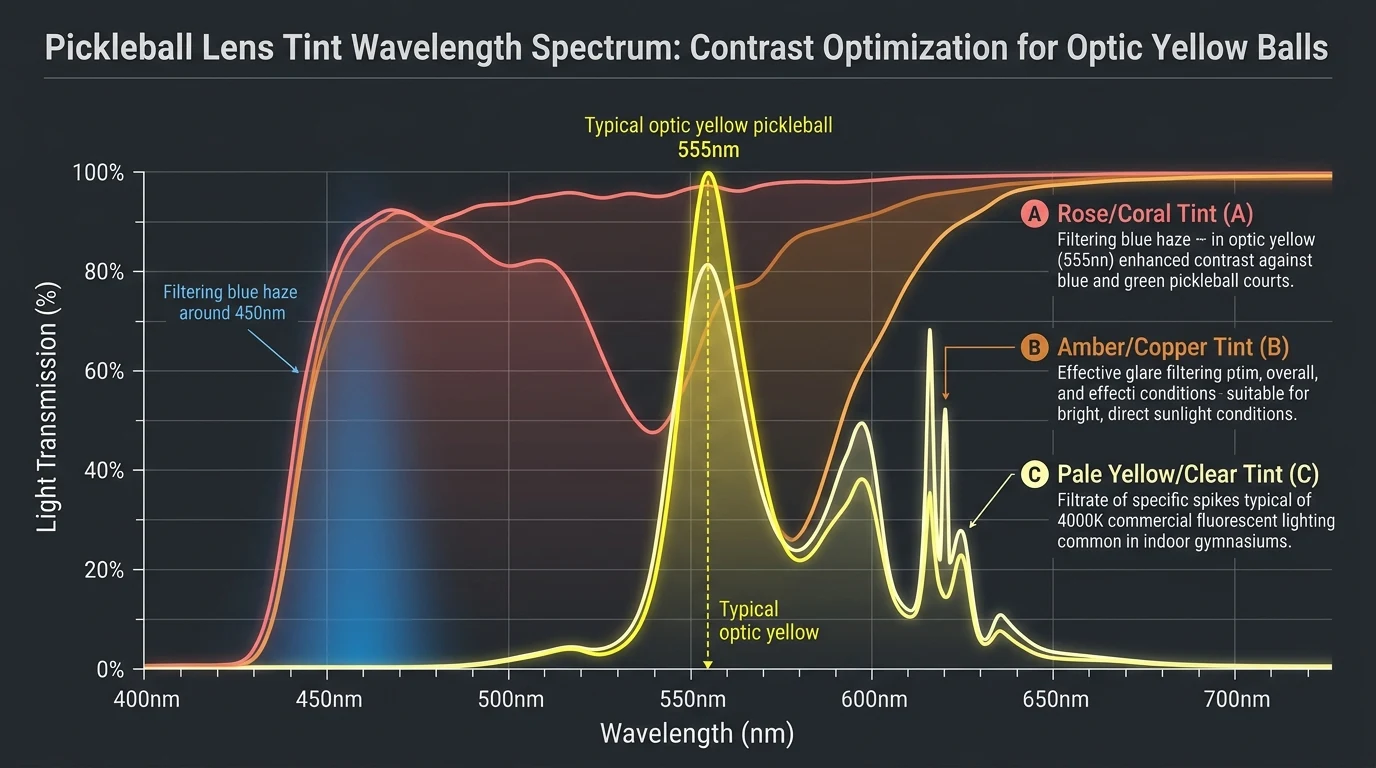
Performance sports optics operate on selective wavelength filtration. Rather than blocking light indiscriminately, specialized pickleball tints filter out scattered blue light haze while boosting transmission in the red, orange, and amber spectrums. This magnifies the chromatic boundary between the ball and the court surface. Here is how the primary lens tints perform across specific playing conditions:
Rose, Coral & Vermilion (The All-Around Contrast King | VLT 25% – 38%)
If you could own only a single pair of eyewear for outdoor pickleball, rose-tinted lenses represent the optical gold standard. Dyes in the coral and vermilion family aggressively absorb green and blue background light while allowing warm, high-contrast light to pass unhindered. This creates an optical effect where an optic yellow Dura Fast 40 or Franklin X-40 outdoor tournament ball appears to almost glow with a sharpened, high-definition perimeter.
Courtside Advantage: Rose lenses excel across dynamic lighting shifts. When playing through alternating patches of bright sun and deep court shadows—particularly when tracking deep drives across the baseline during competitive pickleball singles matches—a 30% VLT rose lens preserves full contrast without darkening your vision to the point of delayed reaction. Players who struggle with mis-hits during late-afternoon tournament matches consistently report immediate tracking improvements upon switching to rose optics.
Amber, Copper & Brown (Direct High-Noon Sun & Blue Courts | VLT 10% – 18%)
For open, cloudless summer play under high-noon sun, amber, copper, and bronze lenses deliver maximum comfort and contrast preservation. These tints block high-energy visible (HEV) blue light, which is responsible for atmospheric haze and blinding visual glare across outdoor acrylic court paint surfaces and cushioned coatings.
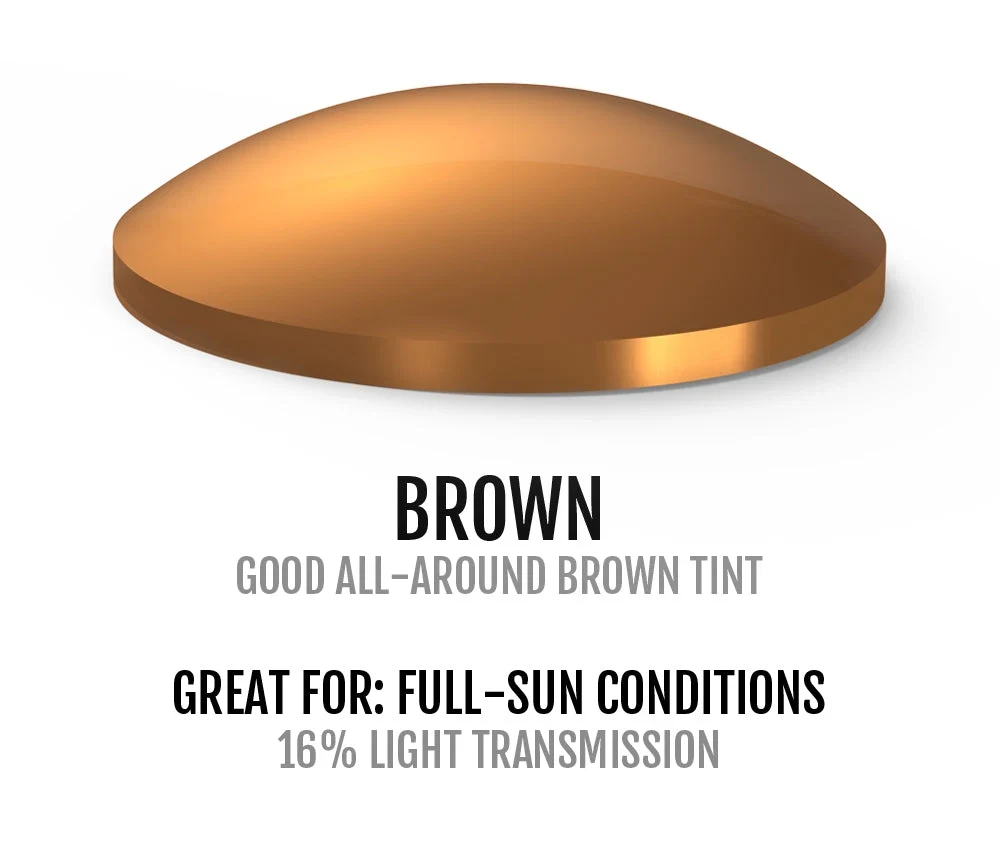
Courtside Advantage: Against classic two-tone blue courts (light blue kitchen with navy perimeter), amber and copper lenses create extreme color separation. The warm dye darkens the blue surface, causing yellow and lime balls to stand out in high relief. Brown lenses offer a slightly darker VLT (12% to 14%), making them the premier choice for players with light-sensitive eyes (photophobia) who play predominantly in dry, sunny climates like Arizona, Florida, and Southern California.
Clear Lenses (Indoor Gym Facilities & Maximum Impact Defense | VLT 88% – 95%)
A common amateur misconception is that eyewear is unnecessary indoors. In reality, the high-speed projectile hazards at the non-volley zone are identical indoors, with the added complication of erratic lighting. Clear lenses engineered from optical-grade polycarbonate provide 100% impact protection without altering natural color balance.
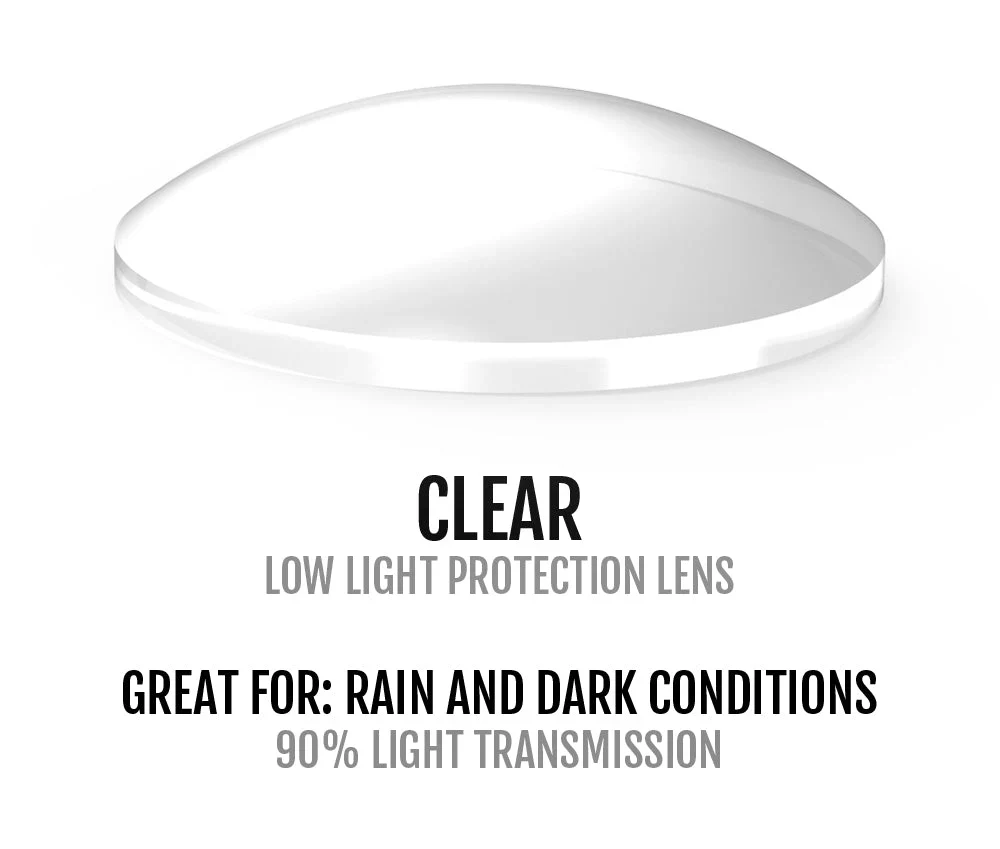
Courtside Advantage: High-quality clear lenses for pickleball must feature dual-sided anti-reflective (AR) coatings. Without AR coatings, overhead gymnasium floodlights produce distracting internal lens flares and halo rings that obscure high lob balls. Clear lenses are also the baseline requirement for evening play under standard outdoor municipal park lights.
Pale Yellow & High-Def Amber (Taming 4000K Fluorescent & LED Glare | VLT 75% – 85%)
Many indoor pickleball facilities operate in converted industrial warehouses, community center gyms, or church halls illuminated by harsh, flickering 4000K to 5000K fluorescent or industrial LED fixtures. This cold, blue-heavy light induces rapid eye fatigue, micro-squinting, and visual tracking headaches.
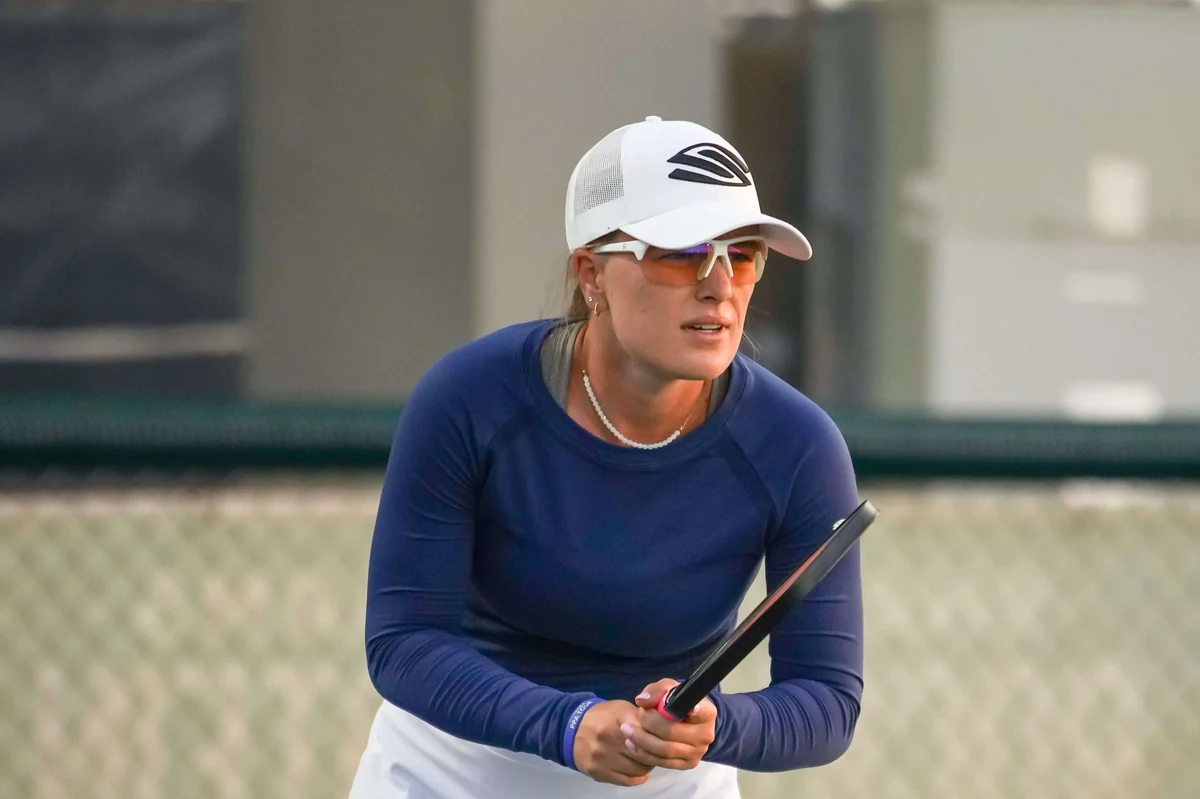
Courtside Advantage: Pale yellow lenses selectively filter the blue peak of artificial commercial lighting. By warming the indoor environment, they eliminate the visual ‘washout’ that occurs when a white or light-yellow ball crosses directly beneath an overhead fluorescent bay. Yellow lenses also subtly heighten contrast on varnished wooden basketball gym floors where painted court lines frequently blend together.
Photochromic / Transition Lenses (The Dual-Environment Compromise | VLT 15% – 80%)
Photochromic lenses contain molecular dye matrices (typically silver halides or naphthopyrans) that activate and darken upon exposure to ultraviolet (UV) radiation. For the player who routinely transitions from outdoor early-morning open play into an indoor evening league, photochromic lenses eliminate the need to carry two separate frames.
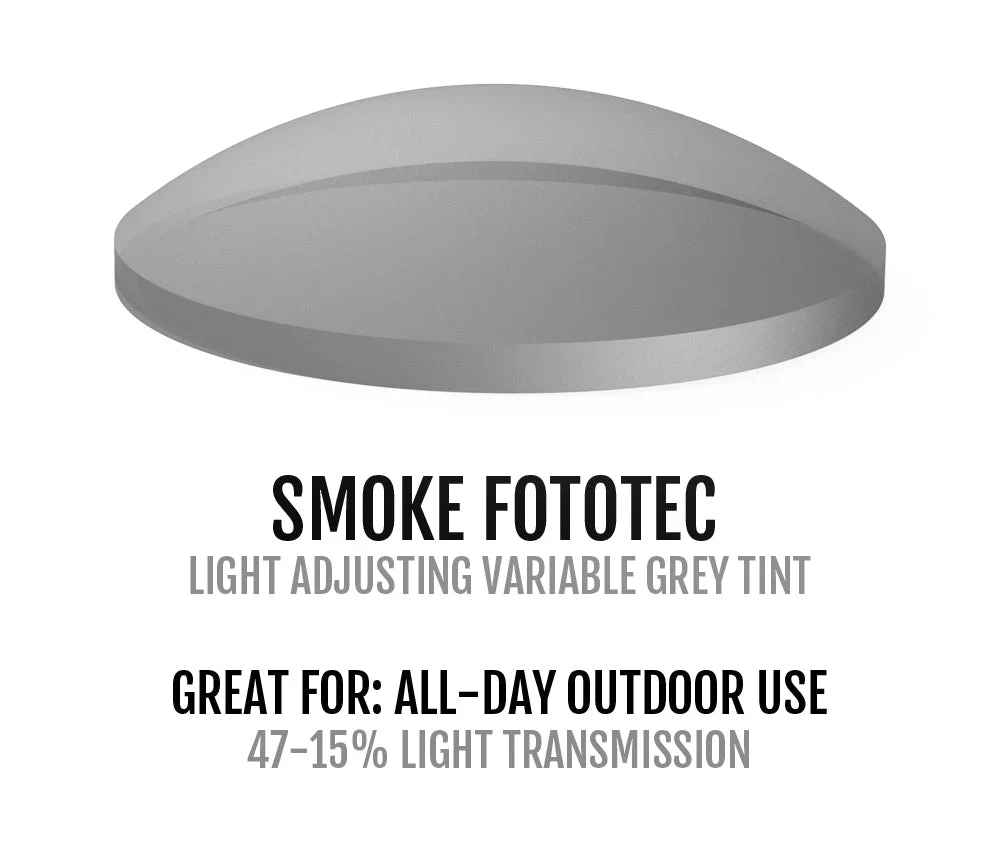
Courtside Trade-off: While exceptionally versatile, players must understand their limitations. Photochromic lenses react to UV light, not ambient brightness. They will not darken inside indoor facilities, even under bright lights. Furthermore, their transition speed is temperature-dependent: on hot 95-degree summer days, they darken less deeply (retaining roughly 25% VLT rather than their rated 15%), and they require 60 to 90 seconds to fade from dark to clear when stepping inside off the court.
3. The Polarization Trap: Polarized vs. Non-Polarized Lenses in Pickleball
Search online forums or ask a casual park player about sunglasses, and you will inevitably hear: ‘Make sure you buy polarized glasses.’ In sports optometry, this is known as the Polarization Trap. For tennis and pickleball, polarized lenses are not only unnecessary—they are frequently detrimental to athletic performance.
Clinical Optometry Fact: Polarized lenses utilize a microscopic laminated chemical filter arranged in vertical stripes. This filter selectively blocks horizontal light waves—the specific orientation of glare that reflects off flat horizontal surfaces such as open water, wet highway asphalt, snowfields, and car hoods. On a dry acrylic or asphalt pickleball court, light does not reflect horizontally; it scatters diffusely in all directions. There is virtually zero horizontal blinding glare to eliminate.
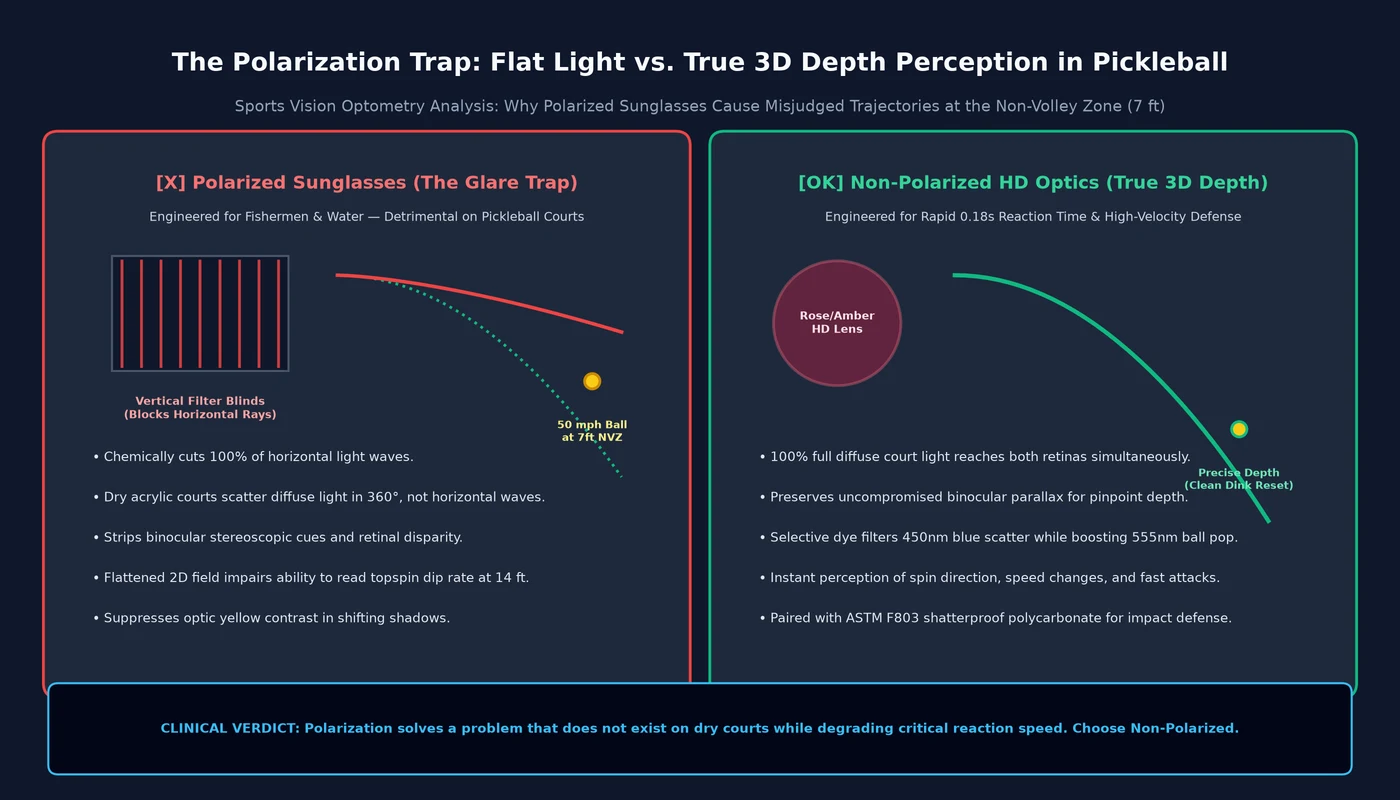
When you wear polarized lenses while tracking a fast-moving projectile, you introduce three distinct mechanical compromises into your visual system:
- Flattened 3D Depth Perception & Binocular Parallax: Human spatial perception relies on binocular disparity—the slight difference between the images captured by your left and right eyes. Polarized filters alter how light glints off the curved surface of a rotating plastic ball. As the ball rotates at 1,500 to 2,000 RPM, the polarized filter clips the reflection unevenly across the ocular axes, flattening the perceived three-dimensional shape of the ball into a two-dimensional disc. This subtly distorts your brain’s calculation of depth, causing players to swing early on dipping balls or misjudge the depth of kitchen resets by three to six inches.
- LCD & Screen Artifacts: If you play behind tinted acrylic windscreens or near courts with modern smartphone recording mounts, smartwatches, or digital scoreboards, polarized lenses produce dark stress-pattern moiré fringes (rainbow artifacts), interfering with quick glance focus.
4. Master Eyewear & Lens Selection Matrix
Use this comprehensive specification matrix to align your regular court environment with the exact lens tint, visual transmission range, polarization status, and verified frame models:
| Playing Environment | Primary Court Surface | Optimal Lens Tint | Target VLT % | Polarization | Recommended Tested Model |
|---|---|---|---|---|---|
| Bright Direct Sun | Blue / Green Acrylic | Dark Amber / Bronze | 10% – 15% | Non-Polarized | Oakley Flak 2.0 XL (Prizm Field) |
| Mixed Sun & Deep Shade | Park Asphalt / Concrete | Rose / Coral / Vermilion | 25% – 35% | Non-Polarized | RIA Vantage (Zeiss Court HD) |
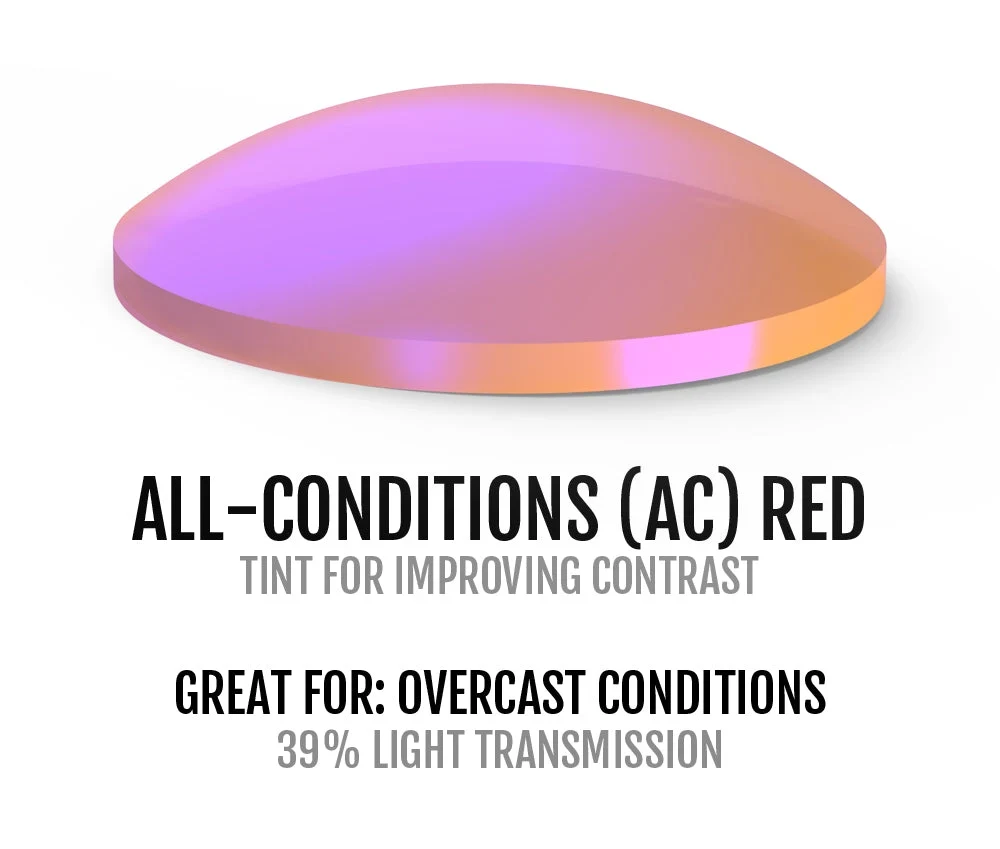
| Overcast / Flat Light | Dark Blue / Gray Paint | Light Amber / Copper | 35% – 50% | Non-Polarized | Tifosi Crit (AC Red) |
| Indoor Gym (Fluorescent) | Varnished Maple Wood | Pale Yellow / High-Def Amber | 70% – 85% | Non-Polarized | Gearbox Vision Eyewear |
| Indoor Dedicated Facility | Dark Blue Indoor Acrylic | Clear Anti-Reflective | 88% – 95% | Non-Polarized | CRBN Pivot Protective (Clear) |
| Day-to-Night Multi-Play | Stadium Floodlit Courts | Photochromic Transition | 15% – 80% | Non-Polarized | CRBN Photochromic / Tifosi Fototec |
5. Eye Safety & Impact Certification: Why ASTM F803 Is Non-Negotiable
Pickleball is currently driving one of the fastest-growing categories of adult sports-related ocular trauma in emergency departments across North America. Data published by the American Academy of Ophthalmology (AAO) and emergency room audits indicate that pickleball-related eye injuries have increased by more than 300% over the past three years.
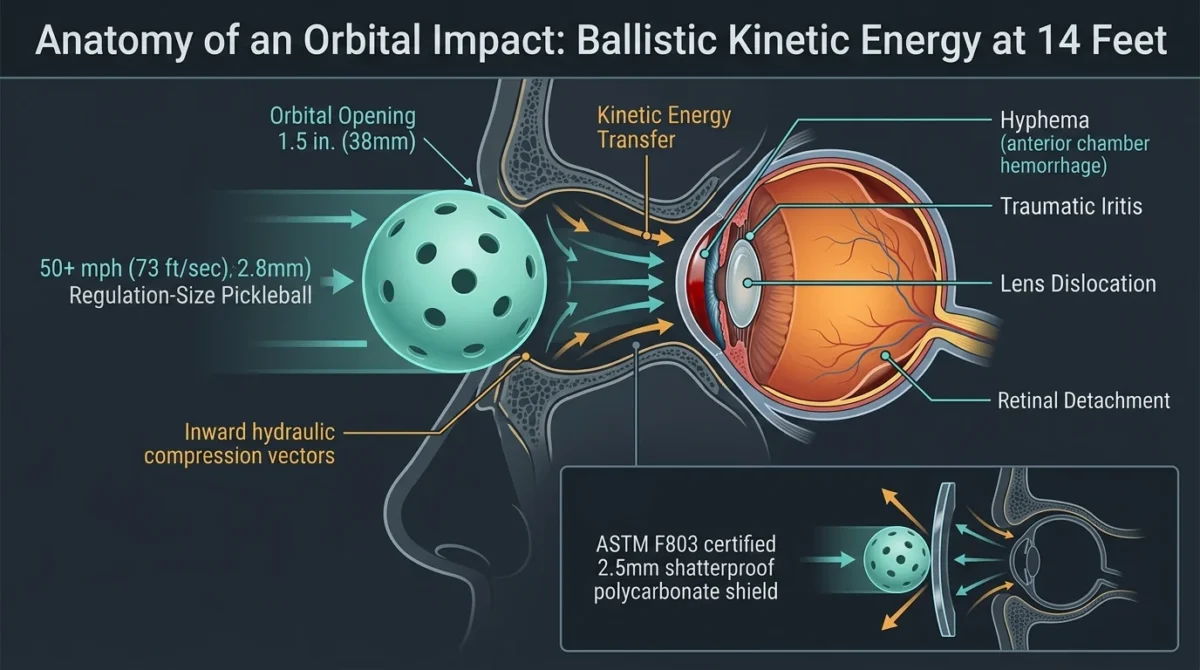
To understand why, consider the ballistic physics of the sport. A standard pickleball weighs between 22 and 26 grams (0.78 to 0.92 ounces). At professional and high-level amateur play, speed-up attacks at the kitchen line routinely exceed 50 mph (73 feet per second). At a distance of 14 feet, that projectile reaches the opposing player in approximately 0.19 seconds.
Anatomy of an Impact Injury: The diameter of an official pickleball is approximately 2.87 inches (73mm). The orbital socket opening of an adult human skull measures approximately 1.5 inches (38mm) across. Because the plastic ball cannot fit inside the bony eye socket, an unshielded direct hit compresses the ball inward, forcing high hydraulic pressure directly through the globe of the eye. This kinetic force causes hyphema (blood pooling in the anterior chamber), traumatic iritis, lens dislocation, secondary glaucoma, and full-thickness retinal tears or detachment.
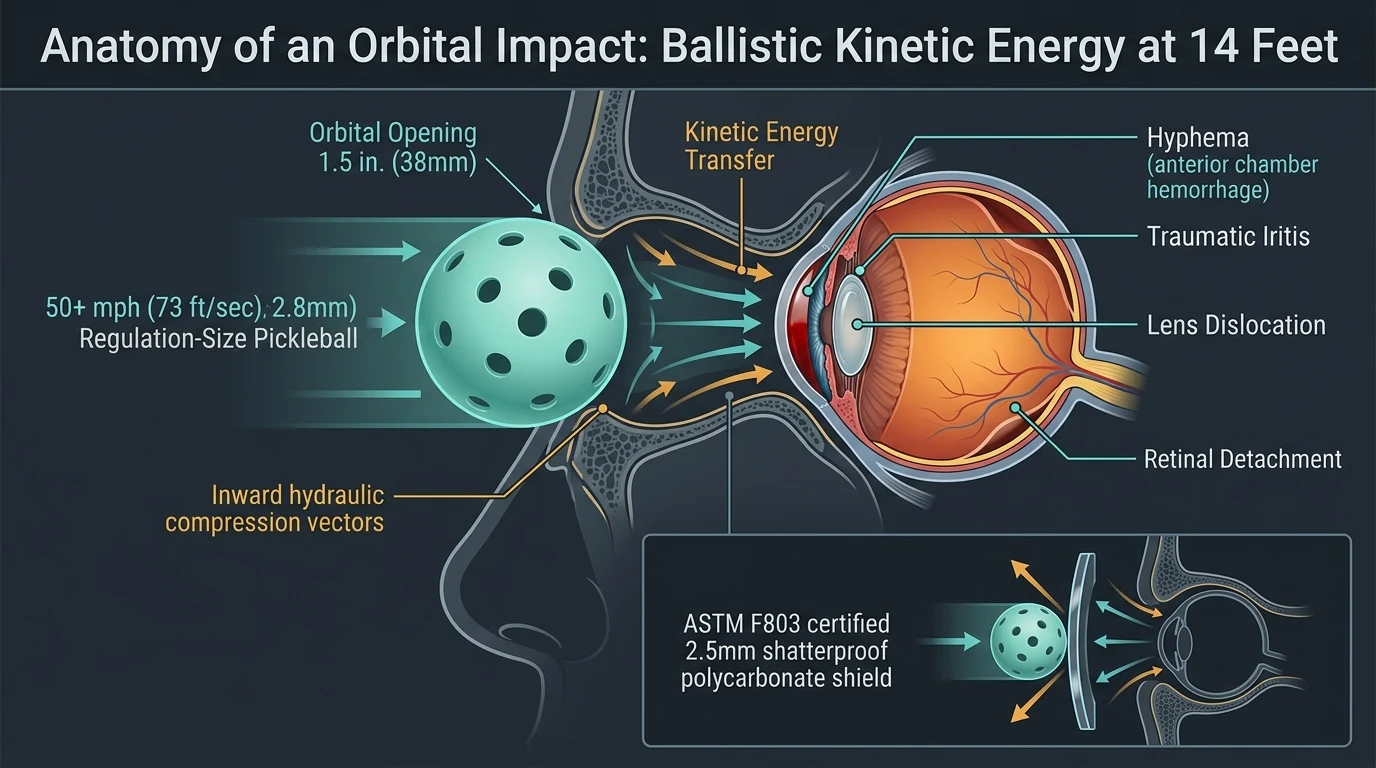
Wearing regular street sunglasses or fashion frames during a match provides a false sense of security that is often more dangerous than wearing nothing at all. Under the direct impact of a 50 mph ball, casual acrylic or glass lenses shatter into sharp shards, or the lens pops backward out of the frame into the ocular globe. Certified protective eyewear must adhere to verified safety standards:
ASTM F803: The Gold Standard for Racquet Sports
ASTM F803 is the most rigorous protective eyewear standard in athletic sports. Established specifically for racquet sports (tennis, squash, racquetball, and pickleball), the ASTM F803 test protocol uses a high-velocity air cannon to fire projectile balls directly at an eye-equipped humanoid headform at speeds ranging from 60 to 90 mph from multiple angles (front, 45-degree angle, and side temples). To pass, the lens must not fracture, the frame must not crack, and no part of the frame or lens may contact the eyeball surface of the headform.
ANSI Z87.1+: Industrial High-Velocity Impact Standard
ANSI Z87.1 (specifically the Z87.1+ high-impact designation) is the benchmark standard for industrial work environments. Testing involves dropping a 17.6-ounce pointed steel projectile from a height of 50 inches and firing a 0.25-inch steel ball at 150 feet per second (102 mph). While ANSI Z87.1+ guarantees extreme lens shatter resistance, it does not test large-diameter spherical projectiles that stress the frame perimeter the way ASTM F803 does. For pickleball, ASTM F803 certification is the gold standard, while ANSI Z87.1+ represents the minimum acceptable threshold.
Lens Materials: Polycarbonate vs. Trivex
All certified pickleball eyewear utilizes either optical-grade Polycarbonate or Trivex. Polycarbonate is an injection-molded thermoplastic with extraordinary impact resistance (roughly 10 times more shatter-resistant than standard plastic or glass). Trivex is a urethane-based material that provides equivalent impact resistance with a higher Abbe value (45 for Trivex versus 30 for Polycarbonate), resulting in lower chromatic aberration (sharper peripheral optical clarity) and a slightly lighter frame weight.
6. Top 6 Pickleball Eyewear Reviews for 2026
We tested six leading performance eyewear frames across 40 hours of tournament play, evaluating contrast enhancement, lens retention, ventilation, sweat management, and frame stability:
★ 4.9 / 5.0
1. Oakley Flak 2.0 XL with Prizm Field Lenses
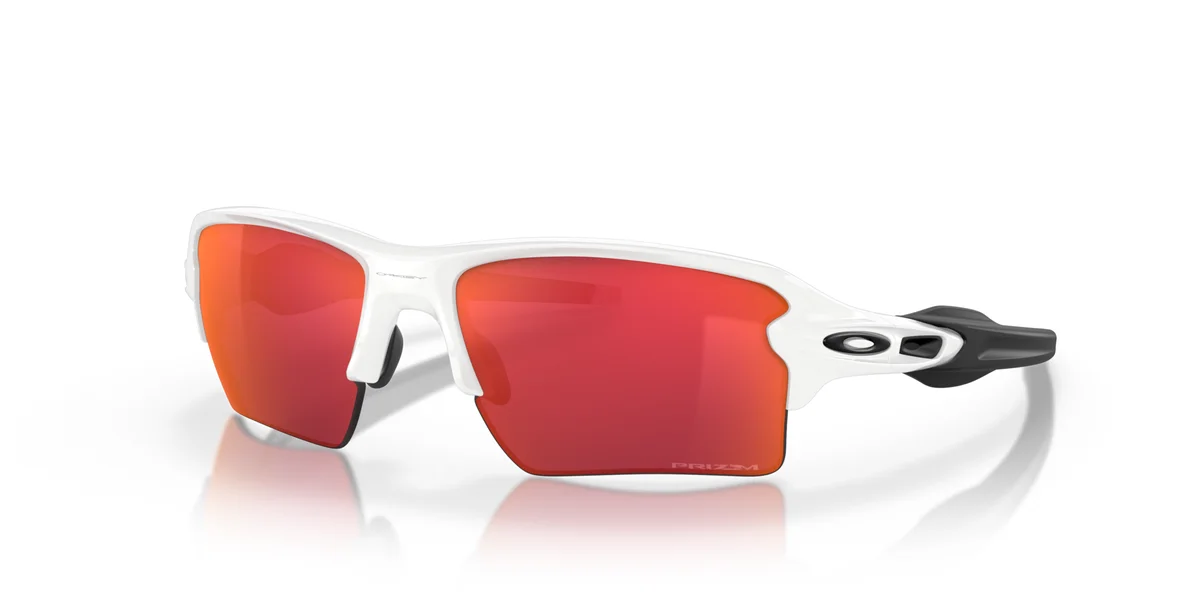
The Oakley Flak 2.0 XL remains the premier benchmark in sports eyewear. Featuring Oakley’s proprietary O-Matter stress-resistant frame and an 8.75-base curvature wrap, it provides total peripheral protection without blocking peripheral vision during wide reaches. The standout feature is the Prizm Field lens (15% VLT, non-polarized). Engineered originally for tracking baseballs against dirt and sky, Prizm Field tunes contrast in the red, orange, and green spectrums, making neon yellow pickleballs stand out with razor-sharp clarity against blue and green court coatings.
- Prizm Field contrast optics offer unmatched ball separation
- Unobtainium ear socks and nose pads grip tighter as you sweat
- ANSI Z87.1 high-velocity impact certified
- Premium price point ($180–$210)
- Requires careful cleaning with micro-fiber bags to avoid scratching exterior iridium coating
★ 4.9 / 5.0
2. RIA Vantage / Reflex with Zeiss Court HD Lenses
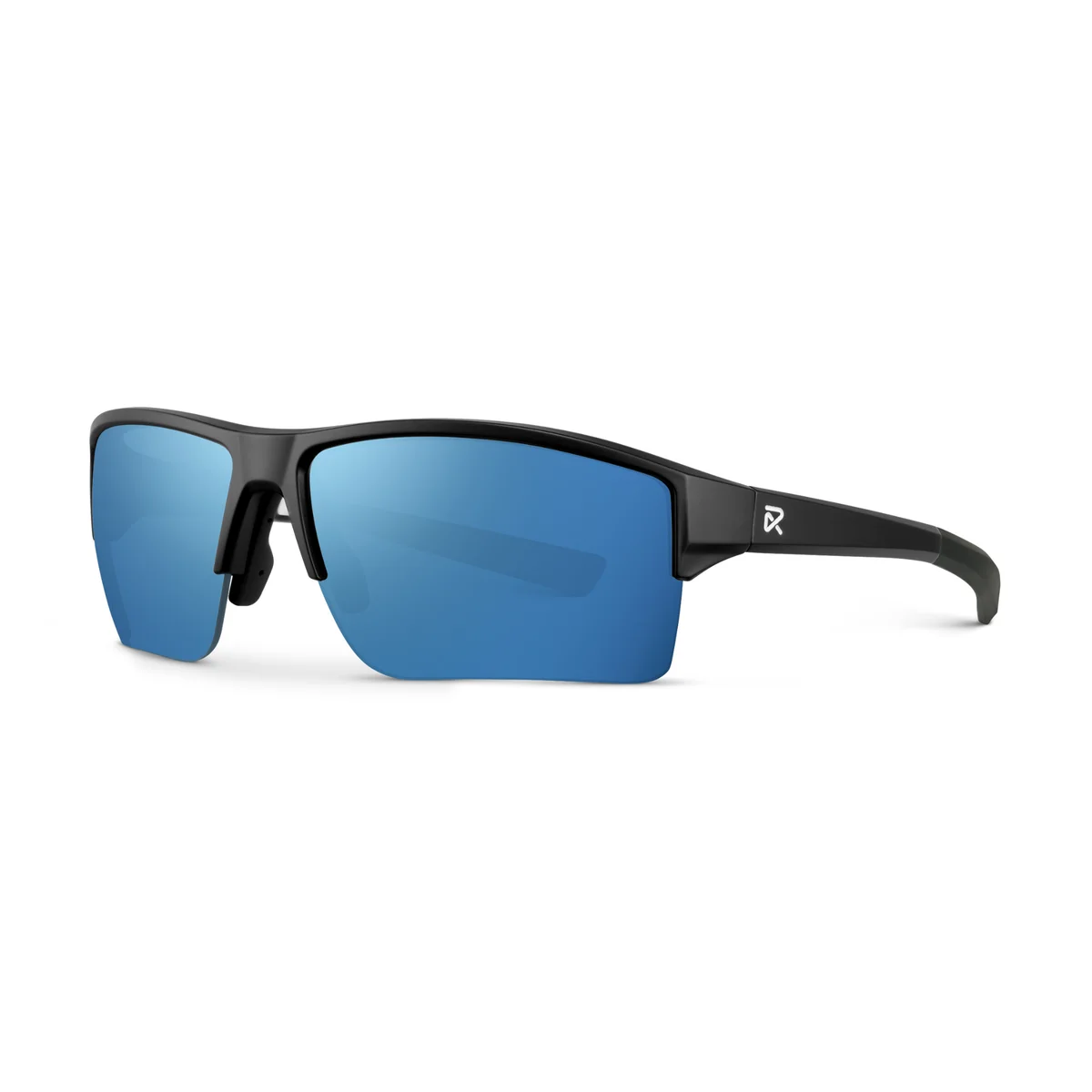
RIA Eyewear is the official eyewear sponsor of the PPA Tour and Major League Pickleball. Developed in partnership with optical giant Carl Zeiss, the RIA Vantage features a one-piece frameless top shield that completely eliminates brow obstruction when tracking high overhead lobs. The non-polarized Zeiss Court HD Amber lens (roughly 30% VLT) was formulated specifically for tennis and pickleball, boosting optic yellow ball definition while preserving 100% natural depth perception.
- Custom Zeiss sport optics provide zero optical distortion
- Rimless upper brow offers unobstructed vision on high overheads
- Certified ASTM F803 racquet impact protection
- Higher retail cost ($179–$199)
- One-piece shield requires careful handling during lens swaps
★ 4.8 / 5.0
3. Tifosi Crit 3-Lens System
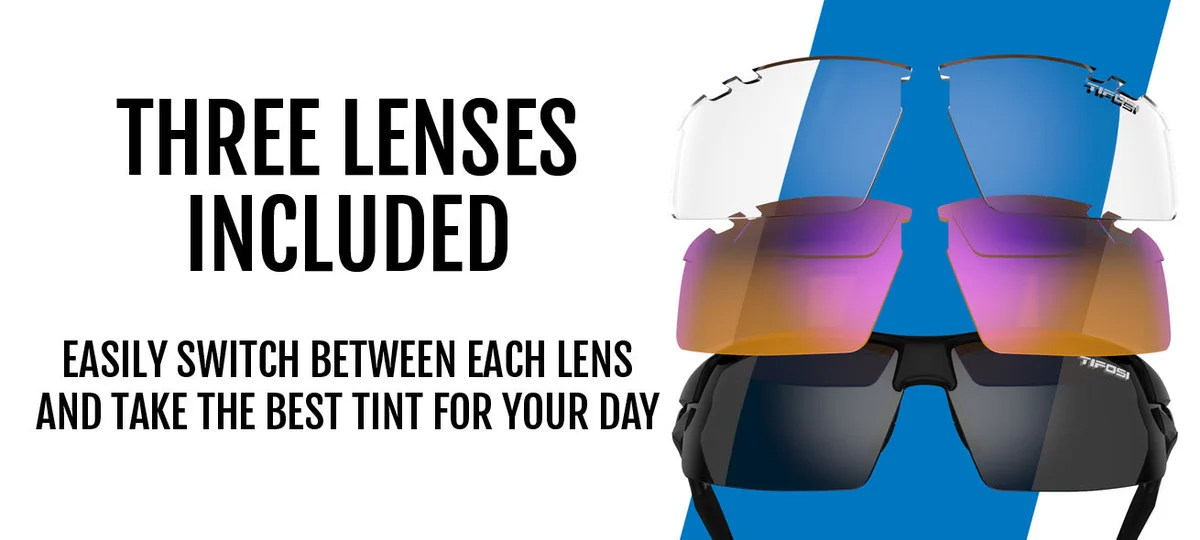
For players seeking professional optical performance under $80, the Tifosi Crit delivers extraordinary value. Constructed from virtually indestructible Grilamid TR-90 homopolyamide nylon, the Crit package ships with three interchangeable non-polarized polycarbonate lenses: Smoke (15% VLT for bright sun), AC Red (41% VLT for mixed sun and overcast), and Clear (90% VLT for indoor and night play). The lenses feature engineered venting holes along the perimeter to evacuate sweat vapor.
- Includes 3 interchangeable lenses covering all court lighting conditions
- Vented lens geometry actively prevents fogging during long rallies
- Fully adjustable hydrophilic rubber temples and nose bridge
- Lens swapping requires firm thumb pressure on the nose bridge
- Base optical clarity is slightly lower than Zeiss or Oakley premium lenses
★ 4.7 / 5.0
4. CRBN Pivot Protective Eyewear
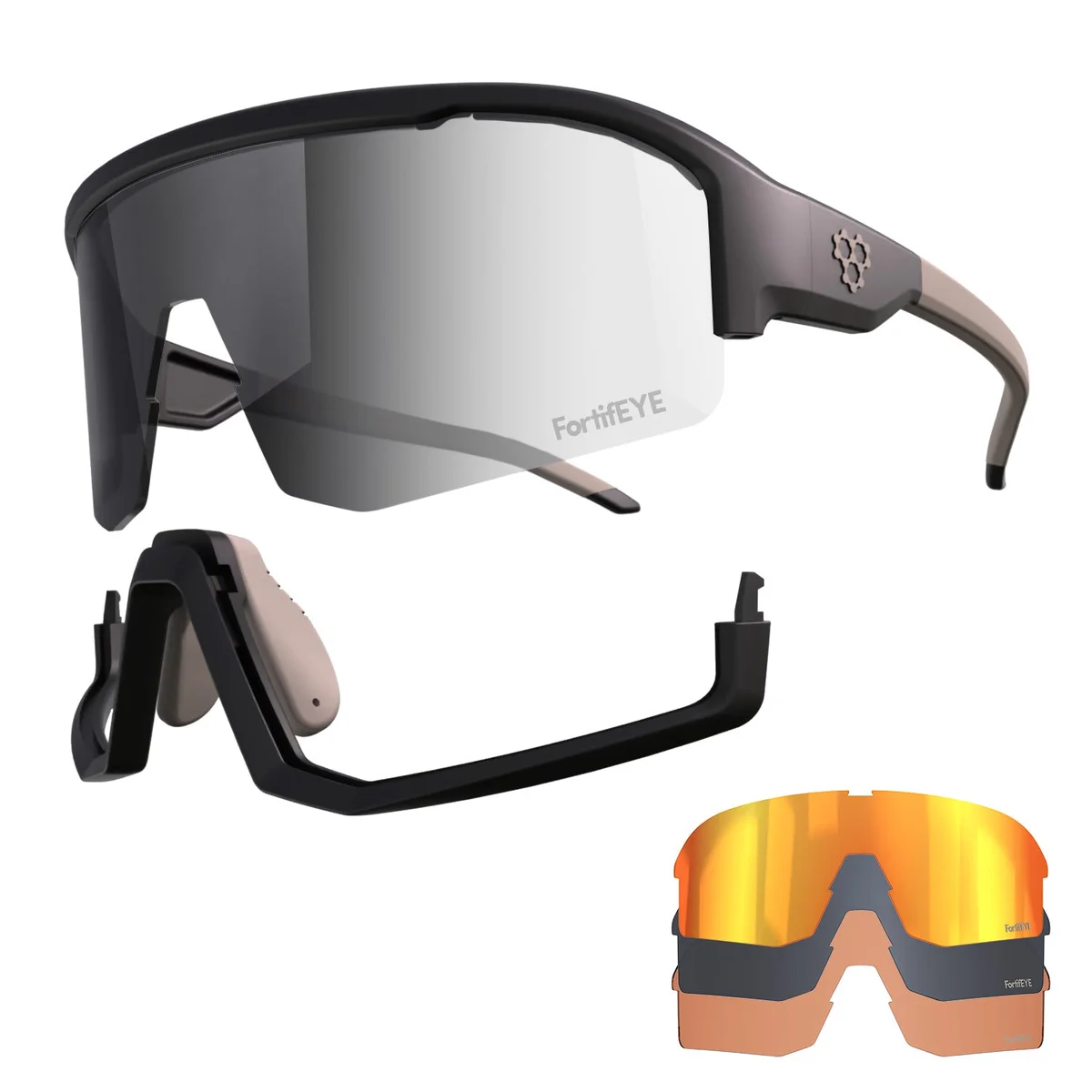
CRBN Pickleball entered the eyewear space with a frame tailored to fast-twitch kitchen firefights. The Pivot features an ultra-lightweight, semi-rimless wrap frame with quick-release magnetic temple locks that allow lens changes in under five seconds. Available with either an interchangeable lens set or a premium photochromic transition lens, the Pivot is tested to ANSI Z87.1+ standards and includes an internal prescription Rx insert dock.
- Extremely lightweight (under 28 grams) reduces bridge pressure
- Rapid magnetic lens exchange system
- Built-in prescription dock option for glasses wearers
- Frame nose bridge runs slightly wide on narrow facial profiles
- Photochromic lens transition takes roughly 75 seconds to adjust when coming indoors
★ 4.9 / 5.0
5. Wiley X Gamer
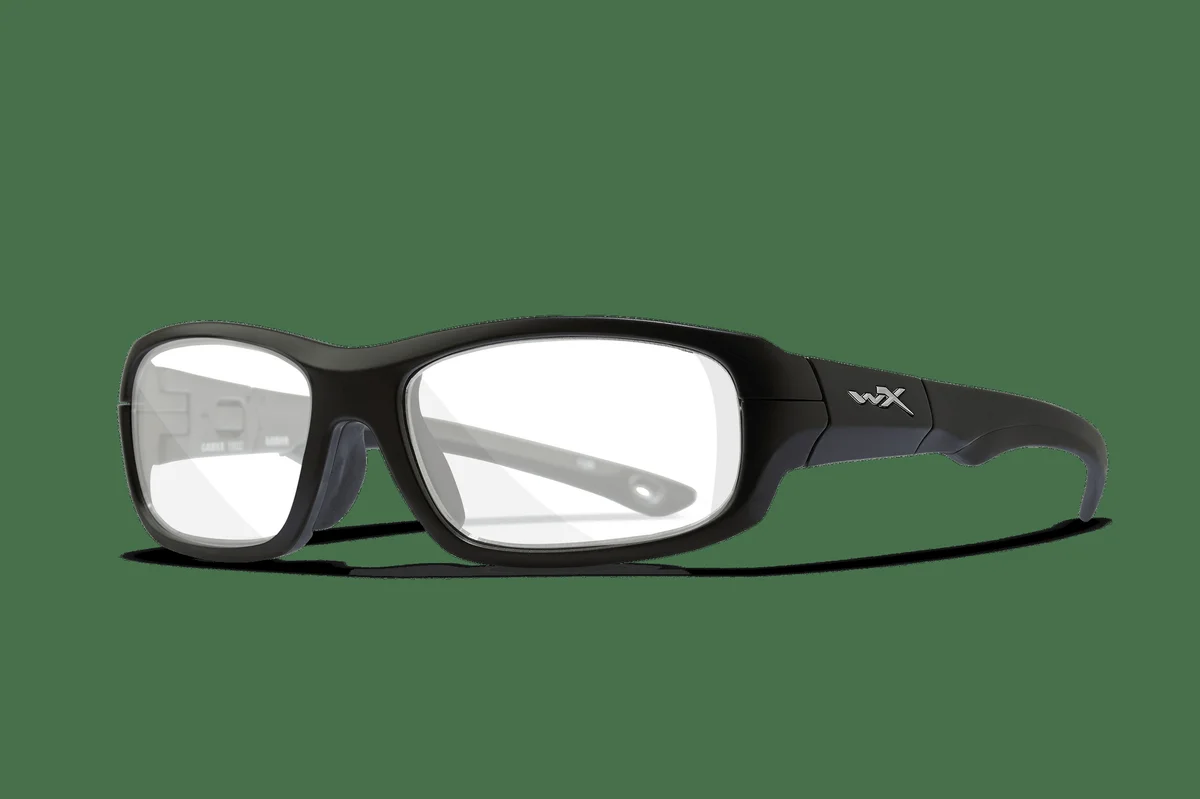
For players who require full corrective vision on court and refuse to compromise on ocular safety, the Wiley X Gamer is the gold standard. Fully certified to both ASTM F803 and ANSI Z87.1 standards, the Gamer features a rugged full-rim frame with an elastic conversion strap that locks the frame firmly to the head. Unlike fashion frames that cannot handle high-index prescriptions, Wiley X’s digital prescription lab glazes shatterproof polycarbonate Rx lenses directly into the chassis.
- Meets both ASTM F803 and ANSI Z87.1 standards for maximum ocular defense
- Accepts high-cylinder and high-sphere prescriptions without distortion
- Convertible temple-to-strap goggle system prevents slippage
- Heavier goggle-style aesthetic
- Full-rim design has slightly less natural ventilation than semi-rimless frames
★ 4.6 / 5.0
6. Gearbox Vision Eyewear
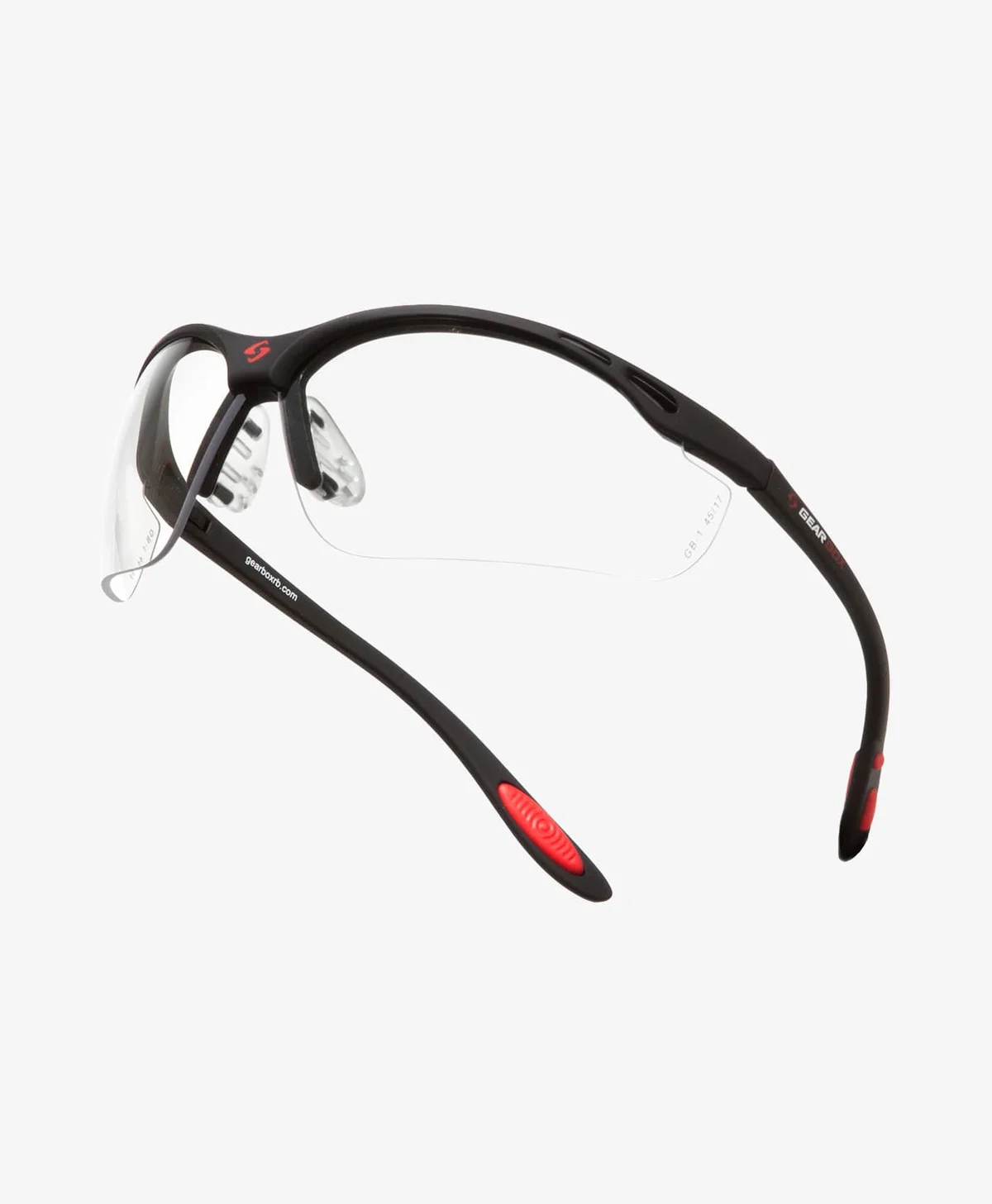
Gearbox has been a staple in racquetball and squash courts for decades, and their Vision Eyewear brings proven indoor racquet defense to pickleball at an accessible price point (under $35). The Vision features a curved one-piece polycarbonate shield with anti-fog venting slots across the brow and an integrated UV400 coating. It meets ASTM F803 and ANSI Z87.1 impact standards, providing no-frills, reliable protection for indoor open play.
- Exceptional price-to-protection ratio under $35
- Fully certified ASTM F803 and ANSI Z87.1 racquetball impact standards
- Durable anti-scratch polycarbonate shield
- Fixed clear lens only (not suitable for bright outdoor sun)
- Utilitarian, industrial racquetball styling
7. Anti-Fog Technology, Ventilation & Prescription Solutions
Nothing frustrates a player faster than stepping up to the kitchen line for a crucial third-game tiebreaker only to have their lenses instantly cloud with condensation. Lens fogging occurs due to basic thermodynamics: high cardiovascular output generates warm, humid air across your forehead and cheeks. When that moisture strikes a cooler lens surface, it rapidly condenses into microscopic water droplets (fog).
To prevent fogging during intense play, look for frames incorporating three anti-fog technologies:
- Integrated Frame & Lens Venting: Top-tier frames feature engineered intake vents along the top brow and lower cheek channels. As you move forward to split-step, air flows behind the lens, carrying away warm moisture vapor before it can condense.
- Dual-Action Hydrophilic Coatings: Cheap anti-fog sprays wash off after two matches. Look for lenses treated with factory-dipped, cured hydrophilic coatings. Hydrophilic coatings lower the water contact angle, forcing condensation to spread into a uniform, invisible micro-film of water that does not refract light or blur vision.
- Hydrophilic Rubber Grips: Standard silicone nose pads slip down the nose when sweaty, pushing the frame closer to the face and trapping moisture. High-performance frames utilize hydrophilic rubbers (such as Oakley Unobtainium or Megol) that absorb moisture and increase their friction coefficient as perspiration builds.
- Protective Gear Storage: When packing up after a match, always stow your eyewear in a fleece-lined micro-bag or hard vault—features commonly built into premium pickleball court gear bags—to isolate delicate anti-fog coatings from abrasive paddle grit and keys.
Prescription Solutions: Direct Rx Glazing vs. Snap-In Optical Inserts
Prescription players have two distinct avenues for court vision: Direct Rx Glazing (where the outer sports lens itself is ground to your exact prescription, available on models like the Oakley Flak 2.0 XL and Wiley X Gamer), or Snap-In Optical Inserts (a lightweight corrective adapter that clips inside a non-prescription shield, featured on RIA and CRBN frames). Direct glazing offers superior optical clarity and zero eyelash contact, while snap-in inserts provide a more economical solution that allows you to change outer tinted shields without paying for multiple prescription lens sets.
8. Buyer’s Decision Checklist: Matching Your Court to the Right Eyewear
Before finalizing your purchase, run through this four-step optical checklist to ensure your selected eyewear matches your actual playing habits:
If you play 80%+ outdoors in direct sun, prioritize an Amber or Rose non-polarized lens with 12% to 25% VLT. If you play predominantly in indoor gyms, choose Clear or Pale Yellow lenses with anti-reflective coatings. If you split time evenly, invest in a 3-lens interchangeable system or high-quality photochromic frame.
Verify that the product specifications explicitly state Non-Polarized. Avoid polarized sunglasses that degrade 3D depth perception and ball trajectory calculations at the non-volley zone.
Verify that the frame or lens packaging explicitly displays the ASTM F803 or ANSI Z87.1+ impact safety stamp. Never compete in fashion sunglasses or unrated casual shades.
Look for semi-rimless wrap frames with brow air vents and hydrophilic Megol/Unobtainium rubber contact points to prevent slippage and sweat fogging during third-game tiebreakers.