Balls
Few things ruin an open-play morning faster than a ball that flies like a wiffle plastic toy in a 10 MPH breeze or snaps clean along the seam on a chilly 45°F court. Official USA Pickleball specifications require tournament balls to weigh between 0.78 and 0.935 ounces, span 2.87 to 2.97 inches in diameter, and rebound between 30 and 34 inches when dropped from 100 inches onto smooth concrete. But standard lab numbers tell only half the story once you step onto asphalt.
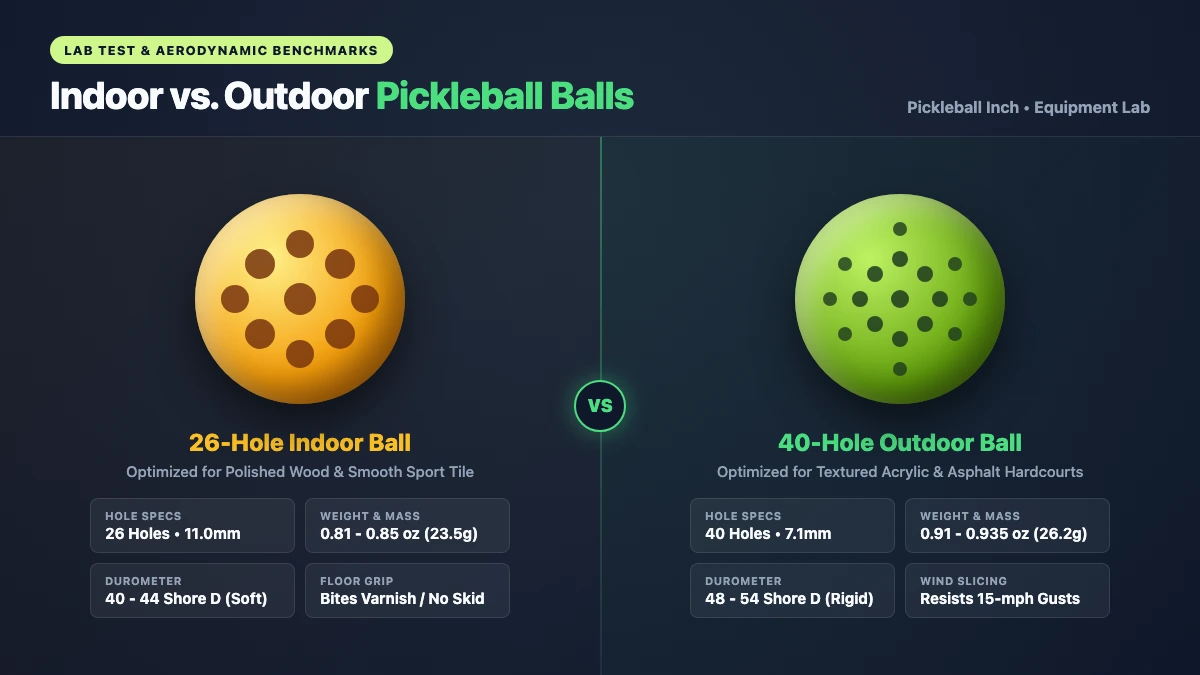
Outdoor balls rely on 40 small, precision-drilled holes and hard, rotational-molded polyethylene rated between 45 and 50 on the Shore D durometer scale. That rigid shell cuts straight through wind gusts without fluttering offline. The trade-off is winter brittleness. Hard outdoor plastic loses elasticity quickly in cold air, turning yellow shells brittle enough to crack after just three hard overhead smashes. Indoor balls flip the engineering entirely. They feature 26 larger holes and softer, low-density plastic blends engineered to grip smooth gymnasium hardwood without skidding or making deafening echoes.
Field Testing Takeaways:
- Outdoor Standards (Franklin X-40 & Dura Fast 40): Stiff, true-flying flight trajectories with high bounce rebound; swap to softer blends when air temperatures dip below 50°F to prevent cracked seams.
- Indoor Gym Formulations: Softer rubberized touch engineered to stick to urethane basketball flooring and prevent lethal skate skids on quick digs.
- Longevity Math: High-compression tournament balls stay round for roughly 3 to 5 intense matches before losing bounce height and developing subtle flat spots.
We test every batch on concrete and hardwood with durometer hardness meters and high-speed drop rigs. Explore our ball breakdowns below to keep your matches consistent across every season.
We put 26-hole indoor and 40-hole outdoor balls through Shore D durometer tests, wind-tunnel drift models, and winter crack tests. Includes real 1-year club replacement cost calculations.
USA Pickleball rulebook essentials made practical: legal wrist-below-waist serve mechanics, non-volley zone momentum faults, line call etiquette, and the logic behind three-number scoring.