
While doubles pickleball commands the vast majority of social park play, learning how to play singles pickleball and discovering how to play skinny singles pickleball unlocks the purest, most athletic, and tactically demanding dimensions of the sport. Often searched by competitive athletes as pickleball how to play singles, how to play singles in pickleball, or how to play pickleball in singles, one-on-one pickleball strips away the safety net of having a partner to cover your weaknesses. Every foot of court space, every passing angle, and every breath of cardiovascular endurance belongs entirely to you.
Whether you are a beginner exploring how to play pickleball singles for beginners, an intermediate player seeking high-repetition dink drills through how to play skinny singles in pickleball (also known as pickleball skinny singles how to play or how to play pickleball skinny singles), or a competitive tournament player studying how to play singles pickleball video and how to play pickleball singles video analysis, this master manual breaks down the court geometry, simplified two-number scoring, passing mechanics, and recovery footwork needed to dominate the singles arena.
Tactical Overview: Singles vs. Doubles Pickleball
- Scoring Simplification: Only two numbers called (Server Score – Receiver Score). No second server, no third digit.
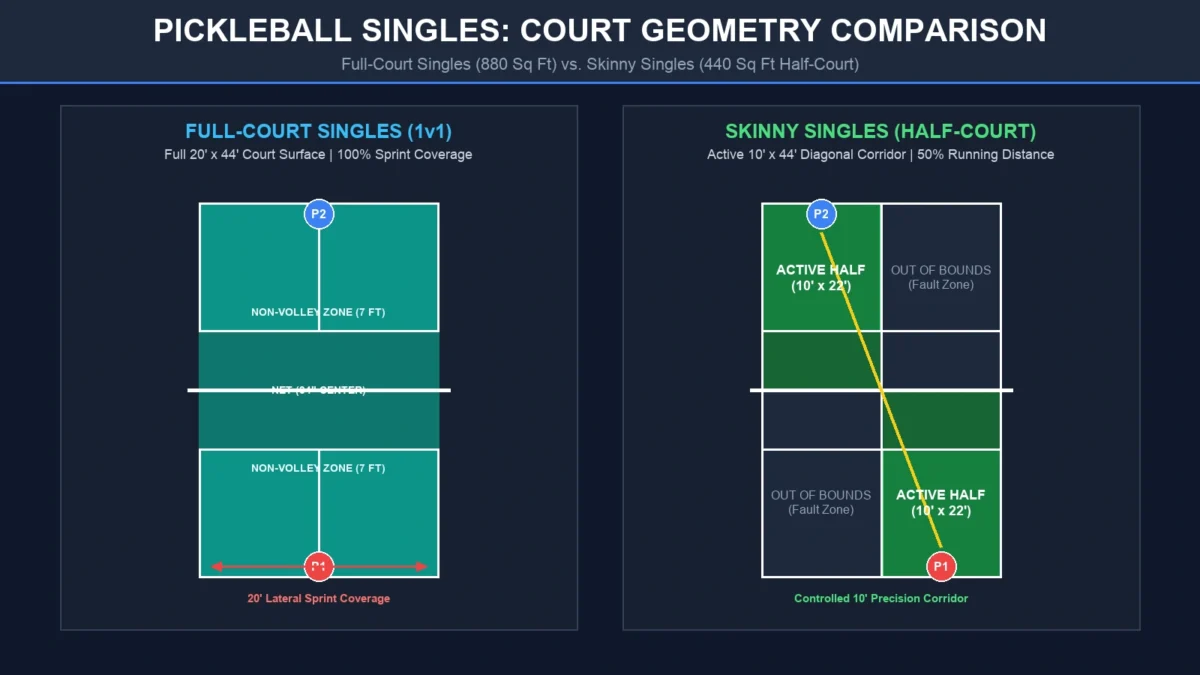
- Court Surface Demand: 880 square feet covered by one player in full-court singles, compared to 440 square feet in skinny singles.
- Shot Hierarchy: 70% third-shot drives and sideline passing shots, contrasting sharply with the 90% third-shot drop frequency in doubles.
- Equipment Alignment: Heavy preference for elongated paddles (16.5″ length) providing extra reach on diving sideline passing saves.
📖 Table of Contents: How to Play Pickleball Singles
- 1. Full-Court Singles vs. Skinny Singles: The Critical Differences
- 2. Official Singles Rules & The Two-Number Scoring System
- 3. How to Play Skinny Singles in Pickleball: Formats & Court Geometry
- 4. Full-Court Singles Tactics: The Modern ‘Mini-Tennis’ Meta
- 5. Video Drills & High-Speed Visual Training
- 6. Conditioning, Footwork & Paddle Selection for Singles
- 7. Frequently Asked Questions: How to Play Pickleball Singles
1. How to Play Pickleball Singles vs. Skinny Singles: The Critical Differences
Before diving into specific rules and tactical shot execution, players must understand the fundamental distinction between traditional full-court singles and the modified half-court variant known as skinny singles:
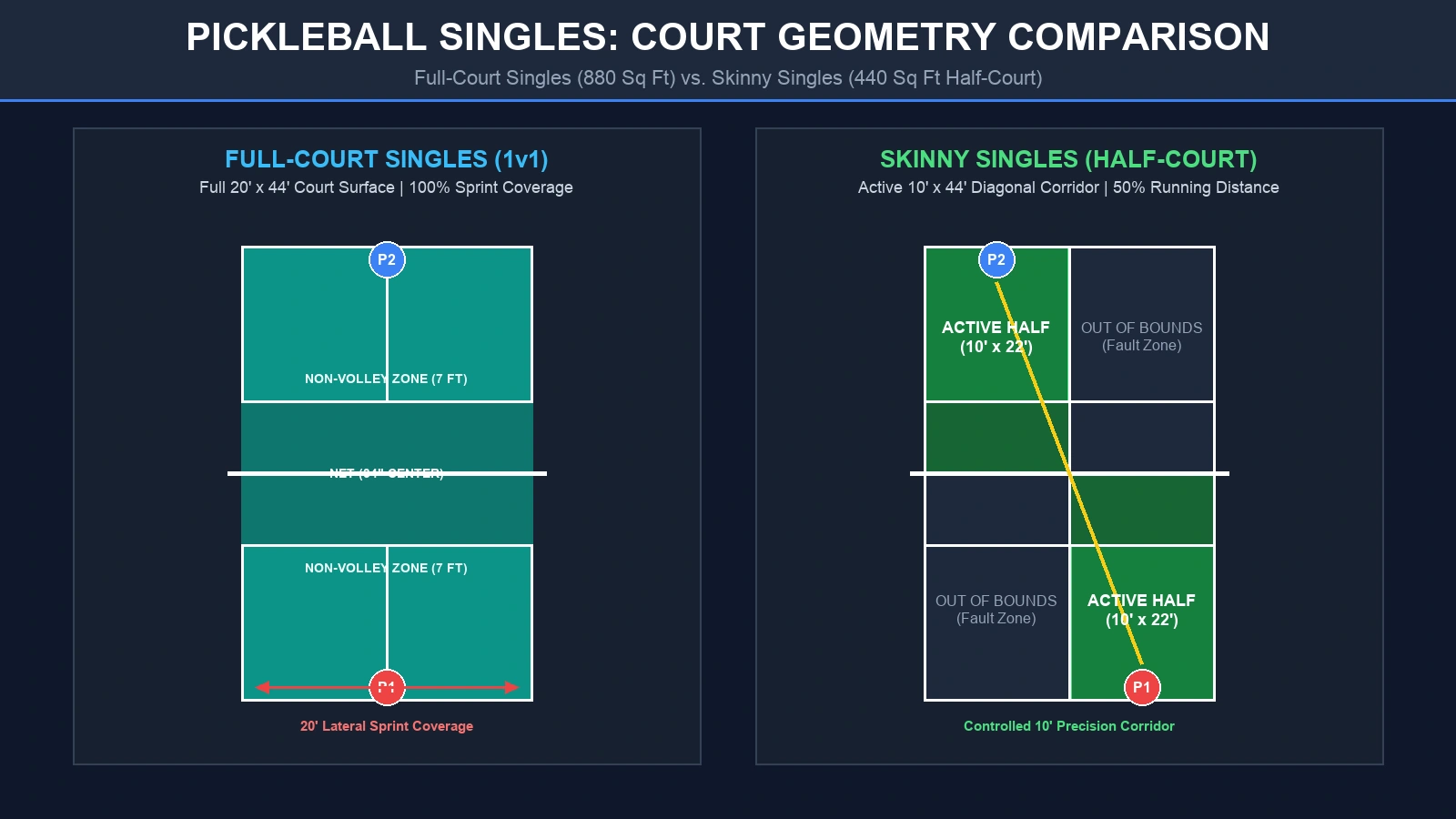
- Full-Court Singles (1v1): Played across the entire regulation 20-foot wide by 44-foot long court. It is a grueling, explosive cardiovascular challenge closely resembling tennis. Players must cover 880 square feet alone, making speed, lateral agility, aggressive passing shots, and deep baseline drives the dominant assets.
- Skinny Singles: Played on exactly half the court width (10 feet wide by 44 feet long). While still a 1v1 format, boundary restrictions eliminate the grueling physical sprint across the full 20-foot baseline. It isolates specific doubles patterns—crosscourt dinking, kitchen resets, and down-the-line drives—making it the ultimate high-efficiency practice drill for doubles players and seniors.
2. Official Singles Rules & The Two-Number Scoring System
One of the greatest reliefs for beginners learning how to play singles in pickleball is that scoring is significantly easier than doubles. In doubles, players must track the server number (e.g., 4-2-1 or 4-2-2) and remember who started where. In singles, there is NO third number to call, NO server-one/server-two confusion, and NO partner switching. As outlined in our official guide to pickleball rules explained, the fundamentals remain rock-solid across all formats.
2.1 The Two-Number Callout Formula
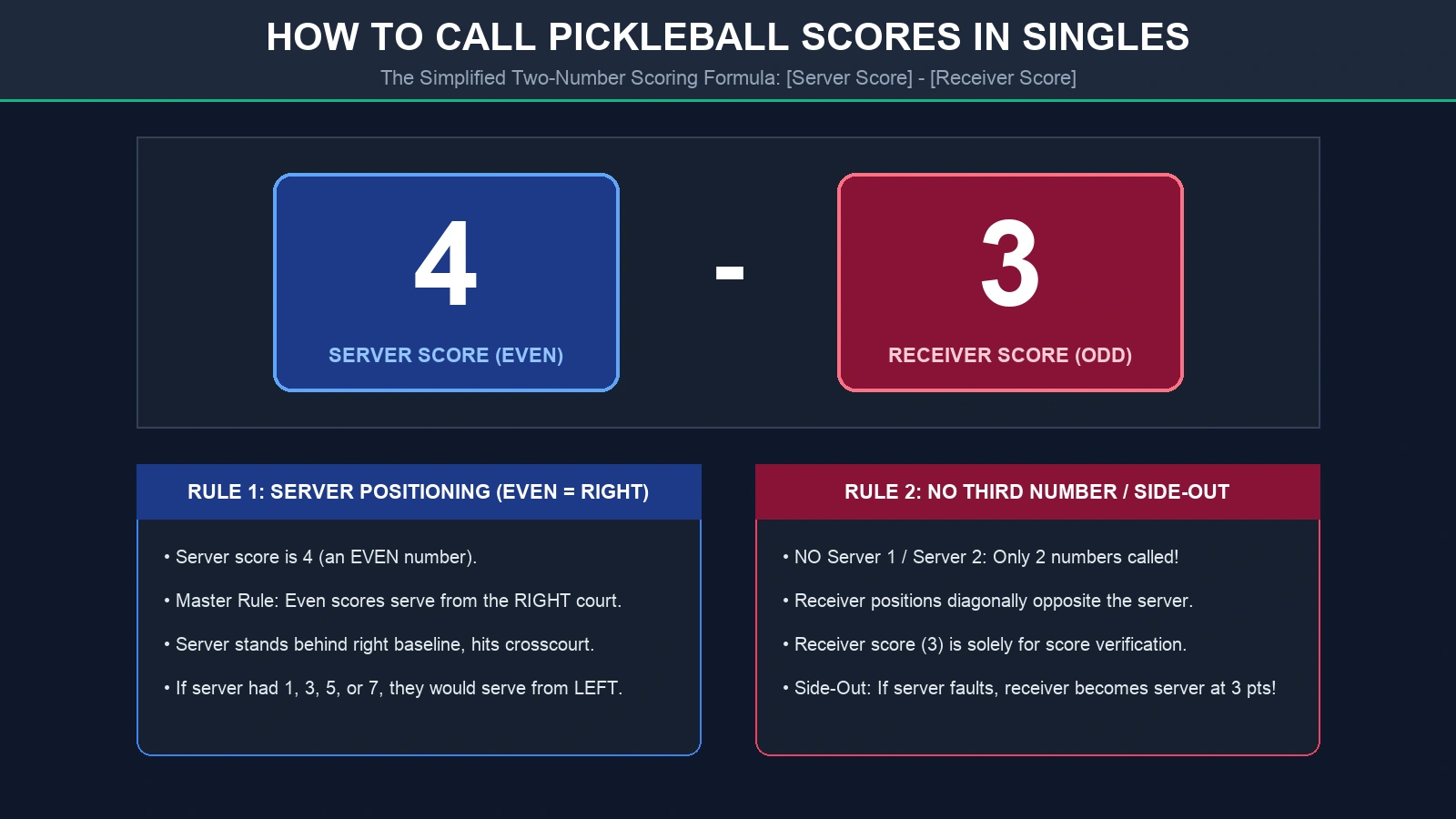
In singles pickleball, the score is announced simply as two numbers before every serve:
For example, if you are serving with 6 points and your opponent has 4 points, you simply call “6 – 4”. If your opponent wins the ensuing rally, a side-out occurs, and they will call “4 – 6” when serving their next turn.
2.2 The Even/Odd Positioning Rule (The Master Principle)
Your court position on serve is determined exclusively by your OWN individual score:
- Even Score (0, 2, 4, 6, 8, 10…): You MUST serve from the Right Service Court (the Even Court) diagonally into the opponent’s right court.
- Odd Score (1, 3, 5, 7, 9…): You MUST serve from the Left Service Court (the Odd Court) diagonally into the opponent’s left court.
- Receiver Alignment: The receiver always mirrors the server’s diagonally opposite court. If the server is on the right court, the receiver stands in their own right court (diagonally across); if the server is on the left court, the receiver stands in their own left court.
2.3 The Side-Out Dynamic in Singles
Just like doubles, points in standard singles can only be scored by the server (side-out scoring). When the server wins a rally, they gain 1 point and immediately switch to the other service box (e.g., from right to left). When the server faults or loses a rally, NO point is awarded; instead, an immediate SIDE-OUT occurs. The opponent takes the ball, checks their own score, positions themselves on the right (if even) or left (if odd), and serves. For a refresher on baseline mechanics and service execution, explore our comprehensive breakdown on how to play pickleball.
3. How to Play Skinny Singles in Pickleball: Formats & Court Geometry
Learning how to play skinny singles pickleball (frequently searched as how to play skinny singles in pickleball or pickleball skinny singles how to play) is the secret competitive advantage used by elite 5.0 players to refine touch, discipline, and shot placement. Because the court width is halved, spraying balls wide is an instant fault, forcing players to hit with surgical accuracy.
3.1 Standard Skinny Singles (Score-Tracking Format)
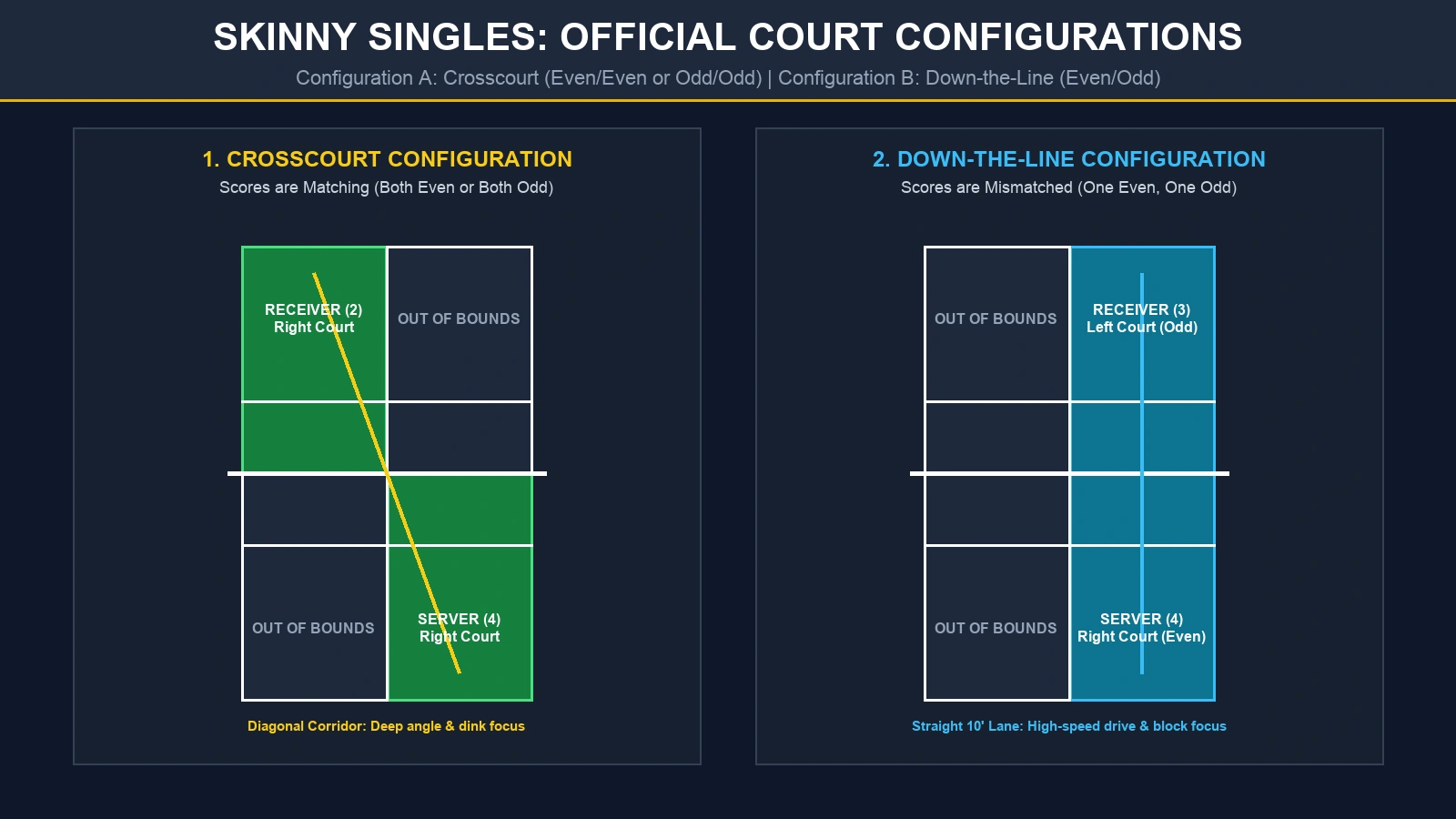
In standard competitive skinny singles, each player’s court position is dictated by their own individual score (Right on Even, Left on Odd). This creates two alternating geometric setups throughout the match:
1. Crosscourt Play (Both Even / Both Odd)
When both players have even scores (0-0, 2-2, 4-2) or both have odd scores (1-1, 3-1, 5-3), both stand on the same relative side of their baselines. You are positioned diagonally across from each other, and all play must land within the diagonal half-court corridor.
2. Down-the-Line Play (One Even, One Odd)
When one player has an even score and the other has an odd score (2-1, 3-4, 5-6), one player is on the right while the other is on the left. You are now positioned directly opposite each other down-the-line! All serves, returns, and dinks must stay within that straight-ahead 10-foot lane.
3.2 Alternative Skinny Singles Formats
Because skinny singles is primarily a training framework, several popular variations exist on recreational courts:
- Format A: Crosscourt Only: Players disregard score-based positioning and play 100% of points diagonally crosscourt. When the server scores, players switch between the even crosscourt lane and the odd crosscourt lane. This is the premier drill for mastering doubles crosscourt dinking.
- Format B: Down-the-Line Only: Players strictly play straight ahead down the 10-foot lane, sharpening fast hands, speed-up blocks, and sideline defense.
- Format C: Receiver’s Choice: Prior to the serve, the receiver designates whether the upcoming point will be played crosscourt or down-the-line, forcing the server to adapt to unpredictable court geometry.
4. How to Play Pickleball Singles Tactics: The Modern ‘Mini-Tennis’ Meta
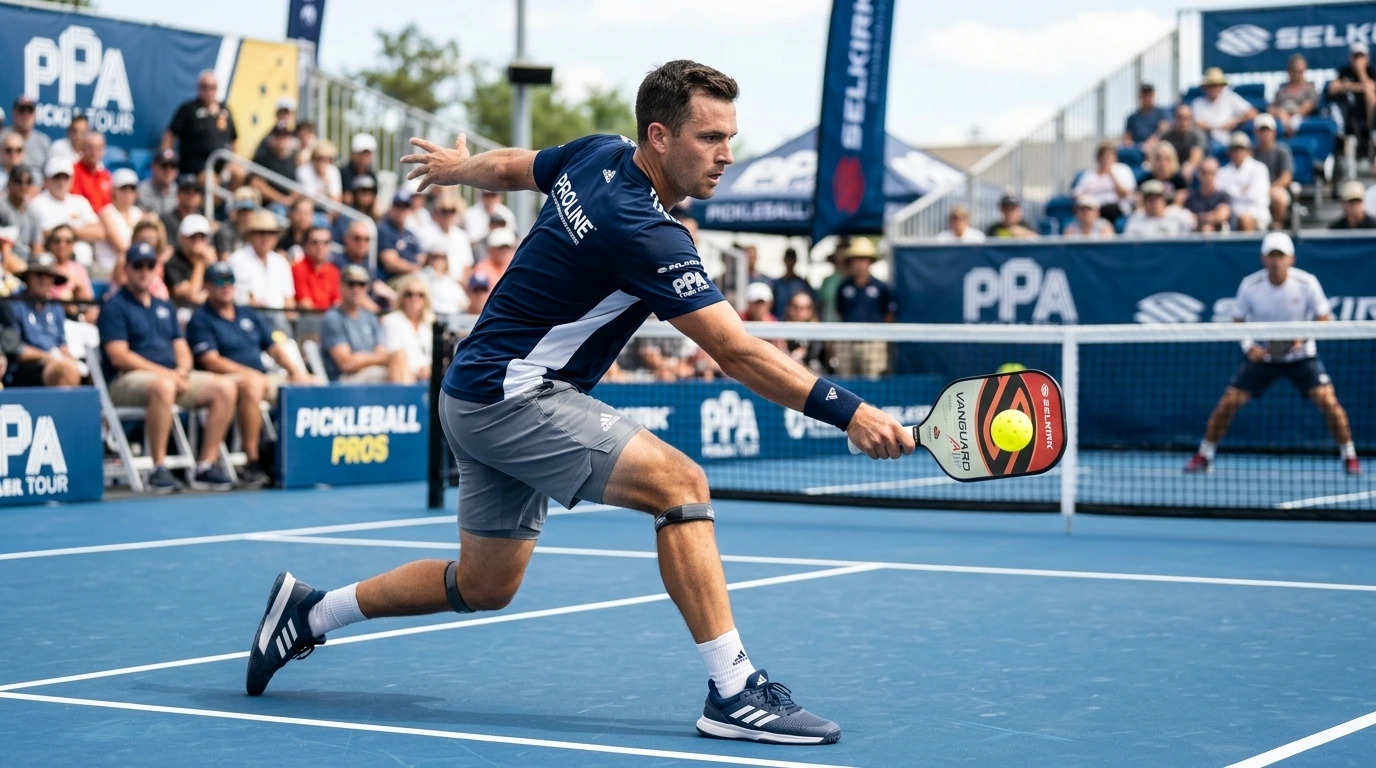
Unlike doubles—where dinking at the kitchen line accounts for 70% of points—full-court singles strategy has evolved into a power-driven, baseline-heavy ‘mini-tennis’ chess match. Understanding shot selection differences between formats is essential:
4.1 The Massive Deep Serve & Return Advantage
In singles, an average serve or shallow return is an immediate death sentence. Because your opponent has to cover 20 feet of lateral space alone:
- Serve Depth (Push Opponents Deep): Drive your serves within 12 to 18 inches of the baseline. A deep serve pushes the receiver back, increasing the flight time of their return and giving you more time to react.
- Deep Corner Returns: The receiver should aim returns deep into the server’s backhand corner. The deeper the return, the longer it takes the server to reach the ball, preventing them from advancing to the kitchen line.
4.2 The Third-Shot Drive vs. Third-Shot Drop in Singles
In doubles, the third-shot drop is universally preached. In singles, however, the Third-Shot Drive reigns supreme:
- Why Drive on 3? When the receiver hits a return and rushes the net, hitting a hard, dipping topspin drive forces a defensive volley. In singles, the net player cannot cover both sidelines simultaneously.
- When to Drop on 3: Only hit a third-shot drop if your opponent hits a laser deep into your corner, pulling you off-balance. A soft drop buys recovery time to reset your court position.
4.3 The ‘Cat-and-Mouse’ Game at the Kitchen
When both singles players successfully reach the kitchen line, the point transforms into the ‘cat-and-mouse’ game. Unlike doubles, where dinking is safe and conservative, singles kitchen play is ruthless:
- Extreme Angles: Players angle dinks sharply toward the outer sidelines, pulling the opponent completely off the court surface.
- Behind-the-Back Passes: Once an opponent is pulled wide into the alley, punch your next shot straight behind them into the open court before they can recover.
5. Video Drills & High-Speed Visual Training
For visual learners searching for how to play singles pickleball video or how to play pickleball singles video, top professional coaches emphasize three essential high-repetition drills:
Top 3 Practice Drills for Singles Excellence
- The 7-11 Skinny Singles Drill: Play skinny singles to 11 points, but the server only needs 7 points to win while the receiver needs 11. This heavily incentivizes the receiver to attack the second shot and forces the server to master high-pressure third-shot drops.
- The Corner-to-Corner Crosscourt Rally: Two players engage in crosscourt-only skinny singles, hitting 50 consecutive non-attackable dinks into the kitchen before any speed-up is permitted. Builds unshakeable patience.
- The Lateral Baseline Shuttle Drill: Server feeds a drive deep to the right corner, sprints to center, touches baseline, and slides to hit a backhand drive from the left corner. Builds the footwork stamina required for full-court tournament matches and PPA Tour professional singles events.
6. Conditioning, Footwork & Paddle Selection for Singles
Singles pickleball places unique mechanical demands on both your body and your equipment:
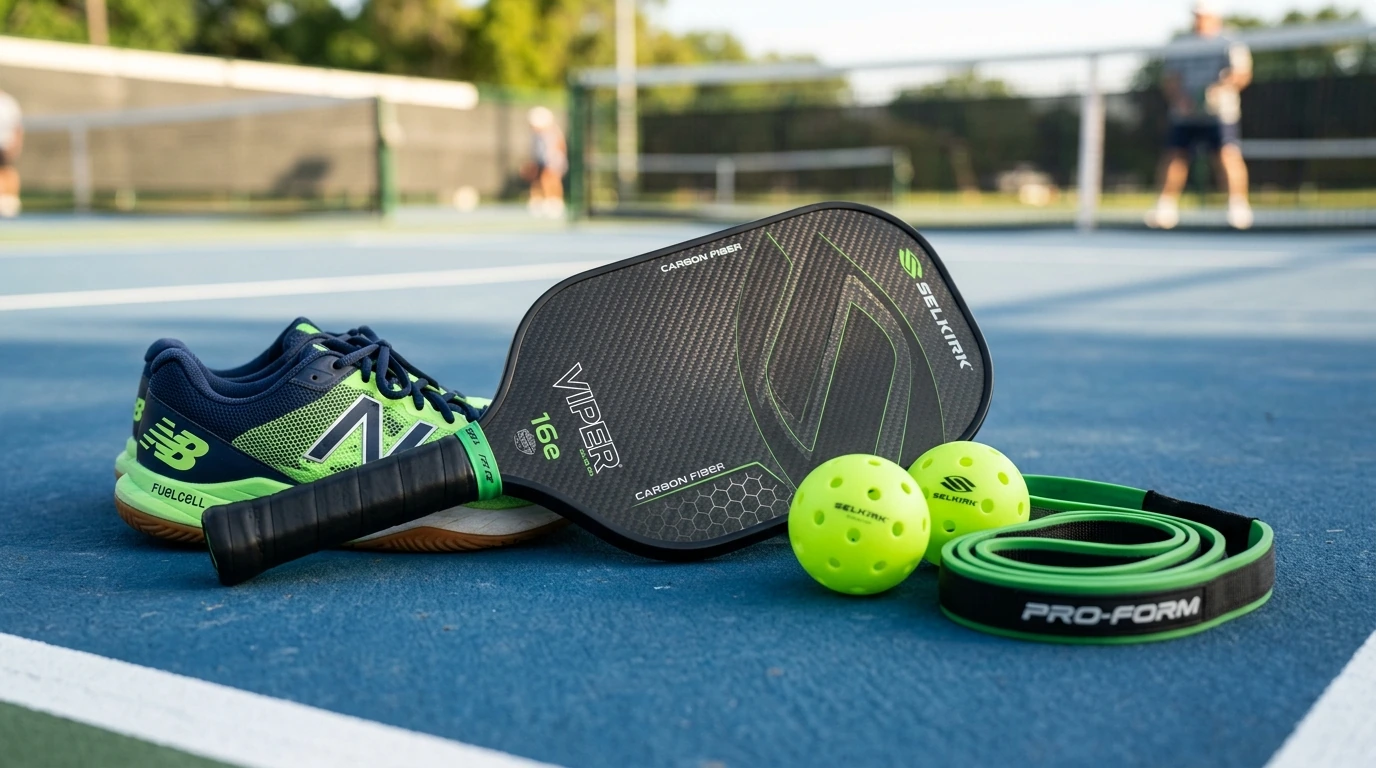
6.1 Elongated Paddle Selection (Reach & Power)
While wide-body paddles (8 inches wide) are favored in doubles for their massive sweet spot during rapid hand battles, singles players overwhelmingly choose elongated paddles (16.5 inches long by 7.5 inches wide). The extra half-inch of length provides crucial reach on diving passing shots, while the higher swingweight generates explosive baseline drive speed.
6.2 Split-Step & Recovery Footwork
The single most common flaw in singles is failing to split-step. The instant your opponent initiates their forward swing, execute a small hop onto the balls of your feet with knees flexed. This unweights your body, allowing you to push off laterally in either direction in a split second. Always recover toward the center T-position behind the baseline rather than admiring your previous shot from the sideline.
Ready to Elevate Your Singles Game?
Mastering how to play pickleball singles demands the ideal blend of explosive conditioning, disciplined shot selection, and the right elongated paddle. For customized gear consultations or tournament drill routines, visit our Pickleball Paddle Lab or reach out through our Contact Page.