
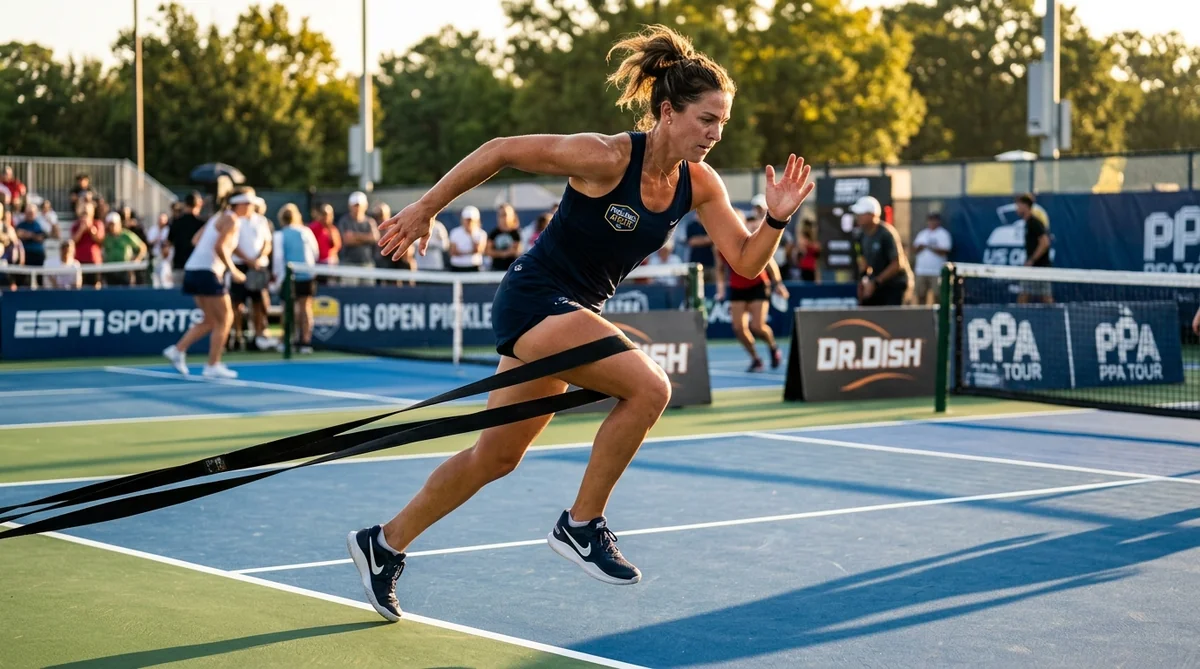
By Alex Turner • Head Coach & Equipment Analyst • Synthesized from Peer-Reviewed Sports Medicine & Biomechanics Research • Published October 2026
The exercise demonstrations, physical conditioning protocols, and injury prevention routines presented in this guide are intended strictly for educational, athletic performance, and informational purposes. While functional strengthening and eccentric tendon conditioning fortify joints against court stress, they do not constitute individualized physical therapy, orthopedic diagnosis, or medical prescription. If you are experiencing acute or chronic joint pain, suspected tendon tears (such as Achilles or rotator cuff), or severe tennis elbow, consult a licensed physical therapist or board-certified sports medicine physician before initiating new high-load or plyometric regimens.
Executive Summary & Core Training Rules
- The Kinetic Chain Reality: Power in pickleball does not originate in the forearm or shoulder. Kinetic energy initiates with ground reaction force through the feet, multiplies through pelvic hip rotation, channels across an anti-rotational core, and discharges through the paddle face.
- The Demands of the Kitchen Line: Unlike tennis, which emphasizes wide lateral strides and baseline running, pickleball requires rapid micro-deceleration, deep isometric knee flexion at the non-volley zone (NVZ), and instant direction changes over compact three-foot distances.
- Injury Epidemic Statistics: Over 500,000 pickleball injuries occur annually in the United States. Eighty-five percent occur in athletes aged 50 and older, with Achilles tendon ruptures, rotator cuff impingements, and lateral epicondylitis (pickleball elbow) leading clinical emergency admissions. In addition to neuromuscular conditioning, protecting against traumatic orbital eye injuries requires certified ASTM F803 impact-resistant pickleball eyewear during high-speed kitchen exchanges.
- The Warm-Up Rule: Never perform passive static stretches on cold muscles before a match. Static stretching dampens explosive tendon elasticity by up to 8%. Use dynamic multi-joint activations courtside to elevate core body temperature and lubricate synovial joint capsules.
- Optimal Training Frequency: Two to three dedicated 30-minute functional strength sessions per week build sufficient tissue capacity to play four days of recreational or tournament matches without cumulative joint inflammation.
What Workouts Should Pickleball Players Do?
The best workout for pickleball players combines multi-planar lateral agility, anti-rotational core stability, and eccentric joint conditioning. Specifically: lateral bounds for kitchen court coverage, Pallof presses for rotational torso bracing, eccentric wrist extensor curls for pickleball elbow armor, and single-leg Romanian deadlifts for Achilles and knee resilience. Players should perform functional strength work 2 to 3 days weekly, paired with a mandatory 5-minute dynamic warm-up before stepping onto the court.
Master Functional Exercise Matrix for Pickleball Performance
Every movement in our performance matrix addresses a specific court vulnerability. Below is the clinical exercise breakdown detailing target muscle groups, prescription parameters, and corresponding match benefits:
The 5 Physical Demands of Pickleball (Why Generic Gym Workouts Fail)
Traditional bodybuilding routines focus almost exclusively on the sagittal plane: bench presses, bicep curls, and leg extensions move weight along straight paths forward and back. However, competitive pickleball lives in the frontal (lateral) and transverse (rotational) planes.
When you plant sideways to scoop an unattackable dink off the bounce, your adductors and gluteus medius must absorb up to three times your body weight in under 200 milliseconds. If you train only on stationary weight machines, your muscular system cannot coordinate the multi-joint stabilization required to brake on abrasive acrylic court paint. Here are the five biomechanical demands unique to pickleball:
- Rapid Lateral Deceleration: Stopping sideways momentum requires the lateral quadriceps, gluteus medius, and calf complex to contract eccentrically, absorbing kinetic energy before it stresses knee meniscus cartilage and the ACL.
- Rotational Torque Generation: Advanced players hitting dipping topspin drives coil their hips 30 degrees away from the incoming ball and explosively uncoil the pelvic girdle through contact, multiplying paddle tip velocity.
- Sustained Low Kitchen Posture: Winning doubles teams stay deep in athletic ready stances at the kitchen line for minutes at a time, demanding intense muscular endurance across the quads, hip flexors, and spinal erectors.
- Fast-Twitch Upper Extremity Reflexes: Kitchen firefights at 14 feet allow less than 0.4 seconds of reaction time, requiring rapid forearm pronation and supination to counter 50 mph attacks off the paddle face.
- Single-Leg Proprioception on Resets: Reaching wide for an outstretched defensive reset requires balancing on one planted leg while stabilizing the upper torso through the abdominal wall without popping the ball up.
Top 10 Functional Exercises for Pickleball Players (Step-by-Step Protocols)
1. Lateral Bound to Balance
3 Sets × 8 Reps / Side
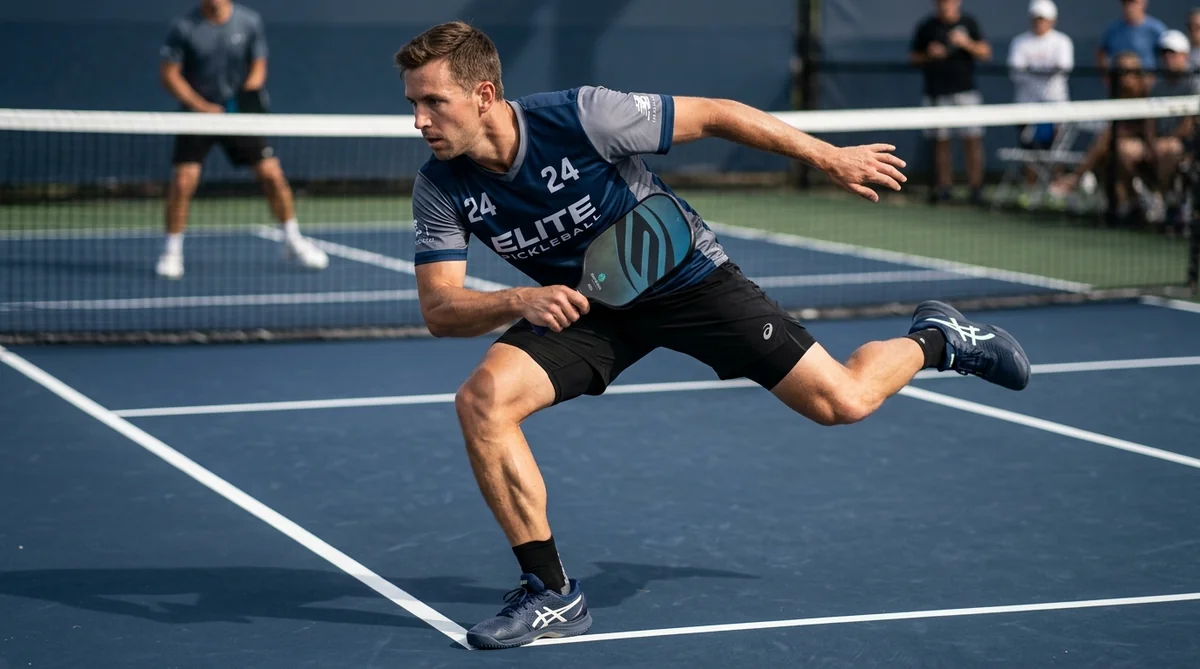
Biomechanical Target: Frontal plane deceleration, eccentric gluteus medius loading, and dynamic ankle inversion/eversion stability.
Step-by-Step Execution Cues:
- Stand balancing on your right leg with your knee slightly flexed and hip hinged backward in an athletic ready position.
- Push off the inside edge of your right foot, leaping sideways 3 to 4 feet to the left.
- Land solely on your left foot, absorbing ground impact by bending your left knee and sinking your hip backward.
- Freeze and hold the landing for two full seconds. Stabilize your ankle, engage your abdominal wall, and spring back to the right.
2. Banded Pallof Press
3 Sets × 12 Reps / Side
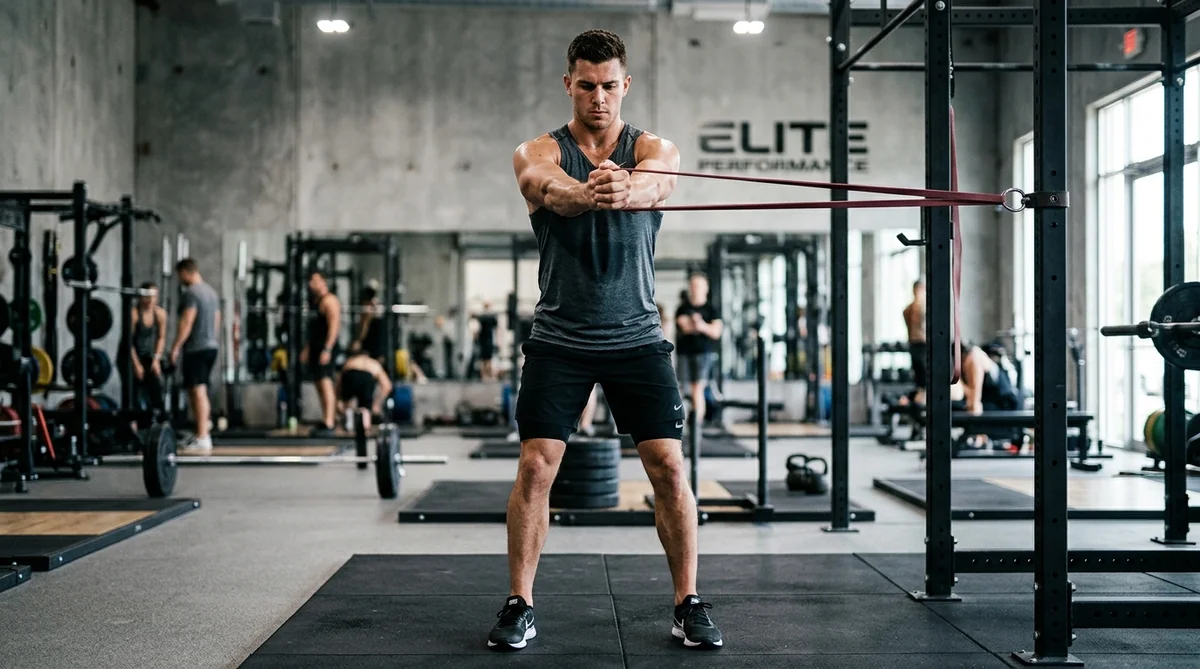
Biomechanical Target: Anti-rotational core stability, transverse abdominis, internal/external obliques, and pelvic positioning.
Step-by-Step Execution Cues:
- Anchor a medium resistance band to a fence post or wall mount at sternum height.
- Stand perpendicular to the anchor holding the band against your chest with both hands. Feet shoulder-width apart, knees soft.
- Press the band straight forward until your elbows reach full extension.
- Pause for two full seconds at full extension, actively resisting the rotational pull trying to twist your torso toward the anchor. Return slowly to your chest.
3. Rotator Cuff External Rotation with Band
3 Sets × 15 Reps / Side
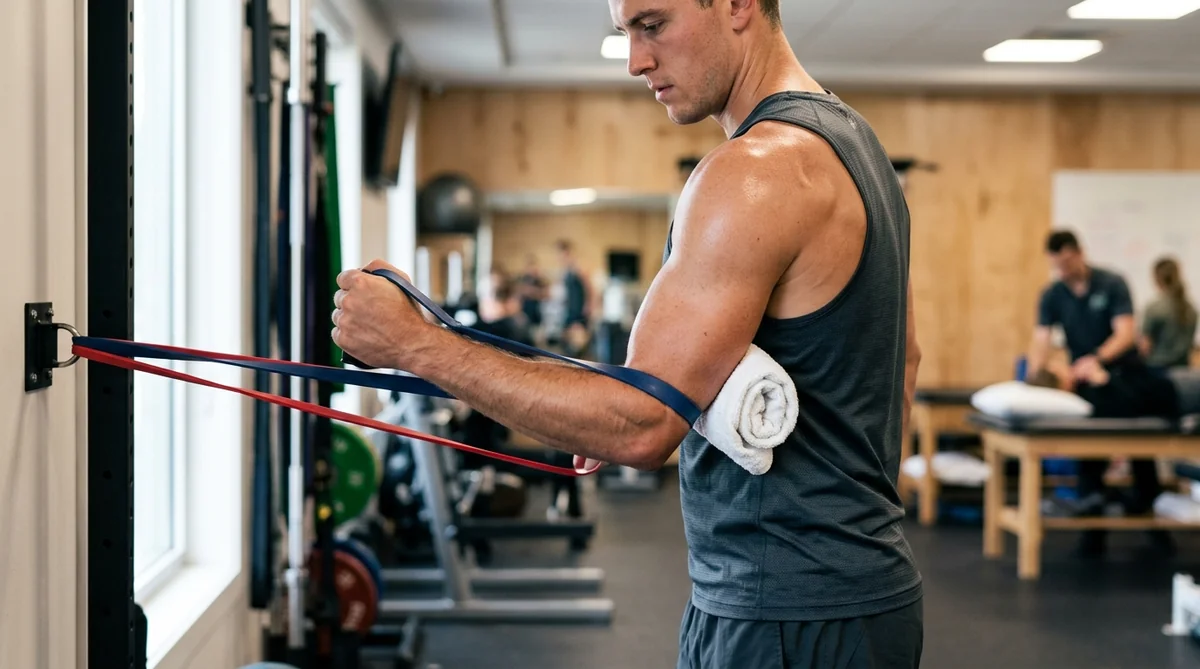
Biomechanical Target: Infraspinatus, teres minor, posterior shoulder capsule, and scapular stabilization.
Step-by-Step Execution Cues:
- Anchor a light loop band at elbow height and stand sideways to the anchor.
- Place a rolled towel between your active elbow and ribcage to enforce strict rotation without compensations.
- Grip the band with your outside hand, elbow bent at 90 degrees across your stomach.
- Keeping your elbow pinned to the towel, rotate your forearm outward until pointing straight ahead. Hold for one second, then slowly return over a 3-second eccentric count.
4. Eccentric Wrist Extensor Curls (Elbow Armor)
3 Sets × 15 Reps / Arm
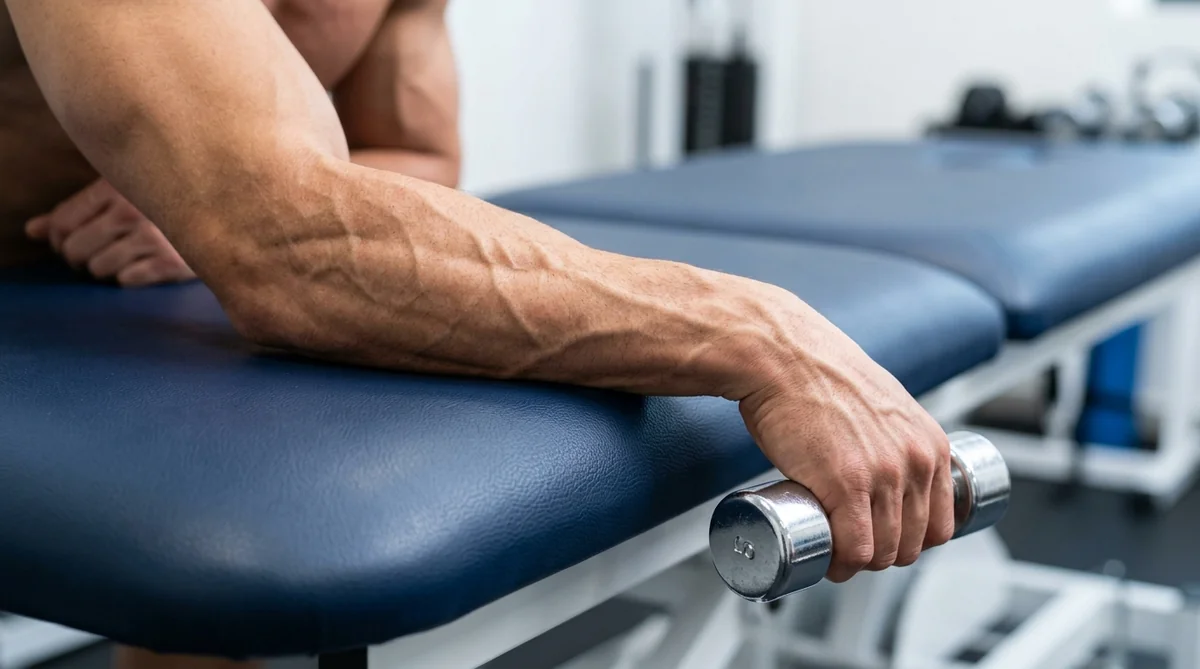
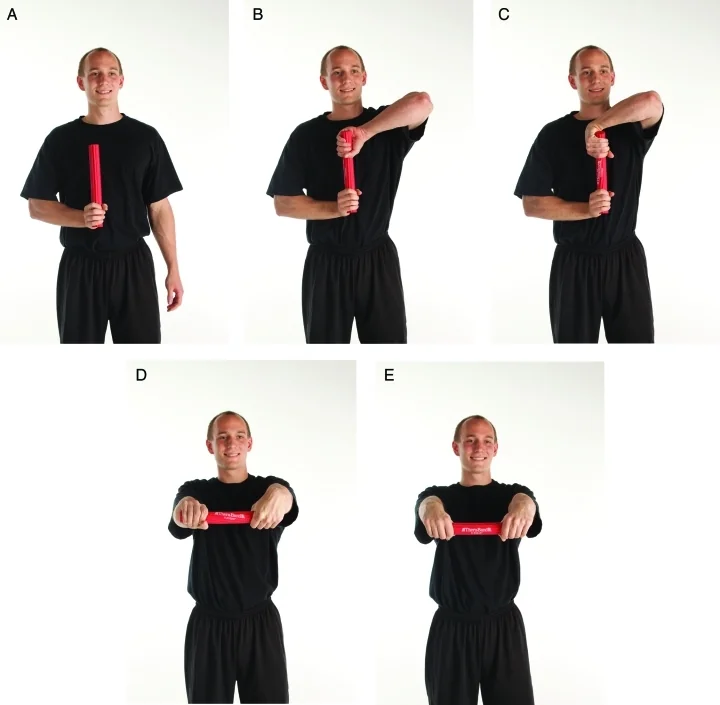
Biomechanical Target: Extensor carpi radialis brevis (ECRB) tendon, common extensor tendon origin, and forearm grip endurance.
Step-by-Step Execution Cues:
- Sit on a bench holding a light 3 to 5 lb dumbbell with your forearm resting flat across your thigh and wrist hanging over your knee, palm facing down.
- Use your opposite (free) hand to lift the dumbbell upward into full wrist extension (eliminating concentric tendon strain).
- Remove the assisting hand and slowly lower the dumbbell downward under strict control over a 3-to-4-second count until your wrist is fully flexed.
- Assist the weight back to the top position with your free hand and repeat only the eccentric lowering phase.
5. Goblet Squat to Overhead Press
3 Sets × 10 Reps
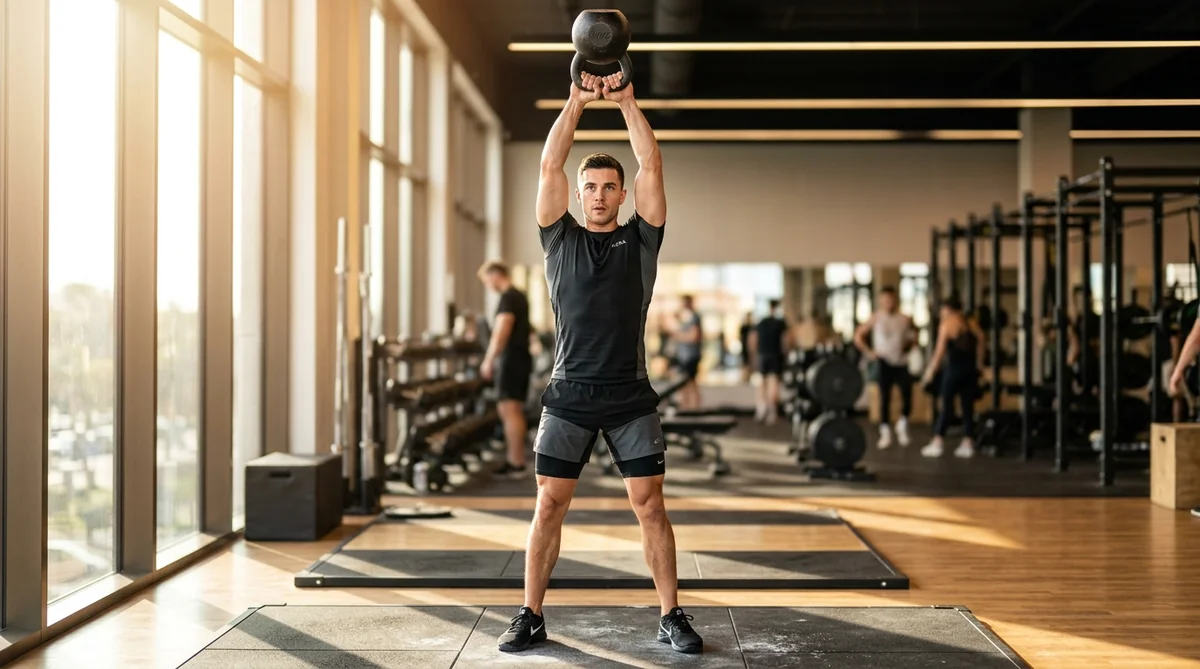
Biomechanical Target: Lower-to-upper body kinetic chain sequencing, quadriceps, gluteus maximus, anterior deltoids, and thoracic extension.
Step-by-Step Execution Cues:
- Stand with feet shoulder-width apart holding a kettlebell or dumbbell vertically against your sternum.
- Sit back between your heels until your thighs reach parallel to the floor, keeping your chest upright.
- Drive forcefully through the floor, standing up with acceleration.
- Channel that upward leg momentum directly into pressing the weight smoothly overhead to full arm lockout. Lower under control and descend into the next repetition.
6. Single-Leg Romanian Deadlift (RDL)
3 Sets × 8 Reps / Leg
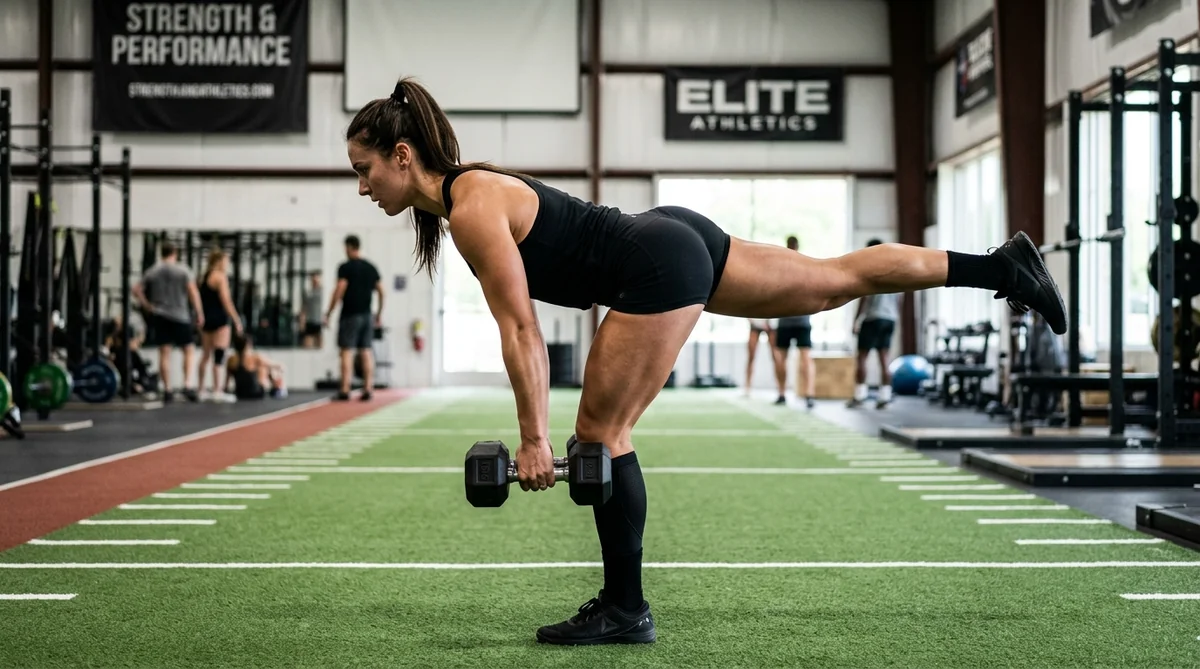
Biomechanical Target: Unilateral posterior chain, eccentric hamstring loading, gluteus medius, and subtalar joint proprioception.
Step-by-Step Execution Cues:
- Stand balancing on your left leg holding a dumbbell in your right hand. Keep a soft micro-bend in your standing knee.
- Hinge forward at your left hip, driving your right leg straight behind you as a counterbalance.
- Lower the weight down along your left shin with a flat, neutral spine until your torso and trailing leg are parallel to the floor.
- Squeeze your left glute to pull yourself smoothly back to the upright starting position.
7. Medicine Ball Rotational Slams
3 Sets × 10 Reps / Side
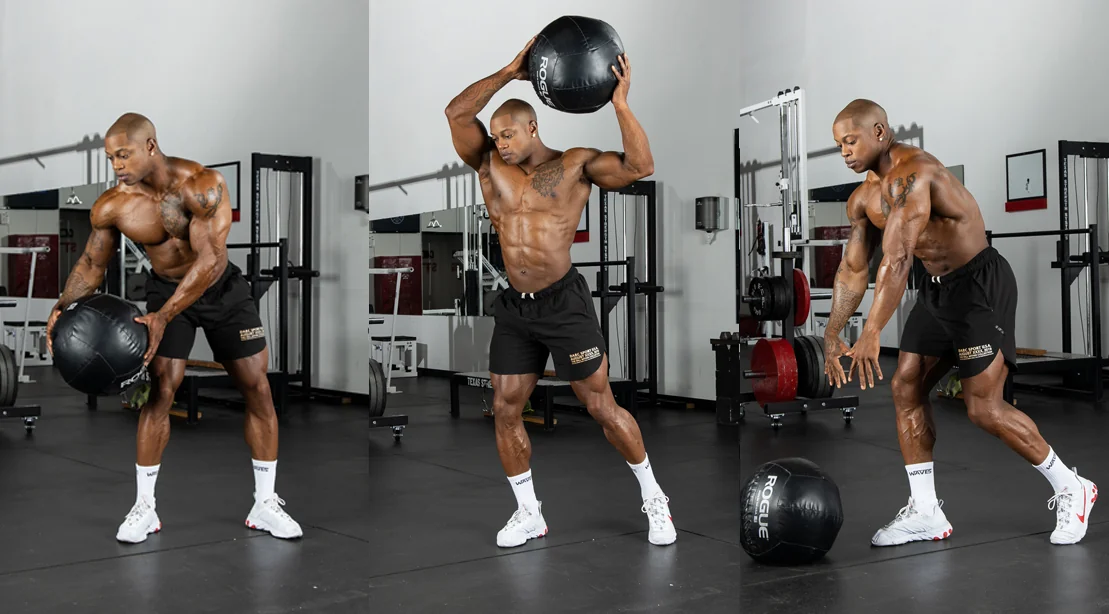
Biomechanical Target: Transverse plane power production, pelvic rotational velocity, latissimus dorsi, and abdominal wall snap.
Step-by-Step Execution Cues:
- Stand with feet shoulder-width holding a 6 to 10 lb dead-bounce slam ball.
- In a sweeping circular arc, lift the ball across your body above your right shoulder while pivoting your rear foot.
- Explosively uncoil your hips and slam the ball into the floor just outside your left foot with maximum downward force.
- Catch the ball off the short rebound or reset immediately into the next repetition.
8. Kitchen Shadow Step-and-Hold
3 Sets × 10 Reps / Side
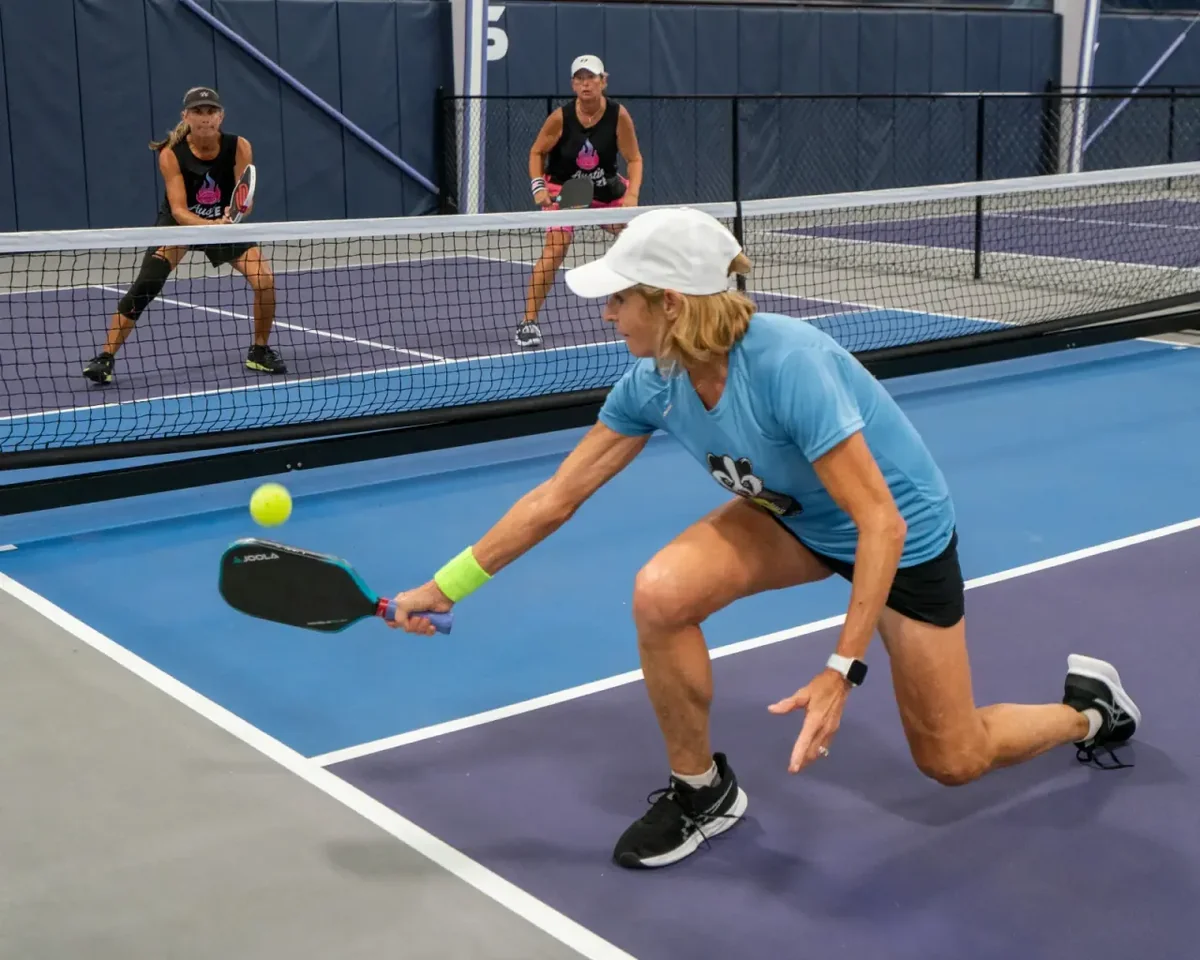
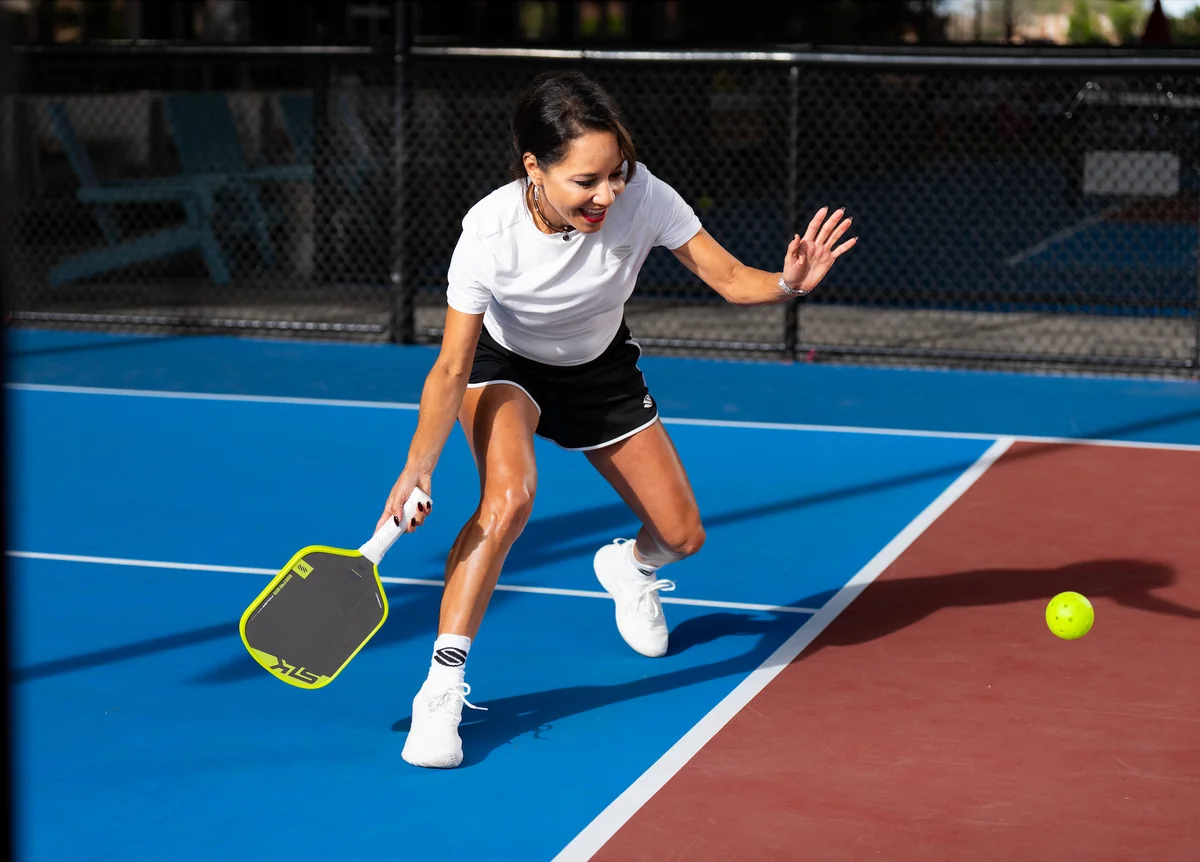
Biomechanical Target: Isometric quadriceps endurance, hip capsule mobility, and core postural stamina below knee height.
Step-by-Step Execution Cues:
- Stand holding your paddle in a balanced athletic ready stance behind an imaginary kitchen line.
- Step forward and laterally at a 45-degree angle into a deep, wide lunge without letting your front foot breach the line.
- Lower your back knee while maintaining an upright chest and holding your paddle out in front in an active reset position.
- Hold this deep lunging posture for 3 full seconds. Push firmly through your front heel to spring back to ready stance.
9. Calf Raise with 3-Second Isometric Pause
3 Sets × 15 Reps
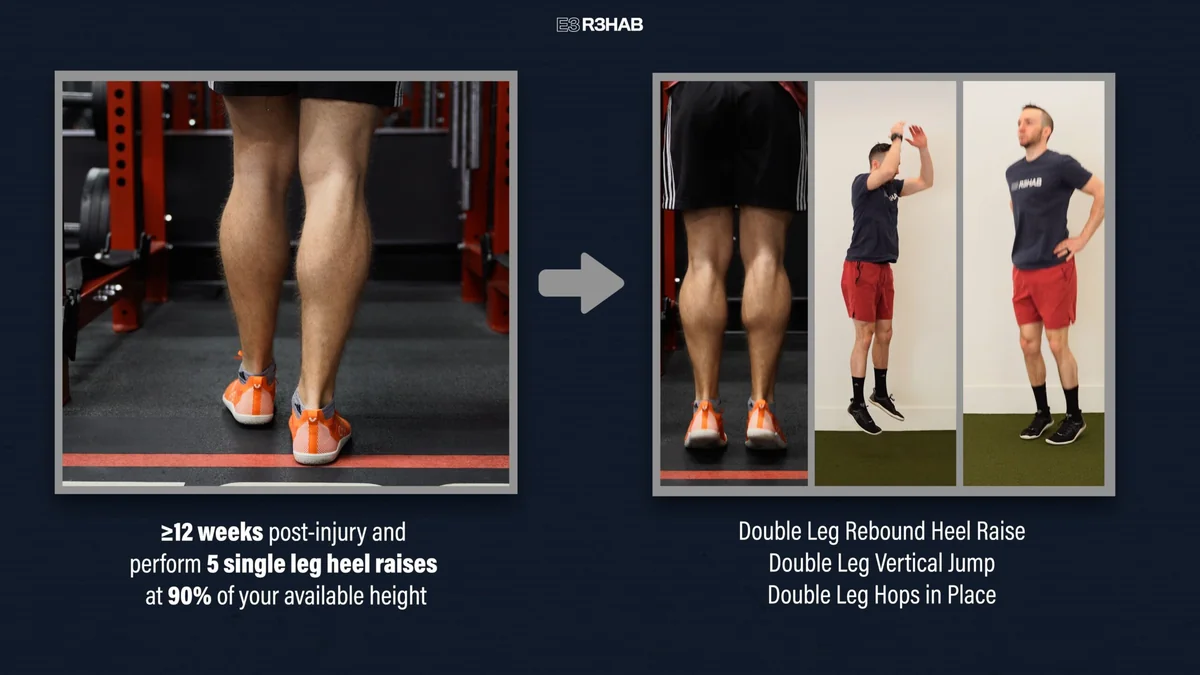
Biomechanical Target: Achilles tendon tensile stiffness, gastrocnemius, soleus, and plantar fascia durability.
Step-by-Step Execution Cues:
- Stand with the balls of your feet on the edge of a step, heels hanging off into a gentle stretch.
- Use light fingertip contact on a wall or railing for balance.
- Press through your big toes to rise to maximum calf contraction height.
- Hold the peak contraction at the very top for 3 full seconds. Lower slowly under control over a 3-second count to a deep stretch.
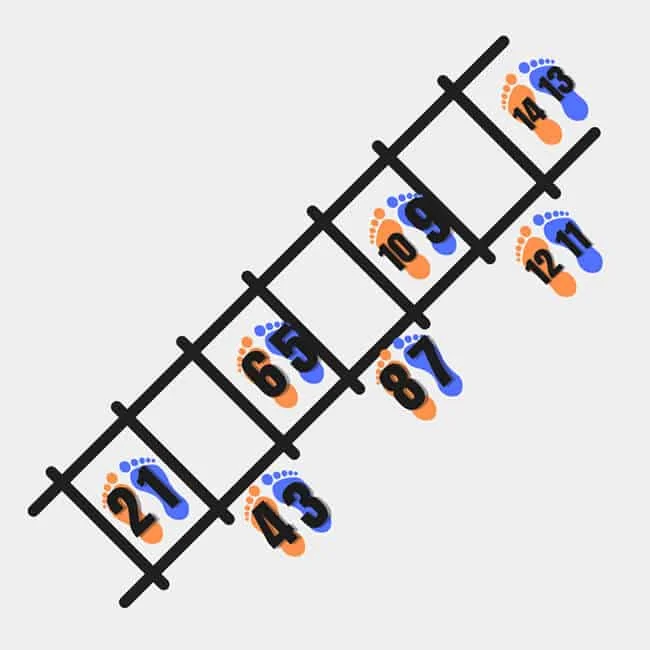
10. Agility Ladder 2-In, 2-Out Footwork Drills
4 Rounds × 30 Seconds
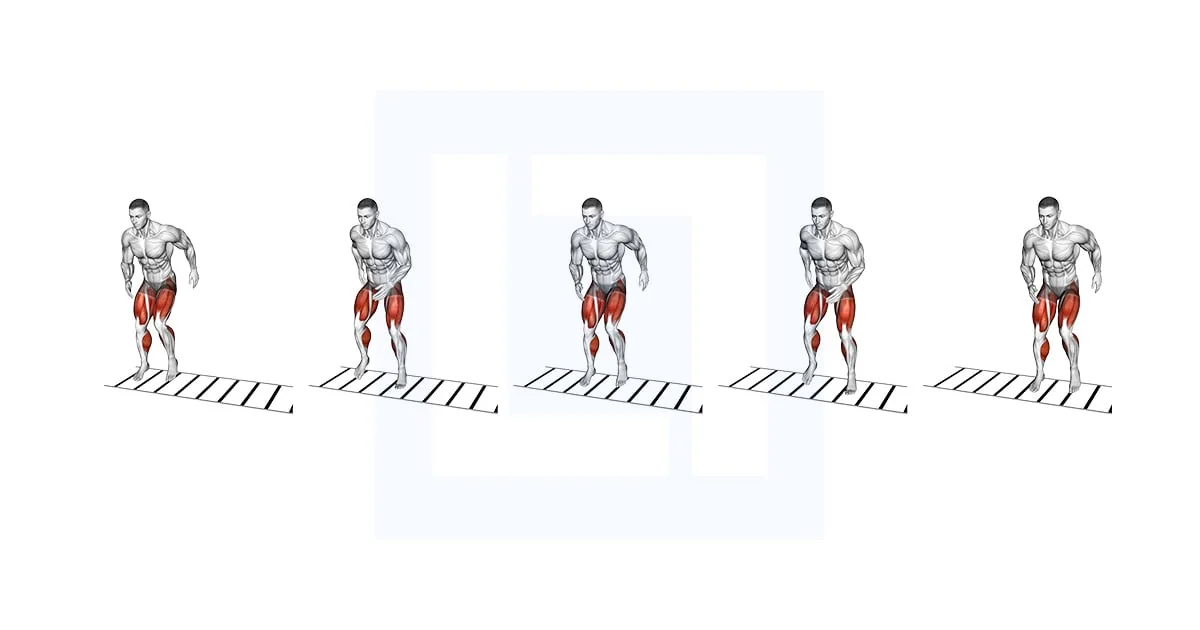
Biomechanical Target: Neuromuscular rate of force development, fast-twitch motor unit recruitment, and dynamic split-step balance.
Step-by-Step Execution Cues:
- Lay an agility ladder flat on the court or turf.
- Step your right foot into the first square, immediately followed by your left foot (2-In).
- Step your right foot outside the next square, followed by your left foot outside (2-Out).
- Move rhythmically down the ladder on the balls of your feet with soft knees, pumping your arms in synchrony with your feet. Keep your eyes up facing forward.
The 5-Minute Pre-Match Dynamic Warm-Up Routine (Never Static Stretch Cold!)
Walking straight from your car onto the court and ripping full-speed drives on cold muscles invites soft tissue injury. Cold tendons are like stiff rubber bands: stretch them suddenly with a hard swing, and they can tear. Spend five minutes running through this dynamic routine courtside to warm your muscles and prepare your joints for play:
Pickleball Exercises for Seniors (Low-Impact, High-Balance 50+ Routine)
More than half of regular pickleball players are 50 and older. Training at this stage of athletic longevity focuses on preserving joint cartilage, maintaining balance to prevent falls, and retaining fast-twitch reaction speed without overloading healing joints:
Target: Knee Cartilage Protection & Quad Power
Sit near the front edge of a sturdy chair, arms crossed across your chest. Stand up smoothly without pushing off your thighs. Pause upright and lower slowly back down under control. 3 sets × 10–12 reps.
Target: Fall Prevention & Vestibular Balance
Stand near a wall for safety. Place your right foot directly in front of your left foot so your right heel touches your left toes (tightrope stance). Balance for 30 seconds without wall contact. Switch feet. 3 sets / side.
Target: Serratus Anterior & Scapular Integrity
Stand two feet from a wall, hands flat at shoulder height. Lower your chest toward the wall, press back out, and protract your shoulder blades forward an extra inch at the top. 3 sets × 12 reps.
Target: Achilles Synovial Fluid & Ankle Mobility
Seated in a chair, lift one foot and trace all 26 uppercase letters of the alphabet in the air with your big toe, moving through full ankle circles and ranges. 2 rounds / foot.
Orthopedic Injury Prevention: Guarding Against Elbow, Knee & Achilles Tears
Pickleball’s sudden stops, aggressive speedups, and repetitive groundstrokes place specific mechanical stresses on connective tissue. Understanding these failure points helps you protect against the three most prevalent injuries:
Mechanism: Repeatedly flicking the wrist on backhand resets pulls violently on the extensor carpi radialis brevis tendon origin.
Clinical Defense: Transition to low-vibration paddles like thick 16mm or foam-injected builds, maintain a firm neutral wrist, and perform our eccentric wrist extensor protocol 3 days weekly.
Mechanism: Backpedaling straight backward to retrieve offensive lobs places maximum tensile body weight onto a stretched calf tendon, causing sudden ruptures.
Clinical Defense: Never backpedal straight backward; always drop-step into a pivot and sprint facing the baseline. Fortify tendon stiffness with deficit calf raises featuring 3-second isometric peak holds.
Mechanism: Grippy rubber court shoes stop abruptly on gritty acrylic paint, twisting the flexed knee joint between femur and tibia.
Clinical Defense: Strengthen your gluteus medius with lateral bounds to absorb deceleration forces at the hip before they reach the knee joint. For home and community courts, choosing cushioned sub-bases as outlined in our Pickleball Court Surface and Paint Guide absorbs up to 21% of impact shock.
Best Grip Pickleball Shoes: Lateral Movement & Ankle Stability Standards
While functional strength training bulletproofs connective tissue from the inside out, selecting good shoes for pickleball provides the mandatory physical defense against severe lateral ankle inversion sprains. Running shoes should never be worn on court; their high stack heights, soft vertical foams, and beveled heel edges induce catastrophic rollover when executing high-velocity directional cuts.
- Pickleball Shoes for Lateral Movement: Require reinforced lateral outriggers—flared rubber flanges extending on the outer forefoot edge to physically block ankle rollover during sharp kitchen resets and slide-and-stops.
- Pickleball Shoes with Ankle Support: Prioritize an internal TPU heel counter and a rigid midfoot torsion shank (such as found in the Asics Gel-Resolution, Babolat Propulse, or K-Swiss Express Light), preventing torsional twisting under sudden deceleration.
- Best Grip Pickleball Shoes: Depend on high-density non-marking herringbone rubber outsoles (Shore A 68–72 durometer) designed to bite into abrasive silica acrylic surfaces without catching or jamming prematurely.
Weekly Pickleball Training Schedules: 2-Day & 3-Day Splits
Schedule A: 2-Day Athletic Maintenance Routine (For Active Rec & League Players)
Frequently Asked Questions About Pickleball Fitness (FAQ)
What are the best grip pickleball shoes for lateral movement and ankle support?
The best grip pickleball shoes for lateral movement feature rigid lateral outriggers, a low-to-the-ground heel-to-toe drop (under 10mm), and a full herringbone rubber outsole. Dedicated court shoes like the Asics Gel-Resolution 9, Babolat Propulse Fury, and K-Swiss Express Light provide essential ankle support through stiff TPU heel cups and torsional composite shanks, preventing ankle sprains and meniscus twisting on hard courts.