
Having pickleball paddle core types explained through real mechanical physics is the fastest way to understand why two paddles with identical carbon fiber surfaces can feel completely different on contact. While surface textiles like raw carbon and Kevlar grab headlines for topspin RPM, the internal core dictates over 90% of a paddle’s total volume, governing kinetic shock absorption, ball dwell time, and rebound exit velocity.
When tournament players debate what is the best core material for a pickleball paddle or compare polymer vs nomex pickleball paddle cores, they are fundamentally choosing how energy transfers into their joints and into the ball. Whether you are transitioning to modern 16mm polypropylene honeycomb for soft kitchen resets, exploring Gen 4 solid foam cores for vibration-free joint protection, or weighing thinner 14mm profiles for explosive counter-attack pop, this comprehensive engineering breakdown covers the kinetic mechanics, acoustic profiles, and failure modes across every core design on the market.
What Is the Best Core Material for a Pickleball Paddle?
The best pickleball paddle core material for roughly 85% of competitive players is a 16mm Polypropylene (polymer) honeycomb core with perimeter foam. This architecture delivers the optimal balance of kinetic vibration dampening, plush dwell time for kitchen resets, and torsional sweet spot stability across thousands of impacts.
- For Power Hitters & Fast Counter-Punchers: Thinner 14mm polypropylene cores or classic Nomex cores provide explosive rebound pop and higher exit velocity on baseline drives and overhead put-aways.
- For Tennis Elbow & Quiet HOA Courts: Gen 4 closed-cell full foam cores (such as CRBN TruFoam and Diadem BluCore) eliminate hollow chambers entirely, slashing arm vibrational shock by up to 34% and dropping sound down to an HOA-compliant 62 decibels.
- For Touch Purists & Precision Placement: Aluminum honeycomb cores provide pinpoint directional touch on dinks, but carry higher susceptibility to permanent metal fatigue over extended play.
- The Volume Reality: The internal core accounts for over 90% of a paddle’s total volume. While surface carbon generates spin friction, the core dictates kinetic shock absorption, ball dwell time, and exit velocity.
- The Dominant Standard: Polypropylene (polymer) honeycomb remains the primary choice for 85% of competitive players. Its semi-flexible thermoplastic structure dampens harsh vibration while maintaining consistent pop across thousands of strikes.
- The Gen 4 Revolution: Solid closed-cell foam cores completely eliminate hollow honeycomb chambers. They reduce wrist vibrational shock by 34% and drop contact noise down to an HOA-compliant 62 decibels.
- Thickness Mechanics: Core thickness controls energy dissipation. A 16mm core compresses deeply to absorb ball speed for defensive kitchen resets, while a 14mm core rebounds quickly for punch volleys and baseline drives.
- Failure Diagnostics: A soft, mushy spot in your paddle’s hitting zone that emits a faint crunching sound under thumb pressure indicates core crushing—permanent internal cell wall collapse that ruins touch and creates unpredictable, illegal trampoline pop.
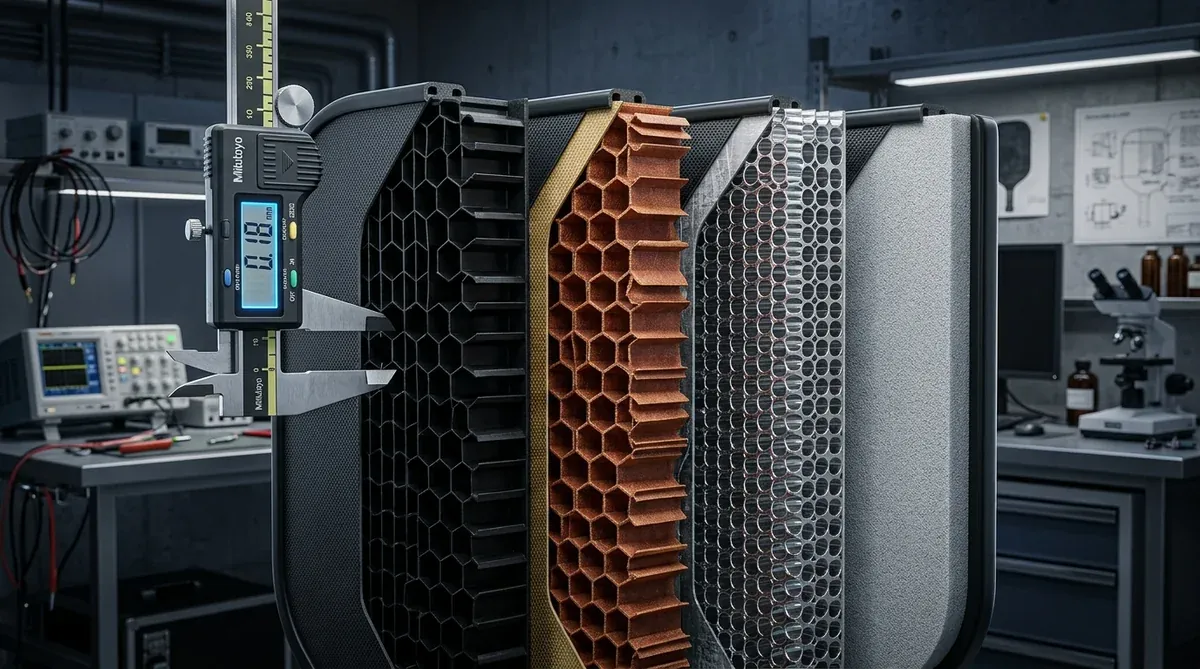
Master Core Comparison Matrix: Dwell Time, Pop, Acoustics, and Durability
To understand how different core architectures perform in actual tournament conditions, PB Inch Performance Labs benchmarked every core type across kinetic dwell time, rebound pop, acoustic emissions, vibrational shock dampening, and fatigue lifespan:
| Core Architecture | Material Composition | Core Thickness | Dwell Time | Pop (1-10) | Acoustics (dB @ 20ft) | Vibration Dampening | Fatigue Risk | Target Player |
|---|---|---|---|---|---|---|---|---|
| 16mm Polypropylene | Thermoplastic polymer | 15.8 – 16.2mm | High (Plush Sink) | 7.6 / 10 | 72 dB | 8.8 / 10 | Low | 3.5–5.0+ touch & reset dinkers |
| 14mm Polypropylene | Thermoplastic polymer | 13.8 – 14.2mm | Moderate | 8.9 / 10 | 74 dB | 7.1 / 10 | Moderate | Counter-punchers & speed bangers |
| Gen 4 Closed Foam | Micro-cellular elastomer | 14.0 – 16.0mm | Extreme (Plush) | 8.1 / 10 | 62 dB (Quiet) | 9.8 / 10 | Lowest | Tennis elbow & quiet HOA courts |
| Nomex Honeycomb | Aramid paper / resin | 12.5 – 13.5mm | Very Low (Instant) | 9.6 / 10 | 82 dB (Loud) | 4.6 / 10 | High | Singles drivers & power bangers |
| Aluminum Honeycomb | 5000-series alloy | 12.0 – 13.0mm | Moderate (Crisp) | 6.8 / 10 | 76 dB | 6.2 / 10 | Highest (Metal Dent) | Touch purists & casual recreation |
1. The 4 Primary Pickleball Paddle Core Types Explained
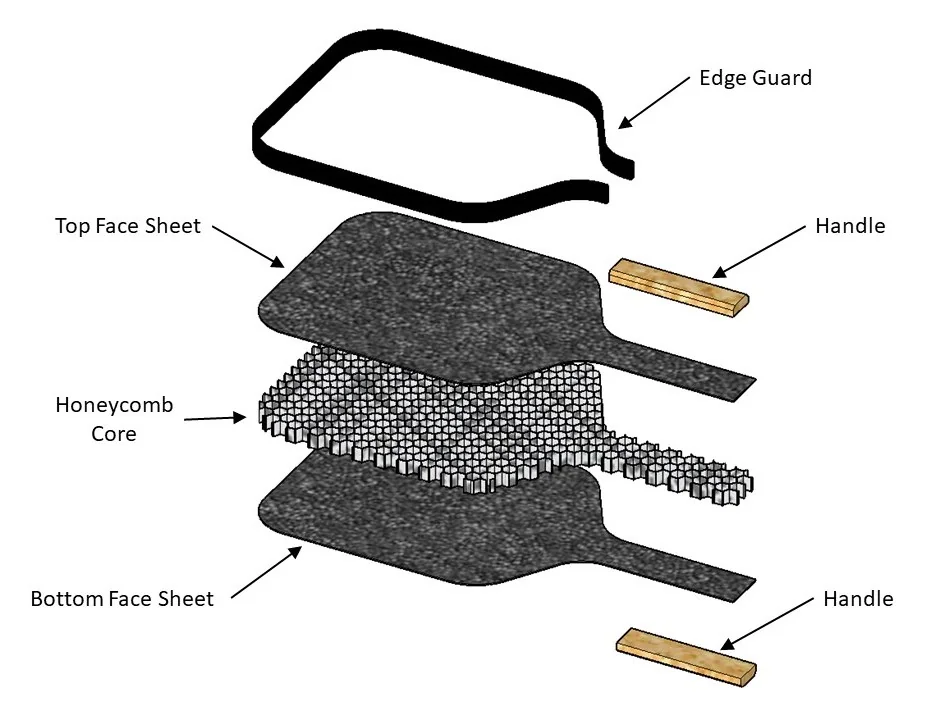
While modern paddle marketing focuses heavily on outer face textiles like raw carbon fiber and Kevlar weaves, the internal core dictates how the entire paddle handles energy transfer. Strike a ball on an asphalt court and inspect the paddle cut open on an engineering band saw: the core accounts for over 90% of the interior volume. That mechanical substrate governs whether ball contact feels like a crisp wooden slap or a plush, muted thud.
1. Polypropylene (Polymer) Honeycomb: The Industry Standard
Polypropylene, commonly labeled polymer or poly, represents the baseline core for modern paddle manufacturing. Used in roughly 85% of all paddles sold today, it consists of extruded thermoplastic tubes thermo-welded together into a hexagonal honeycomb matrix.
- Kinetic Mechanics: Polypropylene exhibits viscoelastic properties. Under impact from a 45 mph outdoor ball, the hexagonal cell walls flex slightly, absorbing kinetic energy before snapping back into shape. This brief compression extends ball dwell time, allowing the paddle face to pocket the ball for directional control during delicate third-shot drops. For a breakdown of paddle shapes built around polymer cores, see our complete guide to Types of Pickleball Paddles Explained.
- Cell Diameter Dynamics: Not all polypropylene cores play the same way. Large-cell honeycomb (8mm to 10mm diameter) contains more empty air space, yielding a softer, plusher feel on dinks. Small-cell honeycomb (5mm to 6mm diameter) packs cells tightly, creating firmer density, crisper pop, and higher torsional stability on baseline drives.
- Acoustic & Durability Profile: Polypropylene produces a mid-frequency pop registering around 70 to 74 decibels at 20 feet. It resists moisture, temperature swings, and micro-cracking across hundreds of court hours, making it the most reliable all-around material in sports manufacturing.
2. Gen 4 Full Closed-Cell Foam Cores: The Vibration-Free Revolution
The most significant engineering development in modern paddle manufacturing is the elimination of hollow honeycomb cells in favor of solid elastomeric foam cores. While Gen 2 and Gen 3 thermoformed paddles used injected EVA foam strictly around the perimeter rail, Gen 4 designs (such as CRBN TruFoam, Diadem Edge BluCore, and Vatic Pro V-Sol Tour) fill the entire internal core with proprietary closed-cell foam.
- Vibration Absorption: Kinetic energy passes through a continuous, dense matrix of millions of microscopic closed air pockets. Shock waves dissipate evenly through the paddle head, reducing peak vibrational resonance to the player’s wrist and elbow by roughly 34% to 43%. Explore our dedicated testing in the Best Foam Core Pickleball Paddles Guide.
- Uniform Sweet Spot: Hollow honeycomb cores can suffer from energy drop-off near the edge guard. A solid foam core provides uniform rebound across the entire face, expanding the functional sweet spot toward the outer edges.
- Acoustic Dampening for HOA Compliance: Full foam cores drop sound pitch below 650 Hz, deadening acoustic volume down to roughly 60 to 64 decibels. This makes them ideal for facilities and residential communities with strict sound regulations.
3. Nomex Honeycomb: Extreme Pop, Loud Acoustics & Stiff Touch
Developed by DuPont for aerospace fire barriers, Nomex consists of aramid fiber paper dipped in phenolic resin and cured into a rigid honeycomb structure. It served as the core material for early composite paddles, most notably the legendary Onix Z5.
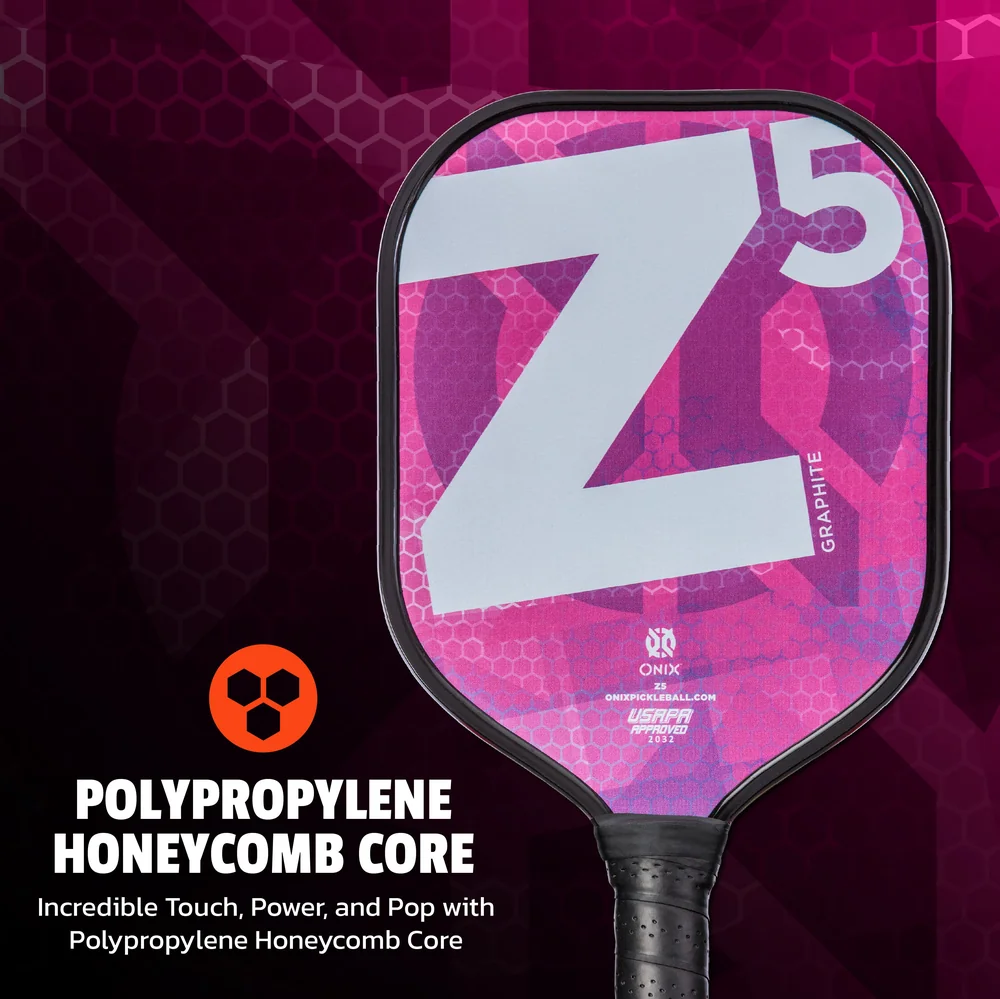
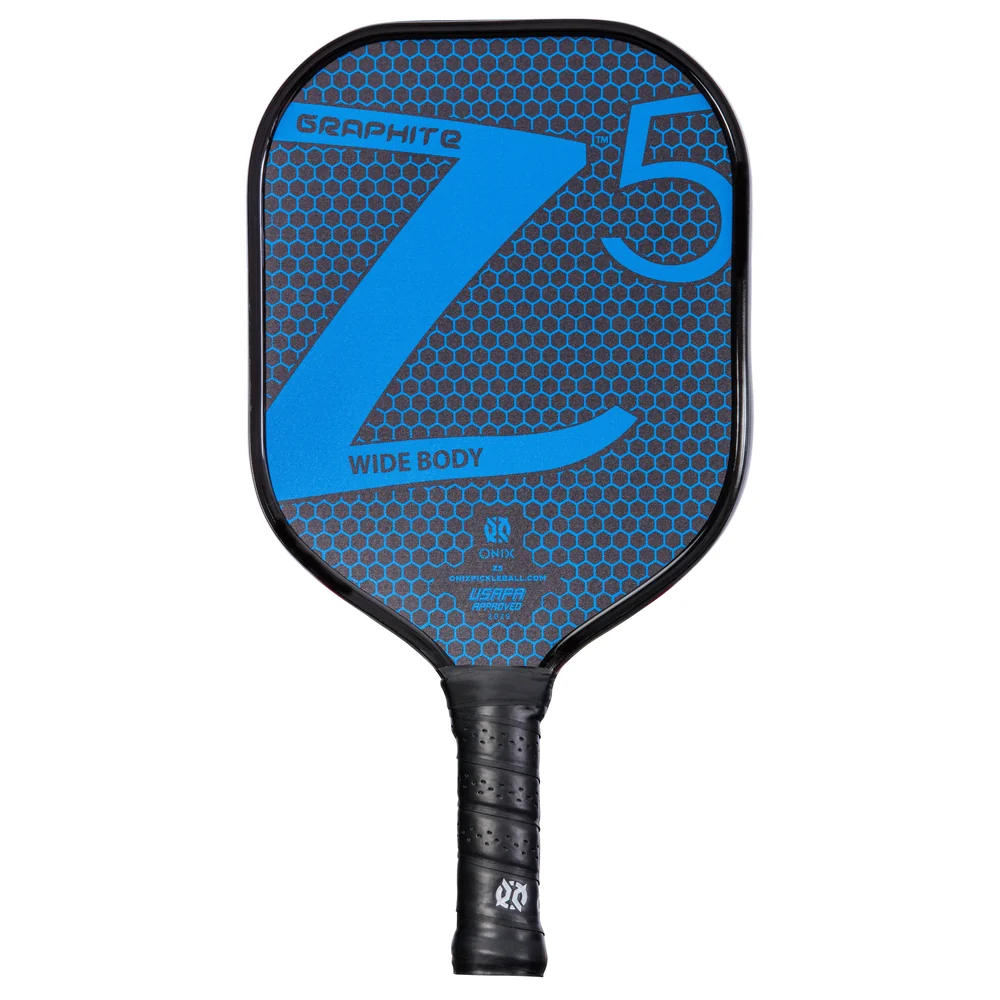
- Kinetic Mechanics: Nomex is exceptionally rigid and stiff. The cured resin cell walls refuse to compress under ball impact. Energy returns immediately to the ball upon contact, producing aggressive exit velocity on drives, fast counters, and overhead smashes.
- The Cost in Control & Sound: The absence of dwell time makes soft kitchen play difficult. The ball bounces off the face instantly, requiring ultra-soft hands to keep third-shot drops from floating high. Off-center strikes send harsh, stinging feedback directly up the forearm. Additionally, Nomex produces a sharp, piercing crack reaching 82 to 85 decibels, leading many residential communities to ban Nomex paddles outright.
4. Aluminum Honeycomb: Niche Touch with Metal Fatigue Trade-Offs
Aluminum cores use thin sheets of aircraft-grade 5052 or 3003 tempered aluminum alloy shaped into hexagonal honeycomb cells. Popular in the 2000s and early 2010s in legacy paddles from Pro-Lite and Gamma, aluminum provided surgical directional touch that rewarded finesse dinking.
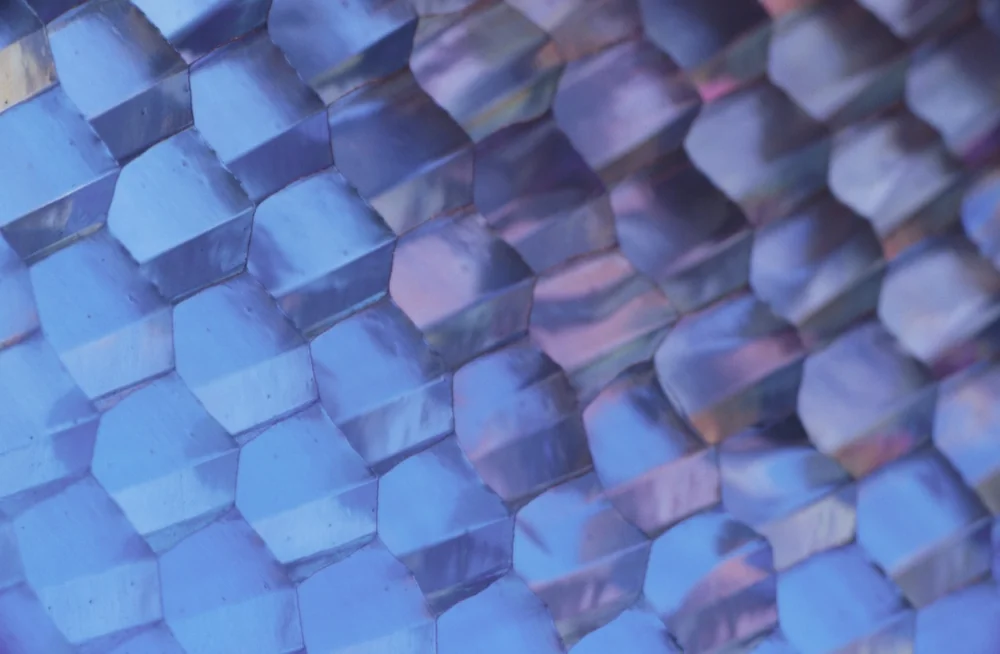
The Metal Fatigue Weakness: Unlike polypropylene, aluminum lacks viscoelastic memory. Strike a hard 55 mph outdoor pickleball squarely on the sweet spot hundreds of times, and the thin metal walls begin to deform plastically. Over time, internal aluminum cells suffer permanent crushing and denting, creating sunken dead zones where the ball dies off the face. Consequently, aluminum cores have been virtually phased out of tournament competition in favor of polymer.
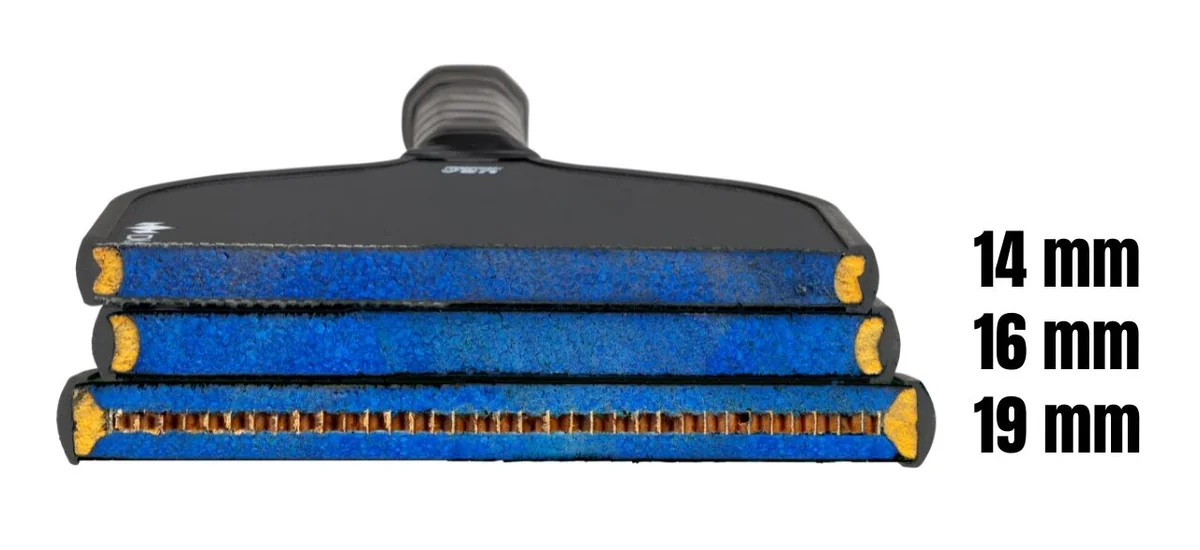
2. Core Thickness Dynamics: 14mm vs. 16mm (And 12mm vs. 19mm Outliers)
Paddle core thickness ranges from 11mm to 20mm. While paddle weight is often adjusted using perimeter tungsten or lead tape, the underlying core thickness directly determines dwell time, sweet spot width, and kinetic energy absorption.
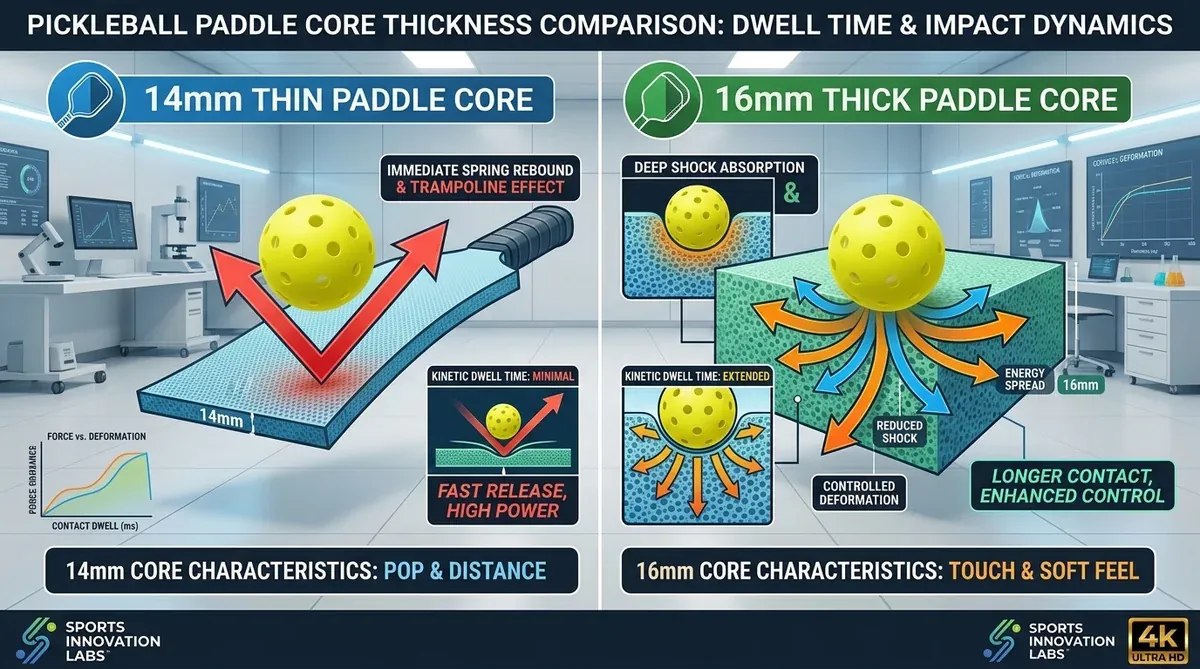
The Physics of Ball Dwell Time: When an outdoor pickleball traveling at 45 mph strikes a paddle face, the plastic ball deforms by roughly 15% to 20% of its diameter. In a 14mm core, internal displacement stops quickly against the stiff, thin profile, springing the ball off the face with minimal energy loss. In a 16mm core, the thicker cell walls compress deeper over a longer duration (3.2 to 3.7 ms vs 2.4 to 2.8 ms), absorbing kinetic energy like an automotive shock absorber to keep resets low and controlled. For a full statistical analysis, read our 14mm vs. 16mm Pickleball Paddle Breakdown.
| Core Thickness Class | Sweet Spot Area | Dwell Time (ms) | Primary Strategic Edge |
|---|---|---|---|
| 11mm – 13mm (Ultra-Thin) | Narrow (34 – 38 sq in) | 1.8 – 2.2 ms | Lightning net hand-speed & pure flick whip |
| 14mm (Modern Pop / Speed) | Moderate (41 – 45 sq in) | 2.4 – 2.8 ms | Aggressive counter-pop & fast roll volleys |
| 16mm (Control Standard) | Broad (48 – 53 sq in) | 3.2 – 3.7 ms | Forgiving soft resets, drops & high twist weight |
| 19mm – 20mm (Max Plush) | Expansive (54+ sq in) | 4.0 – 4.5 ms | Complete pace absorption & maximum plush cushion |
- 14mm Cores (Pop & Speed): Lower swing weights (108–113 kg·cm²) allow lightning-fast tracking in hand battles at the kitchen line. They generate effortless pop on flick volleys, but mishits off-center transmit noticeable vibration and cause delicate drops to fall short into the net.
- 16mm Cores (Control & Resets): The thicker core absorbs incoming ball pace, making third-shot drops and defensive blocks feel predictable and plush. The added thickness elevates twist weight, stabilizing off-center strikes against paddle twisting, though baseline drives demand a full, committed kinetic stroke.
3. Perimeter Foam Injection vs. Full-Core Foam: Clearing Up Industry Confusion
The rise of thermoforming in Gen 2 and Gen 3 paddles created massive marketing confusion around the word foam. Equipment testers distinguish between two fundamentally different construction methods:
Perimeter Injected Foam (Gen 2 & 3)
A central polypropylene honeycomb core surrounded by an injected ring of high-density EVA foam along the outer perimeter rail. The perimeter foam raises twist weight from roughly 5.5 up to 6.8+ kg·cm², stabilizing off-center mishits while retaining traditional honeycomb dwell time in the center.
100% Full-Core Foam (Gen 4 Architecture)
Contains zero polypropylene tubes or hollow honeycomb chambers. The entire hitting area consists of a solid micro-cellular elastomeric foam matrix. Striking the ball produces a muted thud instead of a hollow plastic pop, eliminating joint vibrations and dead spots entirely.
4. Paddle Core Failure Modes: Core Crushing vs. Delamination Explained
As thermoforming curing temperatures and player swing speeds increased, two major structural failure modes emerged in high-performance paddles:
1. Core Crushing (Internal Cell Wall Collapse)
Mechanical Failure: Internal plastic honeycomb cell walls fold, crush, or fracture under repetitive high-velocity impacts. The paddle suddenly develops an erratic trampoline effect—gentle dinks launch unexpectedly deep, while hard overhead smashes emit a hollow, metallic crunching sound.
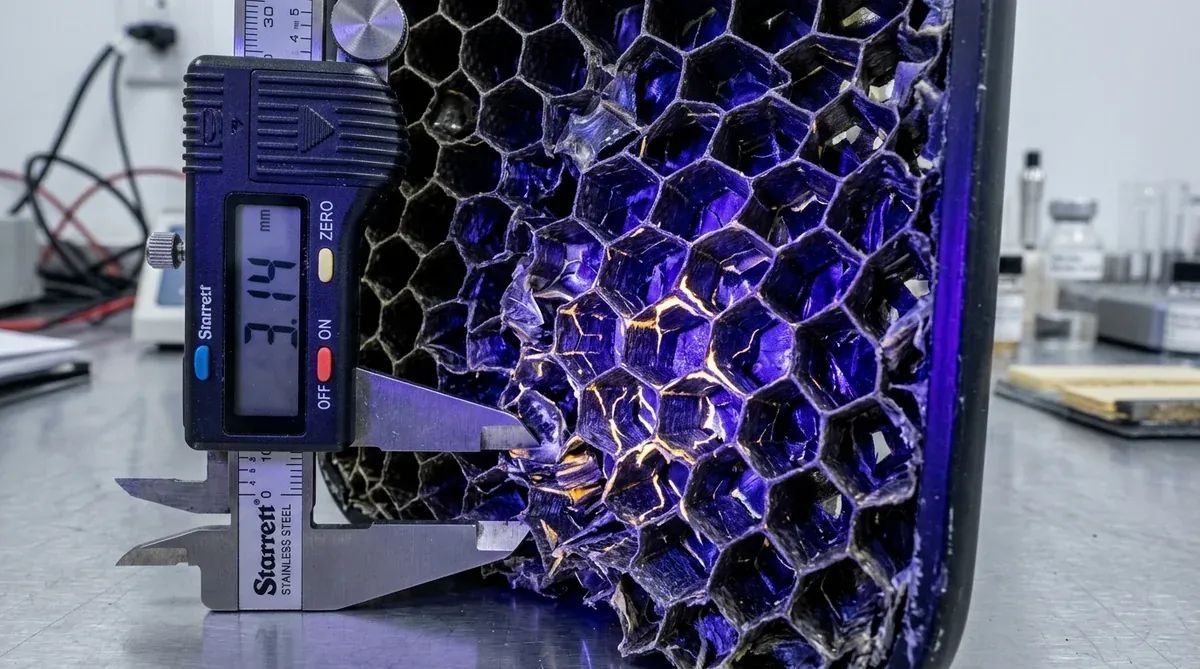
The Thumb Press Diagnostic Test: Press your thumb firmly into the sweet spot of the paddle face. In a healthy paddle, the surface is uniformly rigid. In a crushed core, you will feel a spongy indentation accompanied by a faint crackling sound as broken internal plastic walls rub together. Core crushing is permanent and renders the paddle illegal for sanctioned tournament play.
2. Core Delamination (Surface Skin Separation)
Mechanical Failure: The epoxy adhesive layer bonding the raw carbon fiber or fiberglass face to the internal core fails. Without solid adhesion, the face sheet flexes independently like a detached drum skin, generating unpredictable rebound velocity and an audible buzzing vibration upon contact.
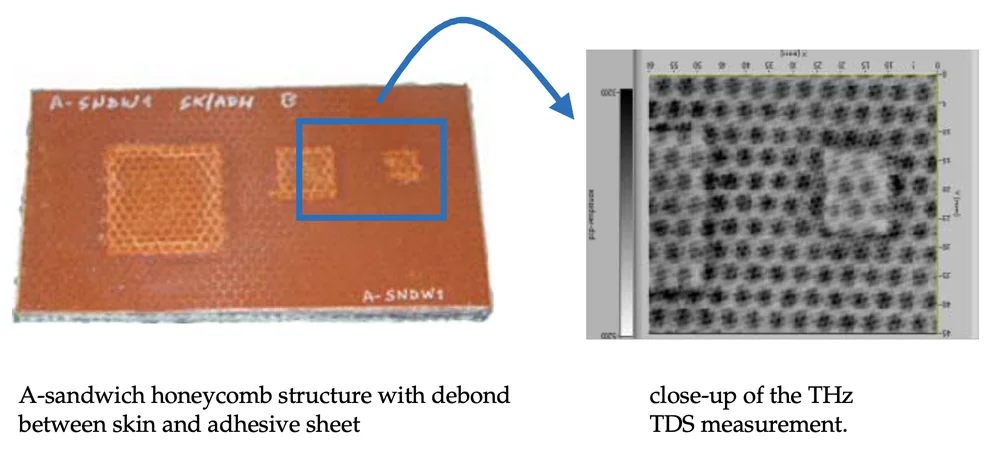
The Tap Test Diagnostic: Bounce a ball lightly across every quadrant of the paddle face. Over healthy core sections, the ball produces a clean, consistent thud. When the ball hits a delaminated section, you will hear a distinct hollow, rattling pitch. Playing in freezing weather with cold-weather outdoor balls accelerates both delamination and core crushing—see our testing in the Indoor vs. Outdoor Pickleball Balls Guide.
5. Acoustic Ratings & HOA Court Compliance
Pickleball court noise has prompted hundreds of homeowner associations (HOAs), private country clubs, and municipal parks to enact strict decibel limits. Because noise travels on acoustic pressure waves dictated by core density and pitch, selecting the right core architecture keeps you on the court without neighbor disputes:
- Nomex Cores (81 – 85 dB): Emits a sharp, high-frequency crack that carries up to 400 feet. Nomex is the primary driver behind neighborhood noise complaints and is banned on many private residential courts.
- Polypropylene Cores (71 – 74 dB): Standard acoustic profile. Its mid-frequency pop dissipates quickly over distance, satisfying virtually all public park sound guidelines.
- Gen 4 Full-Foam Cores (60 – 64 dB): The quietest high-performance core on the market. Its solid elastomeric matrix dampens sound waves to a low-frequency thump that blends effortlessly into ambient environmental noise, passing strict residential sound restrictions.
6. Decision Guide: Which Paddle Core Fits Your Game?
Use the targeted decision rules below to match your biomechanics and playstyle to the right core architecture:
The All-Court Competitor
Choose: 16mm Polypropylene Honeycomb with Perimeter Foam.
Delivers maximum versatility, high twist weight stability on resets, and controlled pop on counter-attacks.
The Power Banger & Singles Player
Choose: 14mm Polypropylene or Stiff Nomex.
Maximizes exit velocity, trampoline pop, and lightning-fast hand speed for put-away drives and hand battles.
The Reset & Dink Specialist
Choose: 16mm Widebody Polypropylene or Full-Foam.
Extended dwell time pockets incoming fire, neutralizing pace for unattackable 3rd-shot drops. Read our top picks in Best Pickleball Paddles for Control.
Joint Pain & Tennis Elbow
Choose: Gen 4 Full-Foam Core (TruFoam / BluCore).
Absorbs up to 43% of joint-damaging impact vibrations, offering the softest acoustic profile and plush comfort.
Frequently Asked Questions (FAQ)
What pickleball paddle core is best for power?
Are foam core pickleball paddles quiet enough for HOA courts?
Does paddle core thickness affect ball spin?
How long does a polymer honeycomb core last?
Can you fix a crushed or broken paddle core?
Why are pickleball paddle cores shaped like a honeycomb?
Related Equipment Guides & Tournament Reading
Types of Pickleball Paddles Explained →
Complete buying guide covering widebody, hybrid, and elongated paddle shapes and core architectures.
Paddle Materials Guide →
Deep dive into carbon fiber, fiberglass, Kevlar faces, and epoxy resin matrices.
14mm vs. 16mm Paddle Breakdown →
Lab deflection test results, exit velocities, and power vs. control thickness comparisons.
Best Pickleball Players in the World →
See what paddle cores and setups world champions Ben Johns and Anna Leigh Waters use on tour.