
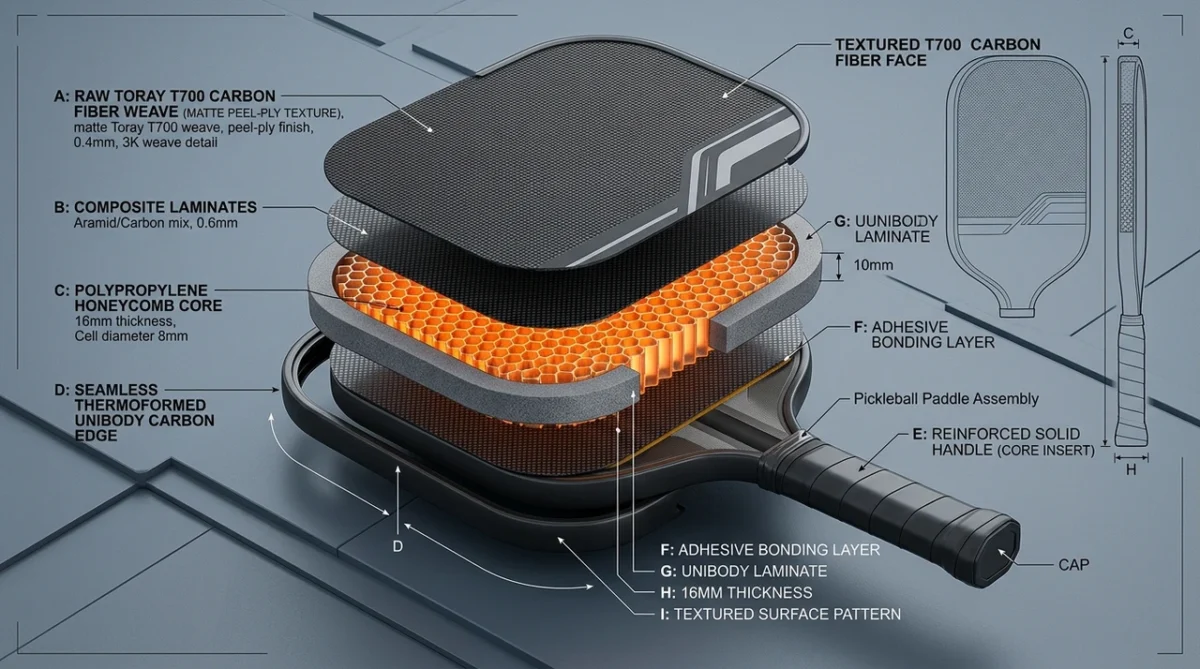
Choosing the right gear starts with understanding pickleball paddle materials. A paddle is not a solid plank of wood or a simple piece of molded plastic; it is a precision composite sandwich where a microscopic layer of carbon, glass, or aramid fiber is permanently bonded across an internal honeycomb structure. The specific combination of surface skin and interior core governs ball dwell time, pop off the face, sweet spot forgiveness, and joint shock absorption on off-center resets.
Every weekend on municipal courts and competitive tournament brackets, players debate whether a raw carbon fiber pickleball paddle is worth the premium price tag over entry-level fiberglass. Marketing copy promises blistering spin and effortless baseline power, but physical reality comes down to material science. Surface tensile stiffness, resin saturation, honeycomb cell diameter, and perimeter edge-foam stabilization dictate how the ball rebounds off your paddle face. This comprehensive guide strips away manufacturer hype to deliver an engineering-grade breakdown of face textiles, internal cores, thermoforming processes, and player-specific selection frameworks.
Direct Answer: What Are Pickleball Paddles Made Of?
- Core Composition: Modern pickleball paddles are built using a composite sandwich architecture consisting of an internal honeycomb core—typically polypropylene polymer or Nomex—encased between two outer face skins made from raw carbon fiber (Toray T700), fiberglass composite, graphite, or Kevlar hybrid weaves.
- Performance Rule: Face materials dictate surface friction (spin RPM) and instantaneous ball exit velocity (pop), while core material and thickness (13mm–16mm) govern kinetic energy absorption, vibration dampening, and sweet spot stability.
The Anatomy of a Pickleball Paddle: Composite Sandwich Architecture
- Paddle Face (Skin / Surface): The outer textile layer (0.5mm–1.5mm thick) that directly impacts the ball. Dictates surface friction (spin RPM), ball exit velocity (pop), and tactile feedback. Primary materials: Raw Toray T700 Carbon Fiber, Composite Fiberglass (FiberFlex), Graphite, and Carbon-Kevlar hybrid weaves.
- Core (Interior Honeycomb): The shock-absorbing engine (13mm–16mm thick) that controls kinetic energy transfer, sweet spot depth, and vibration dampening. Primary materials: Polypropylene (Polymer) honeycomb and Nomex (aramid fiber dipped in phenolic resin).
- Perimeter Walls & Edge Guard: Traditionally an extruded PVC rubber lip; modern high-performance builds inject dense EVA foam along the interior perimeter before sealing in a heated mold to boost torsional stability (twist weight).
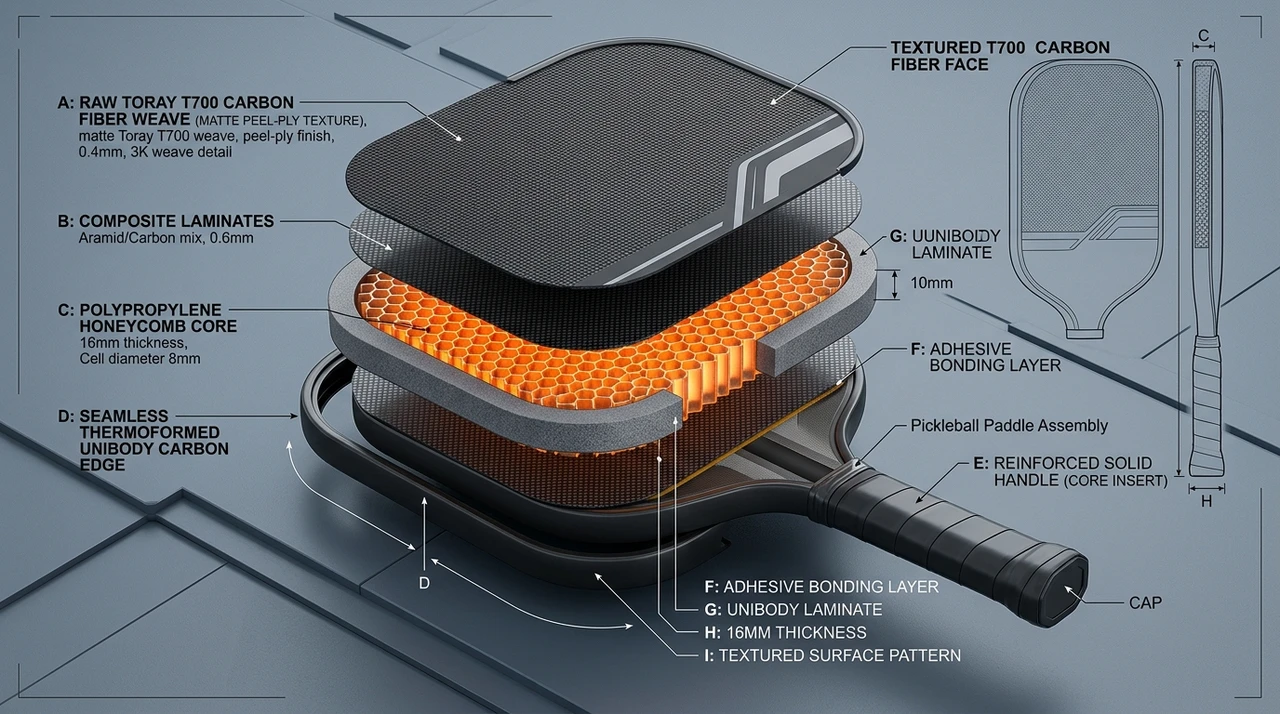
Table of Contents
- 1. Quick Guide: Paddle Face Materials Compared
- 2. Paddle Face Materials: The Complete Surface Breakdown
- 3. Paddle Core Materials & Thickness Impact
- 4. Advanced Construction: Thermoforming & Perimeter Foam Injection
- 5. Playstyle Recommendation Guide: Which Material Fits Your Game?
- 6. Frequently Asked Questions: Paddle Materials Decoded
1. Quick Guide: Paddle Face Materials Compared
To quickly evaluate how various face materials alter on-court dynamics, the matrix below benchmarks the primary surface textiles across laboratory deflection, friction durability, and playability metrics on a 1-to-10 scale:
2. Paddle Face Materials: The Complete Surface Breakdown
The exterior skin of your paddle is the sole point of contact with the ball. How this surface deflects upon impact and grabs the plastic determines your shot trajectory, backspin bite, and reset precision.
A. Raw Carbon Fiber (Toray T700): Maximum Spin and Touch Control
A raw carbon fiber pickleball paddle utilizes unidirectional or cross-woven aerospace-grade carbon filaments—most notably Japanese Toray T700 carbon. Unlike older generation carbon paddles that coated smooth carbon sheets with a clear liquid resin and baked-on crushed glass grit, raw carbon paddles feature a textured ‘peel-ply’ fabric texture cured directly into the top laminate.
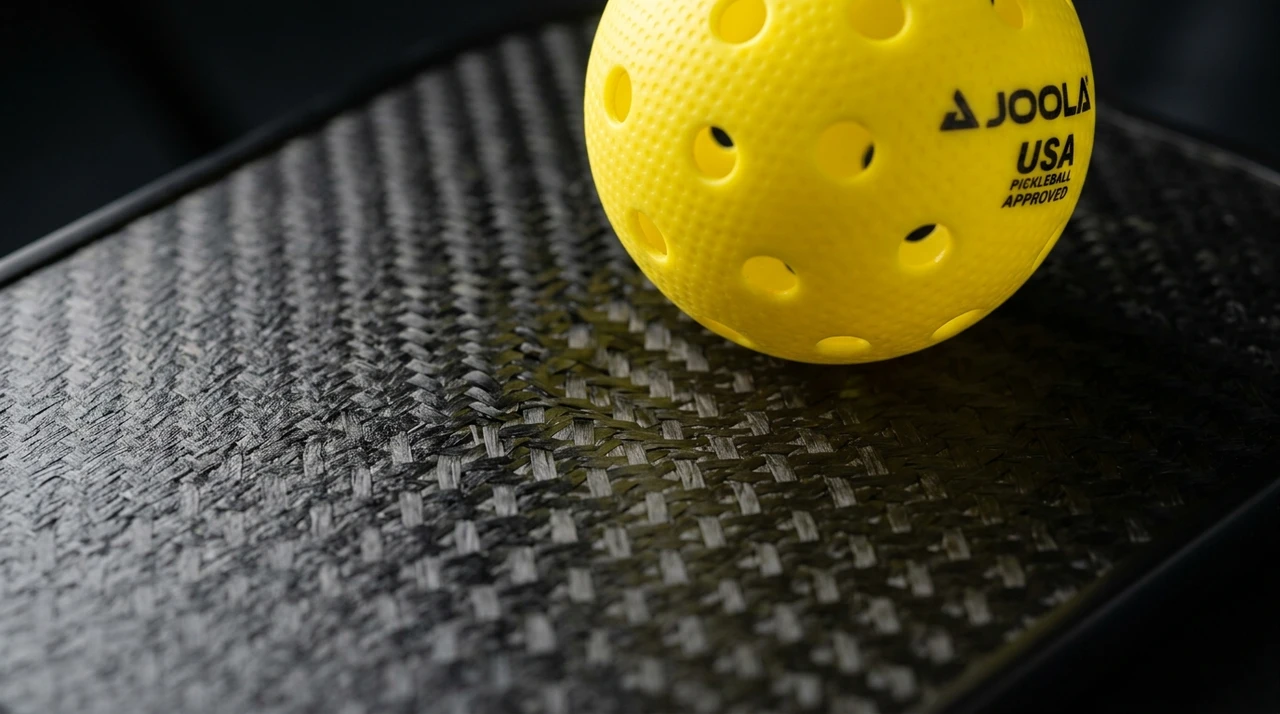
This exposed weave provides an organic micro-texture that grabs the plastic surface of the pickleball at impact. High-speed optical tracking tests demonstrate that raw T700 surfaces consistently generate 1,850 to 2,100 RPM of ball rotation on aggressive roll volleys and dipping topspin drives. Because the friction comes from the physical carbon weave rather than a spray-on topcoat, the spin capability does not rub smooth after three months of intense dinking. (See how this compares in our indoor vs. outdoor ball performance lab tests).
From a kinetic perspective, carbon fiber features an extremely high strength-to-weight ratio and a high modulus of elasticity. It is inherently stiff. When a pickleball strikes a carbon face, the material deforms very little. Instead of springing the ball outward, it absorbs incoming kinetic energy, extending ball dwell time (the milliseconds the ball stays compressed against the face). This extended dwell time provides unmatched directional control, allowing players to absorb 50 mph overhead smashes and drop them feather-soft into the kitchen.
B. Fiberglass (Composite): Explosive Trampoline Pop & Power
When comparing a carbon fiber vs fiberglass pickleball paddle, the physical behavior is night and day. Fiberglass (often branded as ‘FiberFlex’ or ‘Composite’) is composed of fine woven glass fibers bonded with epoxy resin. Glass fibers possess far higher elasticity and flexural yield than carbon filaments.
When a 0.9-ounce pickleball impacts a fiberglass face, the skin flexes inward like a miniature trampoline and snaps back outward instantly. This elastic rebound generates blistering ball exit speed (known across the sport as ‘pop’) with very little manual swing effort. Players who struggle to generate baseline depth or who want lightning-fast hand speed during quick kitchen fire-fights gravitate toward composite faces.
However, that trampoline pop comes at the expense of touch and finesse. Third-shot drops require delicate wrist calibration because the ball launches off the face before the player can guide it. Furthermore, because smooth fiberglass cannot grip the ball on its own, manufacturers apply spray-on sand or polyurethane grit paints to generate spin. Under competitive play, this grit rubs off right in the center sweet spot within 8 to 12 weeks, leaving a slick patch that cuts spin generation by up to 35%.
C. Graphite: Lightweight Directional Precision & Quick Resets
Analyzing graphite vs carbon fiber pickleball paddle constructions often creates confusion because both originate from carbon atoms. The engineering difference lies in layer thickness and crystalline orientation. Graphite faces are constructed by compressing thin, brittle sheets of planar carbon flakes (often just a few thousandths of an inch thick) beneath a clear epoxy gloss.
A graphite face is exceptionally light, stiff, and responsive. It produces a crisp, direct acoustic sound upon impact. There is virtually zero trampoline effect. The ball leaves the face precisely where your wrist angles it. For defensive specialists whose game revolves around redirecting fast drives and punching quick volleys at the net, graphite provides pinpoint directional predictability.
The trade-off is mechanical vulnerability. Graphite’s crystalline structure makes it brittle. Hard clashes with a partner’s paddle or scraping an abrasive concrete court during a desperation dig can cause spider-web micro-cracks or chipped outer layers. For players seeking maximum durability, raw T700 carbon fiber has largely superseded traditional graphite in modern paddle lineups.
D. Kevlar & Hybrid Weaves: Modern Dwell Time & Vibration Damping
The newest frontier in paddle face engineering is the integration of aramid fibers—most commonly DuPont Kevlar. In high-performance hybrid faces, weavers cross-hatch raw carbon fiber threads with Kevlar fibers (visible as distinctive gold, blue, or red cross-stitching).
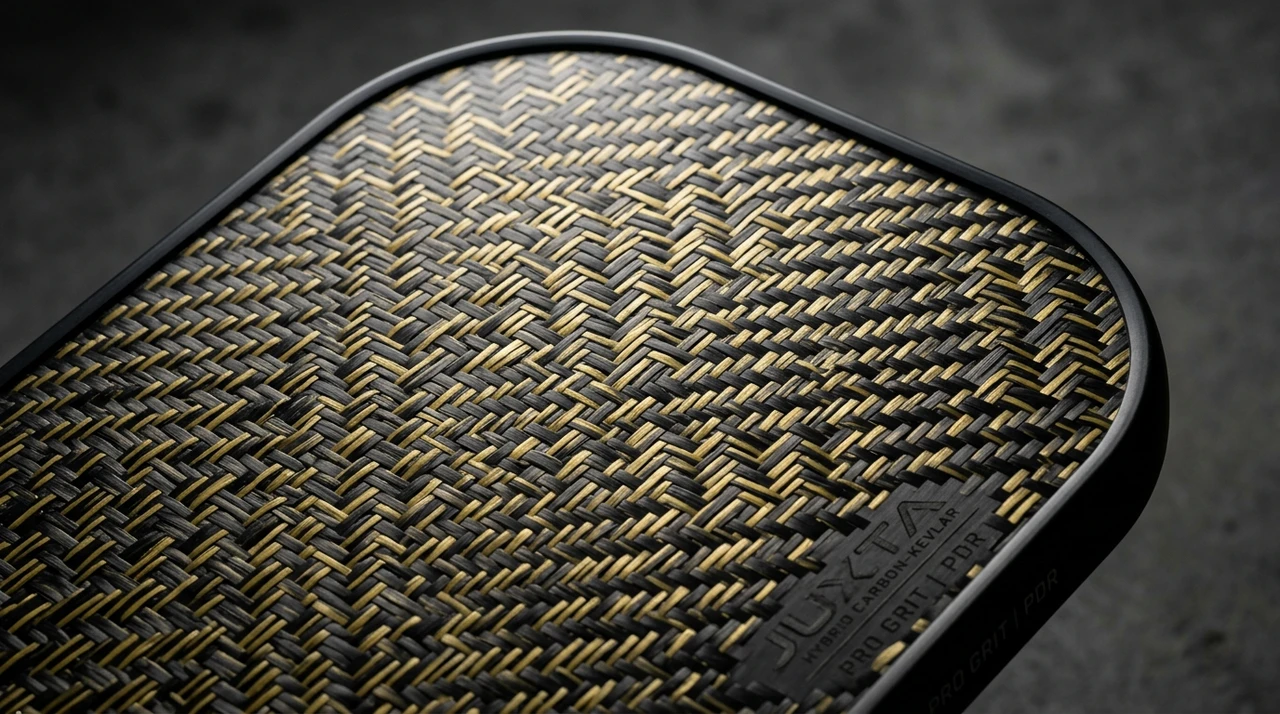
Kevlar is renowned for ballistics and impact dissipation. When incorporated into a paddle face, it softens the naturally rigid feel of carbon fiber without sacrificing structural stiffness. The result is an exceptionally plush, dampened impact sensation with extended dwell time. On 4.5+ tournament circuits, carbon-Kevlar hybrids have become the gold standard for players seeking the heavy spin of raw carbon combined with the vibration-absorbing comfort needed to ward off tennis elbow. Discover top models tested in our Best Control and All-Court Paddles Guide.
3. Paddle Core Materials & Thickness Impact
While the face material commands marketing headlines, the paddle core represents 90% of the paddle’s physical volume and dictates how kinetic energy distributes across your arm. The core acts as an internal shock absorber and energy distributor.
A. Polypropylene (Polymer) Honeycomb Core: The Tournament Standard
Over 90% of modern pickleball paddles approved by USA Pickleball feature an internal core made from polypropylene honeycomb (commonly designated as polymer core). Polypropylene is a thermoplastic polymer engineered into hexagonal cell grids.
Polymer cores dominate competitive play because they strike the optimal balance between acoustic dampening, durability, and energy dissipation. The plastic cell walls compress smoothly upon ball impact, soaking up vibration before it travels down the handle into the player’s wrist, elbow, and shoulder. Furthermore, polymer honeycomb does not crush permanently under repetitive 60 mph impacts, delivering a lifespan that easily exceeds other core materials.
B. Nomex Honeycomb Core: High Velocity, Stiff Feel & Acoustic Pop
Before polymer cores rose to dominance, Nomex was the undisputed king of performance paddles. Nomex is an aramid paper composite dipped in a rigid phenolic resin, originally developed for aerospace fire barriers and flight flooring. It forms a dense, rock-hard honeycomb structure.
Nomex provides virtually zero energy absorption. When the ball strikes a Nomex paddle, nearly 100% of the ball’s kinetic energy is reflected straight back out. The result is explosive shot velocity and a loud, sharp acoustic pop that echoes across the court.
The downside is physical punishment. Because the core refuses to absorb vibration, that shock wave travels straight down the shaft into the player’s arm. Players with a history of medial epicondylitis (golfer’s elbow) or lateral epicondylitis (tennis elbow) should avoid Nomex cores entirely. Additionally, many residential pickleball communities and HOAs have banned Nomex paddles due to their high-decibel acoustic profile.
C. Aluminum Cores: The Fading Precision Relic
Early composite paddles occasionally featured aluminum honeycomb cores. Aluminum delivered pinpoint touch and featherweight maneuverability. However, aluminum suffers from permanent plastic deformation: hit a hard overhead smash in the sweet spot with a heavy ball, and the aluminum cells collapse inward, creating an unfixable dead spot. As a result, aluminum has virtually disappeared from modern tournament rosters.
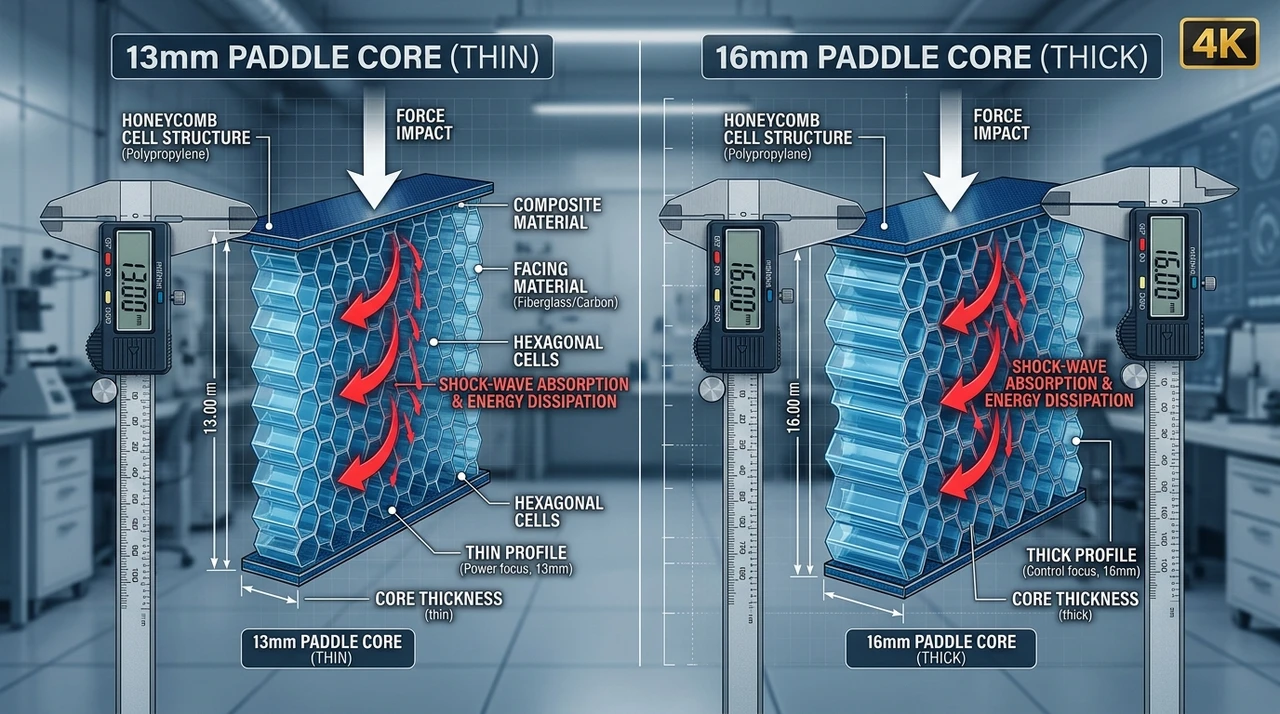
D. Core Thickness Dynamics: 13mm/14mm vs. 16mm
When shopping for a paddle, core thickness is just as critical as the material itself. The standard industry battle is between thin cores (13mm–14mm) and thick cores (16mm). For an in-depth lab breakdown, check out our comprehensive 14mm vs. 16mm Pickleball Paddles Guide.
- Thinner Cores (13mm/14mm): Compress less on impact. The ball bounces off rapidly before sinking, creating explosive exit velocity but demanding precise timing to control.
- Thicker Cores (16mm): Compress deeper under impact. The ball sinks into the honeycomb matrix, expanding the effective sweet spot, stabilizing paddle twist on off-center hits, and muting stinging vibrations.
For players seeking the ultimate plush feel and vibration protection, modern solid micro-cellular foam designs are also making massive waves. Learn more in our review of the Best Foam Core Pickleball Paddles.
4. Advanced Construction: Thermoforming & Perimeter Foam Injection
Prior to 2023, nearly all composite paddles were manufactured using ‘cold-press’ sandwich construction: top face, core, and bottom face were glued together, trimmed on a CNC machine, and wrapped with a plastic edge guard. Modern high-tier paddles have completely abandoned this method in favor of unibody thermoforming.
A. How a Thermoformed Pickleball Paddle is Built
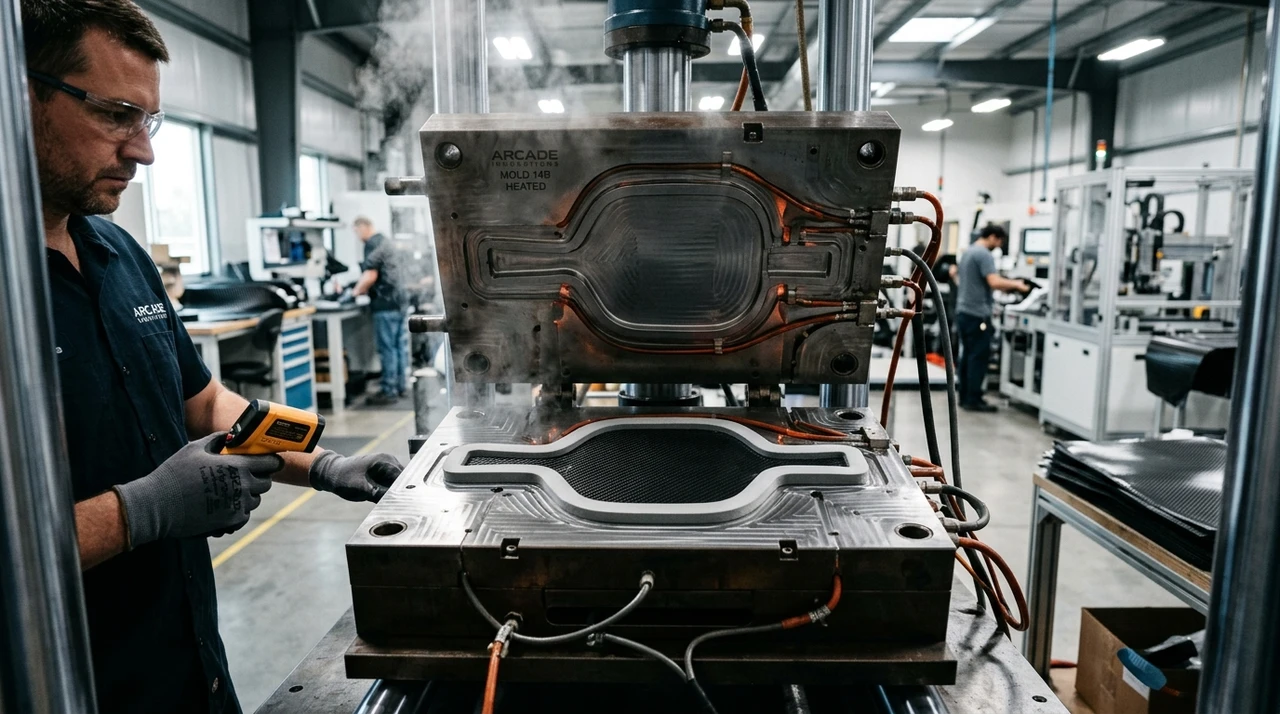
A thermoformed pickleball paddle is engineered inside an aluminum clamp mold subjected to extreme heat and pneumatic pressure. Carbon fiber wraps entirely around the perimeter of the paddle, creating a single seamless carbon shell that encases the honeycomb core.
Before baking, high-density EVA foam is injected along the paddle edges between the honeycomb core and the carbon perimeter wall. This foam injection accomplishes three critical engineering goals:
- Elevated Twist Weight (Torsional Stability): The dense perimeter foam shifts mass to the extreme edges of the paddle, dramatically resisting twist when a 50 mph drive strikes near the perimeter.
- Expanded Sweet Spot: By stabilizing the outer boundaries, the paddle retains consistent ball speed across 85% of the face, minimizing erratic mis-hits on defensive digs.
- Handle-to-Head Structural Unity: Traditional cold-press paddles often snap at the throat after heavy play. A thermoformed unibody extends solid carbon through the neck into the handle, virtually eliminating neck breakage.
B. The Core Crushing & Delamination Hazard
Thermoforming is not without durability trade-offs. The intense heat and pressure used during manufacturing can weaken the bond between the polypropylene cell walls and the carbon face. In early production runs across multiple brands, paddles suffered from ‘delamination’ and ‘core crushing’.
When a paddle delaminates, the carbon skin separates from the crushed honeycomb underneath, creating a hollow, trampoline air pocket. The paddle suddenly generates illegal, trampoline-like ball velocity (often termed a ‘hot paddle’) that fails USA Pickleball deflection coefficient tests. When purchasing a thermoformed paddle, stick with reputable manufacturers who utilize multi-stage baking cycles and offer comprehensive 6-month delamination warranties.
5. Playstyle Recommendation Guide: Which Material Fits Your Game?
Matching paddle materials to your personal athletic strengths and tactical tendencies is the single fastest way to shave unforced errors off your scorecard:
Persona 1: The Power Hitter / Aggressive Attacker
- Playstyle Profile: Drives relentlessly from the baseline, attacks speed-ups at the kitchen line, and looks to finish points with overhead smashes.
- Optimal Face Material: Composite Fiberglass (or stiff thermoformed raw carbon fiber).
- Optimal Core Spec: 13mm to 14mm Polypropylene Core.
- Why It Works: The thin core and responsive face maximize trampoline exit speed, converting compact swings into blistering put-aways without demanding excessive body torque.
Persona 2: The Control Specialist / Dinker
- Playstyle Profile: Patient doubles tactician who wins through unshakeable third-shot drops, soft kitchen resets, and absorbing opponent attacks.
- Optimal Face Material: Raw Toray T700 Carbon Fiber.
- Optimal Core Spec: 16mm Polypropylene Core.
- Why It Works: The thick 16mm core soaks up incoming pace like a sponge, while the raw carbon peel-ply texture provides the micro-friction needed to drop unattackable balls at the kitchen line.
Persona 3: The Spin Craftsman & All-Court Shotmaker
- Playstyle Profile: Aggressive modern player who relies on heavy topspin roll volleys, slicing third-shot drops, and dipping passing shots.
- Optimal Face Material: Carbon-Kevlar Hybrid or Raw T700 Carbon Fiber.
- Optimal Core Spec: 16mm Thermoformed Unibody Core with Perimeter Foam.
- Why It Works: Delivers maximum friction for 1,900+ RPM rotation, backed by the torsional stability needed to maintain control on off-center topspin swipes.
Looking for high-performance options that won’t break the bank? Explore our verified selections in the Best Budget Pickleball Paddles Under $100. Wondering how these core composites translate to elite tournament play? Check out our in-depth tour breakdown of what paddles pro pickleball players use. If you play competitive singles, pairing these paddle insights with our How to Play Pickleball Singles Guide will give you the complete tactical and gear edge.
6. Frequently Asked Questions: Paddle Materials Decoded

Written by Alex Turner
Lead Equipment Analyst at Pickleball Inch. Former competitive college tennis athlete turned 5.0 tournament pickleball player and mechanical equipment researcher. Alex oversees laboratory deflection tests, high-speed spin tracking, and long-term durability evaluations. Learn more on our About Page.