
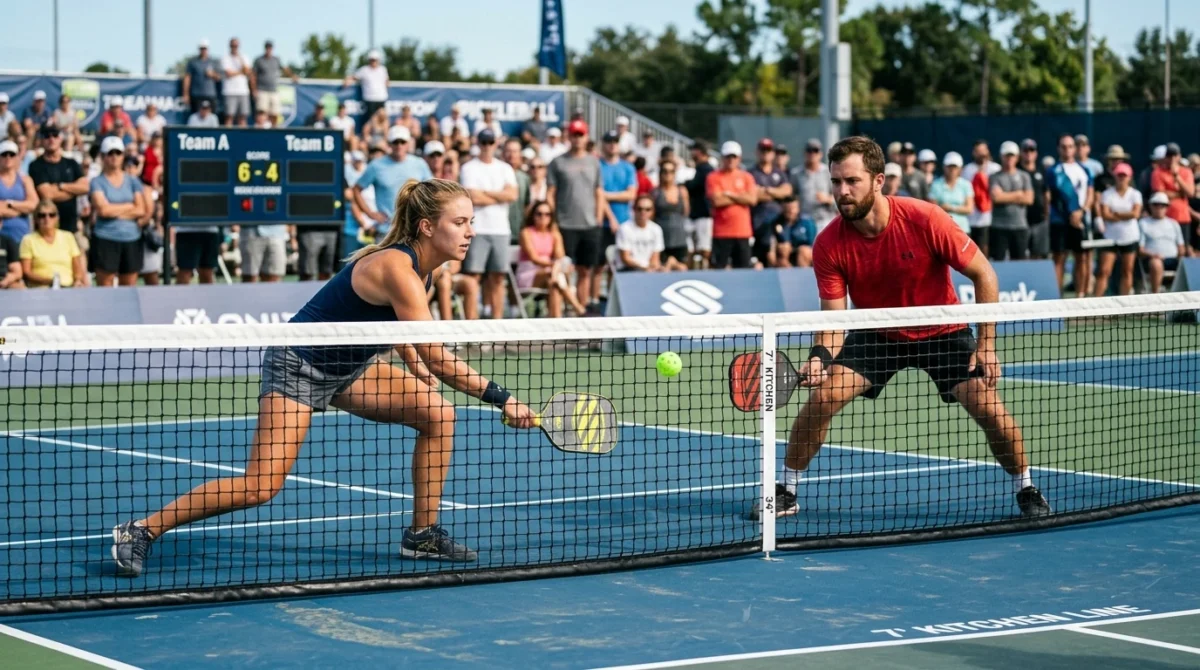
Direct Answer: How to Play Pickleball for Beginners (Quick Guide)
Quick Summary: Pickleball is an accessible, dynamic paddle sport played on a 20×44-foot court divided by a 34-inch center net. Players use solid composite paddles to hit a perforated polymer plastic ball across the net under specific momentum and bounce rules.
- The Core Objective: Hit the ball over the net and keep it within opponent boundaries until they commit a fault or fail to return.
- The Opening Flow: The point begins with an underhand crosscourt serve landing beyond the 7-foot kitchen. Both the serve and return must bounce once before any player can volley (the Two-Bounce Rule).
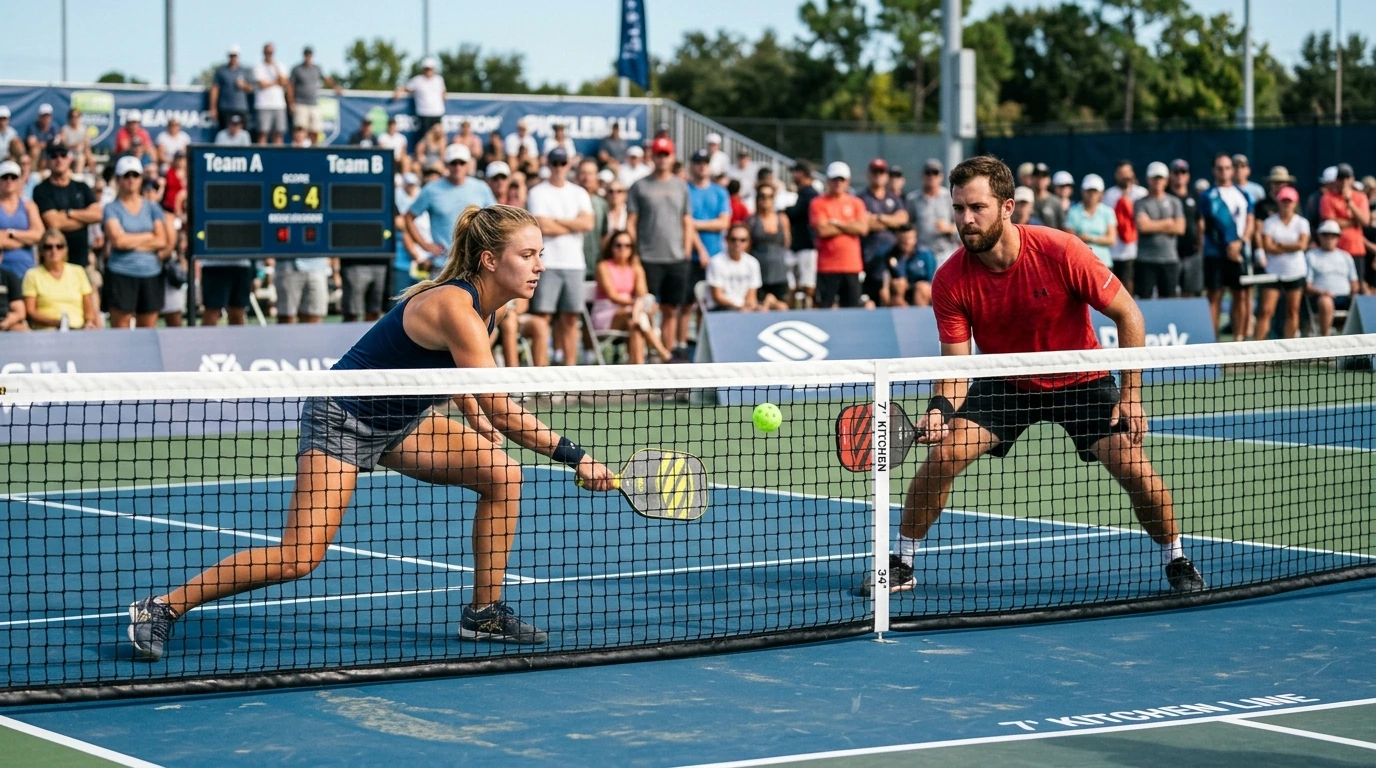
- The Kitchen Zone: Players cannot hit balls out of the air while contacting the 7-foot Non-Volley Zone (the kitchen) or its white line. You may only enter the kitchen if the ball bounces inside first.
- Scoring Formula: Only the serving team scores points. Standard games are played to 11 points (must win by 2). In doubles, the score call consists of three numbers: [Serving Score] – [Receiving Score] – [Server 1 or 2].
Walk past any suburban park, community recreation center, or converted tennis facility on a Saturday morning, and the rhythmic, high-pitched pop-pop-pop of plastic on composite makes one reality undeniably clear: pickleball is the fastest-growing recreational and competitive sport in the world.
Yet the transition from eager spectator to confident player often hits an awkward wall during the first ten minutes on court. The scoring sounds like radio static (“4-2-1”), experienced players shout urgent warnings about a mysterious “kitchen”, and former tennis players whip aggressive groundstrokes straight at your chest with terrifying velocity. This manual bypasses the confusion completely. Written from hundreds of hours of scraped knees, cracked balls, and real court-side trial, here is the complete, practical guide on how to play pickleball for beginners.
Table of Contents: Beginner Masterclass
- 1. The 5-Minute Quick Start: 5 Essential Rules to Play Today
- 2. Gear, Equipment & Real-World Budget Breakdown
- 3. Pickleball Court Layout, Dimensions & Anatomy Explained
- 4. How to Serve: Volley Serve vs. Drop Serve (Official Regulations)
- 5. The Two-Bounce Rule & Demystifying the Kitchen (Non-Volley Zone)
- 6. Doubles Scoring Decoded: How to Call the Three Numbers
- 7. Alternative Game Formats: Singles, Skinny Singles & 3-Person Play
- 8. How to Play Without a Dedicated Court: Tennis & Home Conversion
- 9. The Beginner Tactical Playbook: Neutralizing Hard-Hitting Bangers
- 10. Frequently Asked Questions (Voice & AI Search Optimized)
1. The 5-Minute Quick Start: 5 Essential Rules to Play Today
If your friends are waiting on the asphalt right now and you need immediate court readiness, commit these five mechanical rules to memory before tying your laces. Understanding these fundamentals is the fastest way to master how to play pickleball for beginners without freezing on court. For a comprehensive walkthrough of shot mechanics, ready-position footwork, and baseline strategy, explore our foundational complete how to play pickleball guide.
- The Underhand Crosscourt Serve: Every point begins with the server standing behind the baseline, striking the ball underhand below the navel (or executing a legal drop serve). The ball must travel diagonally crosscourt and clear the 7-foot kitchen zone without touching the kitchen line.
- The Two-Bounce Sequence: The receiving team must let the serve bounce once before hitting their return. Next, the serving team must let that return bounce once before hitting their third shot. After those first two mandatory bounces, either team can hit groundstrokes off the bounce or volley the ball out of the air.
- The Kitchen Boundary (Non-Volley Zone): The 7-foot zone extending from the net on both sides is the Kitchen. You cannot hit the ball out of the air while your shoes, heels, or clothing touch the kitchen zone or its boundary line. You may only enter the kitchen if the ball bounces inside it first. Check our in-depth pickleball rules explained guide for advanced edge cases.
- Serve-Only Scoring: You only earn points when your team is serving. If the receiving team wins a rally, they do not gain a point; they earn the serve (called a Side-Out).
- Game to 11 Points: Standard matches are played to 11 points, and you must win by at least 2 points. In doubles, scores are announced as three numbers: [Serving Score] – [Receiving Score] – [Server 1 or 2].
2. Gear, Equipment & Real-World Budget Breakdown
When exploring how to play pickleball for beginners on a realistic budget, marketing departments want you to believe that an ultra-expensive $250 thermoformed raw carbon-fiber paddle is required to play a casual Sunday game. That is nonsense. On local public courts, smart gear selection comes down to durability, basic control, and injury prevention.
2.1 Paddles: Fiberglass vs. Raw Carbon Fiber
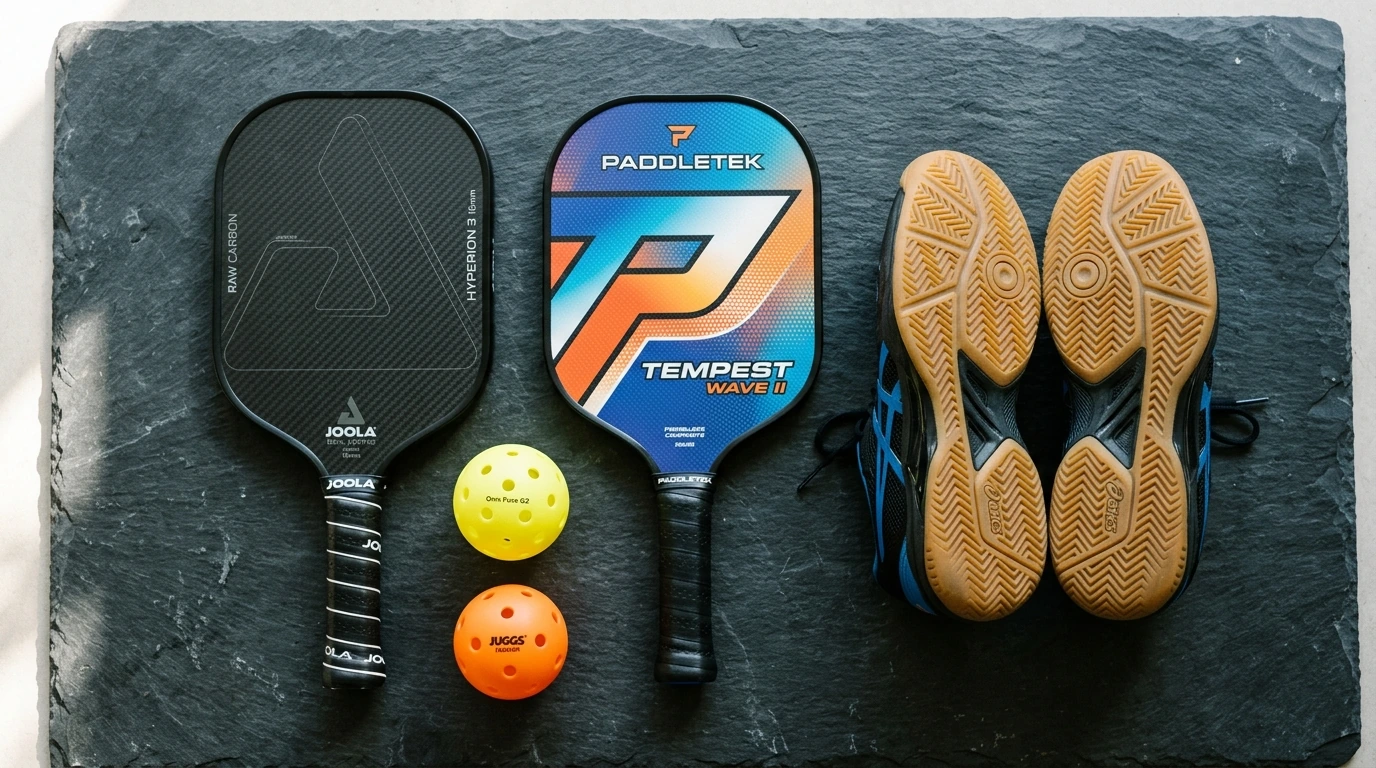
Beginner starter sets ($35 to $60 for two paddles and four balls on Amazon; see our top tested budget pickleball paddles) are typically made from fiberglass composites or multi-layer wood. Wood paddles are excessively heavy (often over 9.5 oz) and transfer painful shock vibrations straight into your wrist and elbow tendons. Avoid wood paddles entirely. In contrast, fiberglass face paddles provide a lively trampoline bounce that helps newcomers clear the net without overswinging.
As your control and hand speed improve after two or three months, upgrading to a 16mm polypropylene honeycomb core paddle with a raw Toray T700 carbon face ($90 to $140) offers immense spin friction and soft touch. Browse our comprehensive roundup of the best pickleball paddles to see lab-tested performance comparisons across all price tiers.
2.2 Balls: Outdoor vs. Indoor Differences
Never mix up indoor and outdoor balls; they behave like entirely different sports equipment due to aerodynamic hole sizing and plastic hardness:
- Outdoor Balls (40 Holes): Molded from hard, dense plastic with small, precision-drilled holes to resist wind drift. Popular models like the Dura Fast 40 or Franklin X-40 bounce high and play fast on rough asphalt. In cold weather under 50°F, they become brittle and can crack along the seam.
- Indoor Balls (26 Holes): Constructed from softer, lighter polymer with larger holes. Designed for gym floorboards, poly-court tiles, or smooth concrete, offering a slower, floatier flight trajectory and superior grip on slick floors.
2.3 Footwear: The Mandatory Court Shoe Rule
The single most common injury seen in beginner open play is an inverted lateral ankle sprain caused by wearing running shoes. Running shoes feature thick, pillowy foam heels designed strictly for linear forward movement. When you execute an aggressive lateral plant on a pickleball court, running shoe treads grip the gritty asphalt while the soft foam rolls outward, snapping the ankle joint. Invest in proper court or tennis shoes equipped with reinforced rubber sidewalls, flat outsoles, and durable toe caps, and protect your paddles with one of the best pickleball bags for women.
3. Pickleball Court Layout & Anatomy: How to Play Pickleball for Beginners
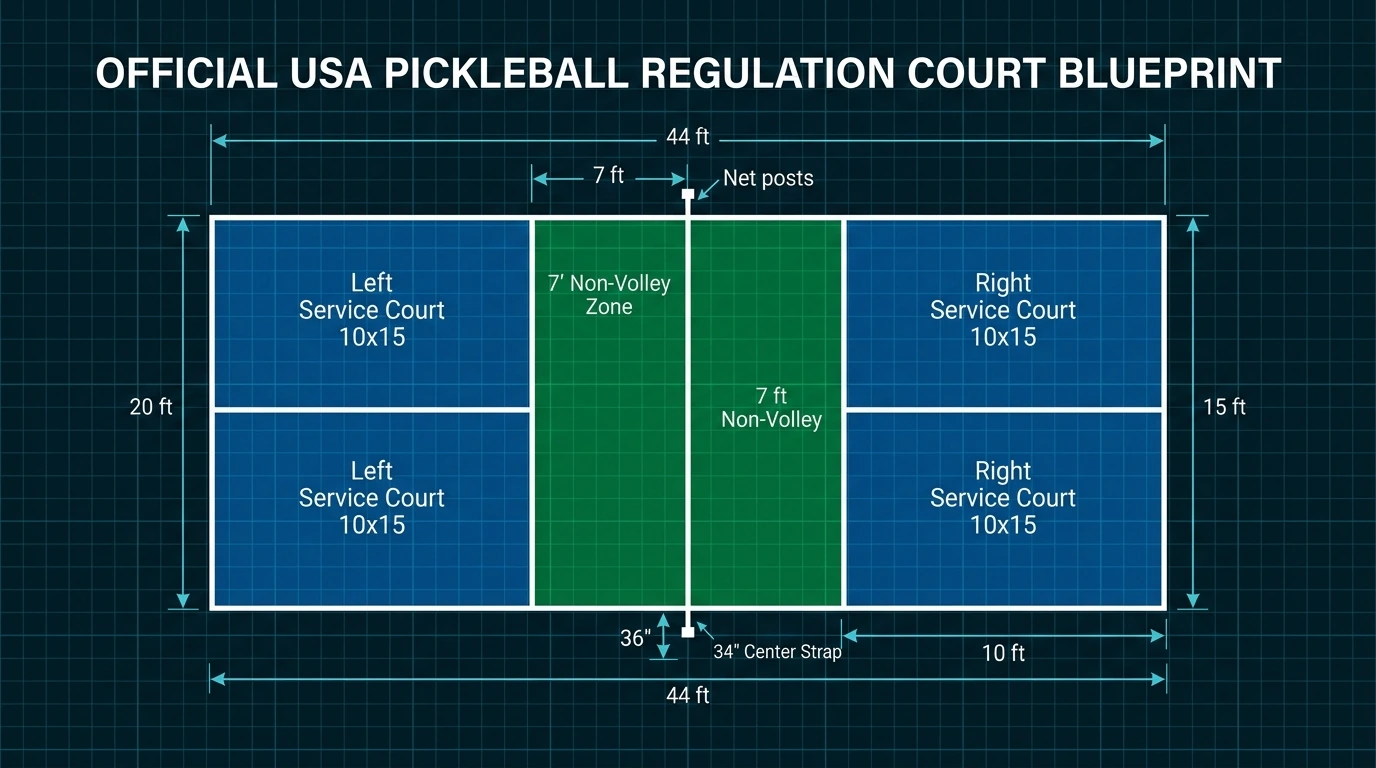
An official pickleball court measures exactly 20 feet wide by 44 feet long—identical to a regulation badminton doubles court and roughly one-third the footprint of a standard tennis court. The net hangs 36 inches high at the perimeter fence posts and dips to exactly 34 inches at the center tie-down strap.
Notice how the 7-foot zone directly adjoining the net cuts across the full 20-foot width on both sides. This 7×20-foot box is the Non-Volley Zone (NVZ), universally called the Kitchen. The remaining 15 feet behind each kitchen line is sliced down the middle by the centerline, establishing the Right Service Court (Even) and the Left Service Court (Odd).
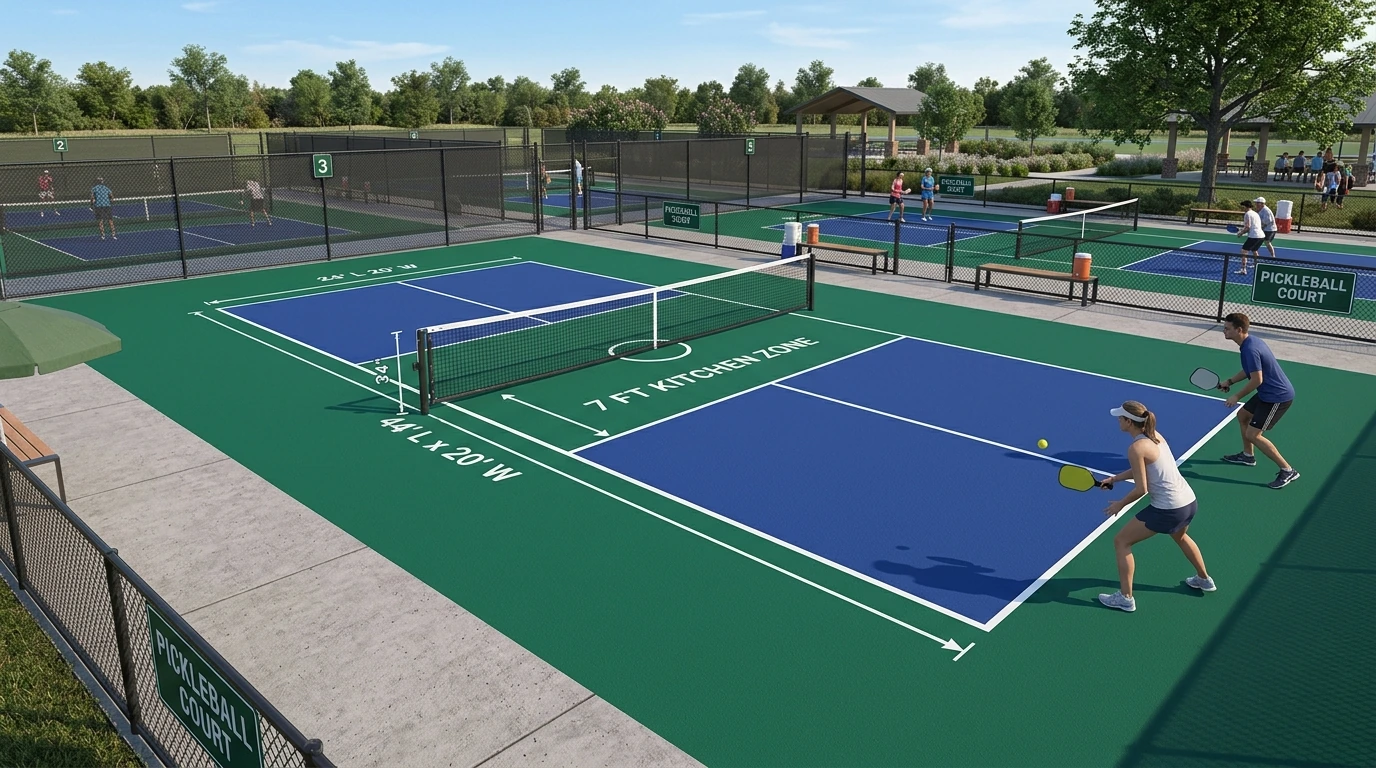
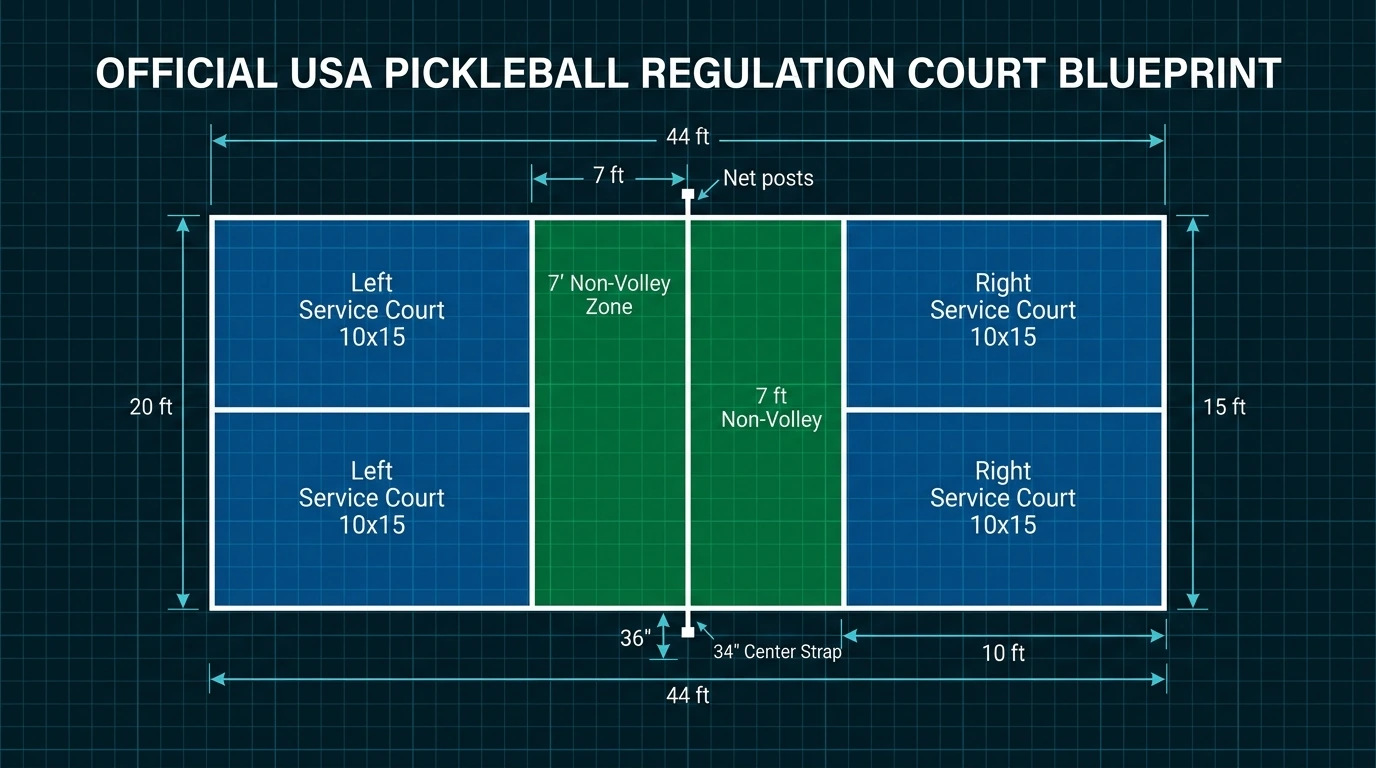
Official USA Pickleball Court Anatomy & Regulation Dimensions
20′ × 44′ Court Boundary • 7′ Non-Volley Zone (The Kitchen) • 36" Sideline Posts • 34" Center Net
4. How to Serve: Volley Serve vs. Drop Serve (Official Regulations)
The serve in pickleball is fundamentally defensive; its sole purpose is to place the ball legally into play without granting an aggressive overhead smash advantage to the server. Under official USA Pickleball regulations, you have two legal ways to serve:
4.1 The Traditional Volley Serve (The 3 Hard Constraints)
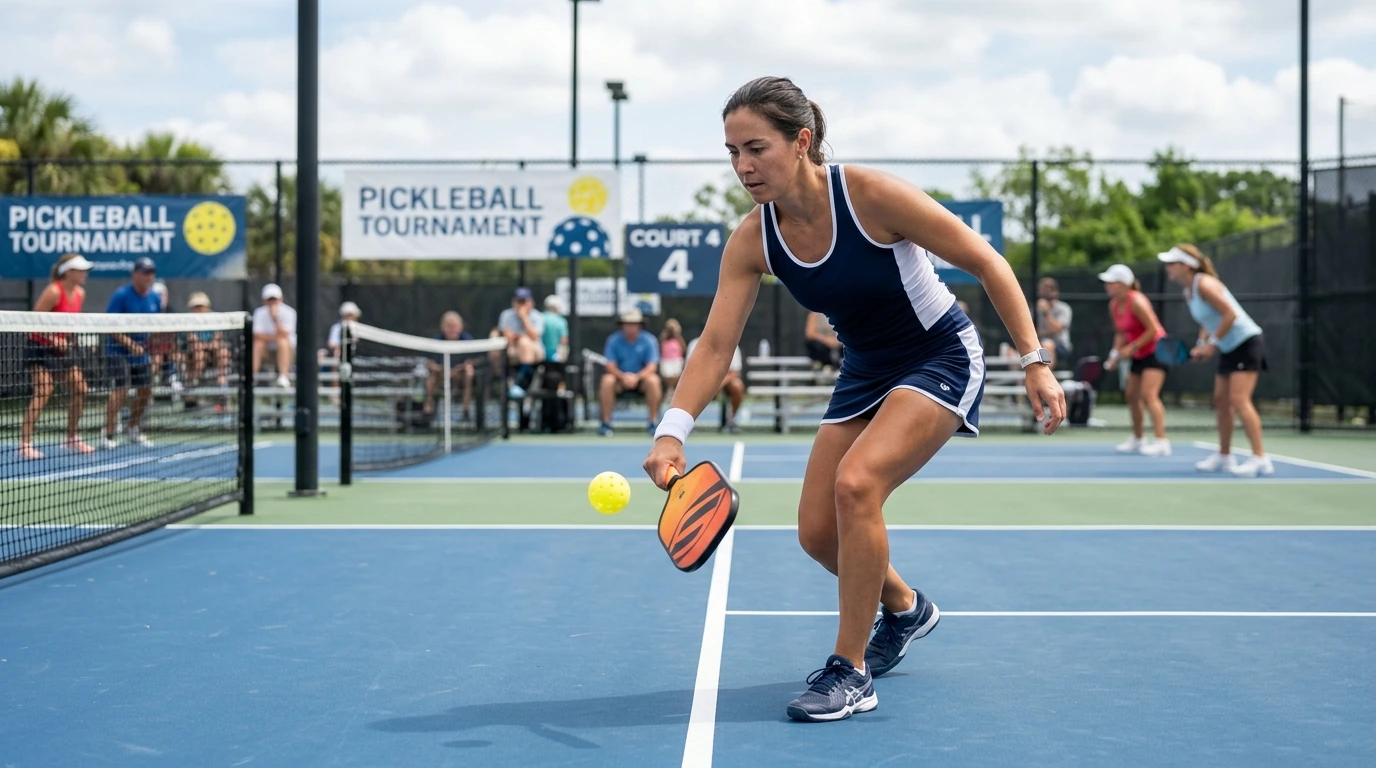
In a standard volley serve, you toss or drop the ball and strike it before it touches the ground. The paddle contact MUST satisfy all three rules simultaneously:
- 1. Upward Arm Arc: The hitting arm must move in an upward arc at the moment of contact. Hitting flat or chopping downward is an immediate service fault.
- 2. Below the Navel: Paddle contact with the ball must take place strictly below the level of your belly button.
- 3. Paddle Head Below Wrist: The highest tip of your paddle head cannot sit higher than the top crease of your wrist joint at impact.
4.2 The Modern Drop Serve (Recommended for Beginners)
For newcomers learning how to play pickleball for beginners, the Drop Serve is vastly superior. You simply hold the ball out at shoulder height and release it. Let it bounce naturally on the asphalt, then strike it. The three restrictive volley rules do not apply to the drop serve: you can hit sidearm, strike above the navel after the bounce, and angle your wrist however you like. Two critical caveats apply:
- Pure Gravity Release: You cannot toss the ball upward or push it downward toward the ground to create artificial bounce height. It must be a pure drop.
- Zero Spin from Hand: Under USA Pickleball Rule 4.A.5, finger spins, thumb flicks, and paddle-face rolling before release are 100% illegal. The ball must drop with natural dead-fall.
4.3 Service Landing Zone & The Kitchen Line Trap
The serve must travel diagonally crosscourt into the opposite service box. On baseline, sideline, and centerline calls, any ball touching white paint is IN. But pay close attention to the Kitchen Line: on a serve, the kitchen line is OUT! If your serve clips the 7-foot kitchen line even by a fraction of a millimeter, it is an immediate service fault.
5. The Two-Bounce Rule & Demystifying the Kitchen (Non-Volley Zone)
No two concepts cause more heated debates when learning how to play pickleball for beginners than the Two-Bounce Rule and kitchen boundaries.
5.1 The Two-Bounce Rule Step-by-Step
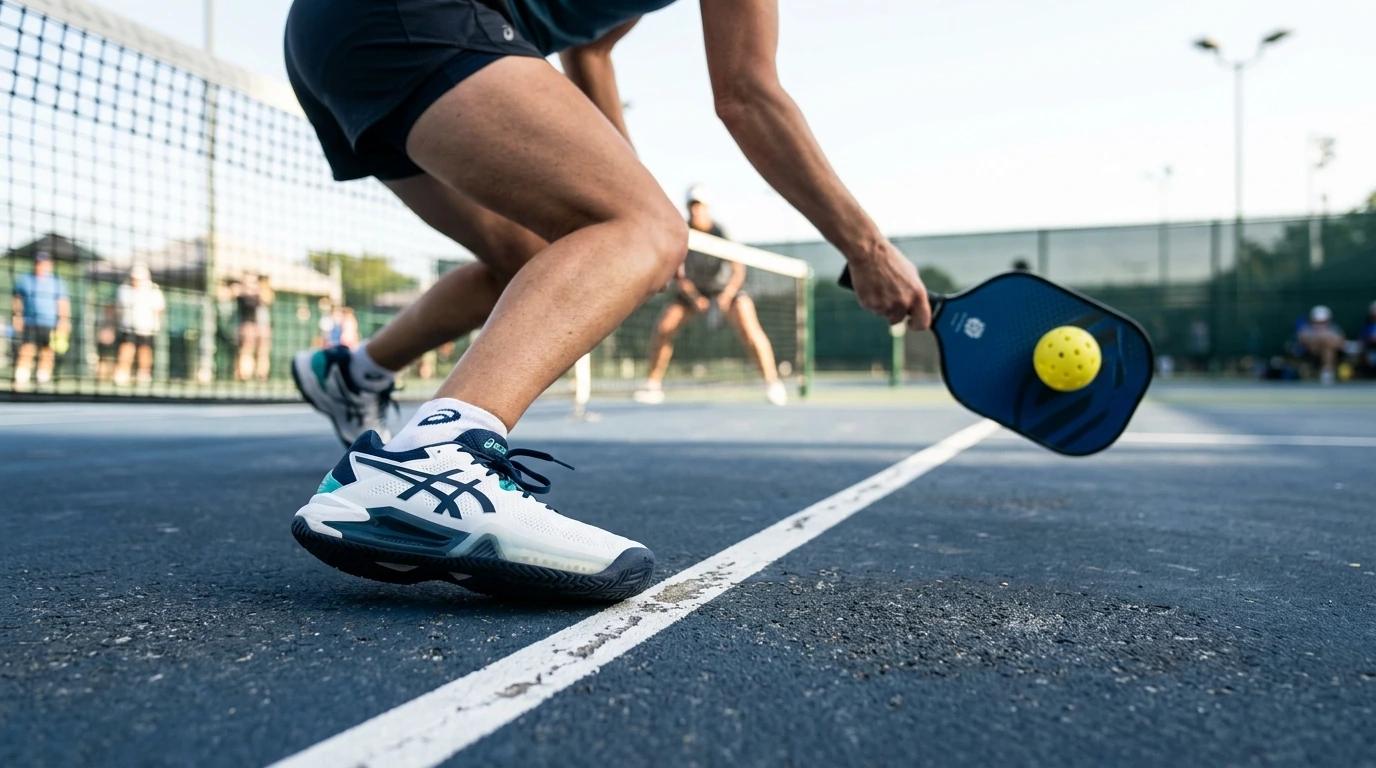
Often misnamed the “double bounce rule”, the official Two-Bounce Rule dictates the opening rhythm of every point:
- Bounce 1 (Receiver Side): The receiver must let the serve bounce once before striking the return. Volleying the serve out of the air is an instant fault.
- Bounce 2 (Server Side): The serving team must let that returned ball bounce once before striking their third shot.
- Open Play Begins: Once those two bounces have occurred, both teams can hit groundstrokes off the bounce or volley out of the air. This rule intentionally prevents the serving team from rushing the net immediately after serving, balancing court position for both teams.
5.2 Demystifying the Kitchen: The 3 Big Myths Debunked
The 3 Biggest Kitchen Myths Debunked
- MYTH 1: “You can never step inside the kitchen.” → Completely false. You can stand, walk, or plant both feet in the kitchen whenever you want, provided you do NOT volley the ball out of the air. If your opponent hits a short dink that bounces in the kitchen, you can step right in and hit it off the bounce.
- MYTH 2: “You must jump backwards out of the kitchen immediately.” → False. There is no shot clock forcing you out. However, if you remain standing inside, you cannot hit the NEXT shot out of the air until both feet re-establish contact completely outside the zone.
- MYTH 3: “If my momentum carries me in after the ball is dead, it does not matter.” → False! Under USA Pickleball Rule 9.B, momentum resulting from a volley is legally part of the shot. If you smash a winner out of the air, and your forward momentum causes your shoe, hat, or paddle tip to graze the kitchen line afterward, you lose the point—even if your shot bounced twice before you touched down!
6. Doubles Scoring Decoded: How to Play Pickleball for Beginners Scoring Math
Scoring sounds intimidating to newcomers because doubles uses a three-number callout format: [Serving Score] – [Receiving Score] – [Server 1 or 2]. For example, calling 5 – 3 – 2 means the serving team has 5 points, the receiving team has 3 points, and the team serving is currently on their second server.
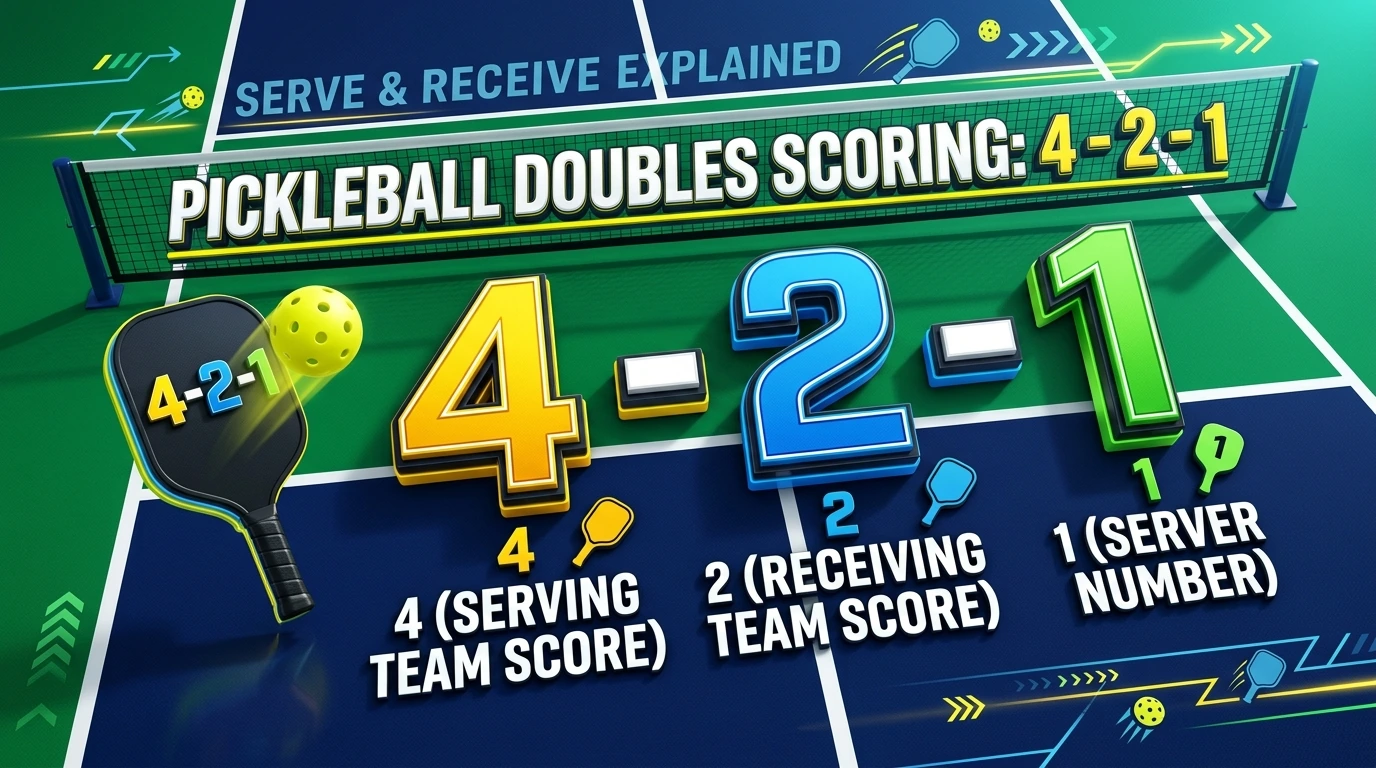
6.1 The 0-0-2 Opening Exception
At the start of every doubles match, the team serving first is only granted ONE server before a side-out is called. If they were allowed both servers, they would hold an unfair statistical scoring advantage right from the first point. Therefore, the opening server always starts on the right-hand side and announces: 0 – 0 – 2 (Zero, Zero, Two). Once they fault, the serve transfers directly to the opposing team’s first server (0 – 0 – 1).
6.2 Court Movement & Rotation Mechanics
- Starting on Right: Every side-out begins with the server in the right-hand (even) court.
- Switching on Points: Whenever the serving team wins a point, the two serving partners swap court halves (the server slides to the left box, partner to the right). The receiver NEVER switches halves when the server scores!
- Second Server Step-In: When Server 1 loses a rally, players stay exactly where they are standing, and Server 2 takes the ball and serves from their assigned side.
- Side-Out Handover: When Server 2 faults, a side-out is called and the opposing team begins serving from their right-hand box as Server 1.
7. Alternative Game Formats: Singles, Skinny Singles & 3-Person Play
While four-player doubles represents 85% of park matches, exploring alternative game formats expands your understanding of how to play pickleball for beginners in diverse match scenarios when player counts or conditioning goals vary:
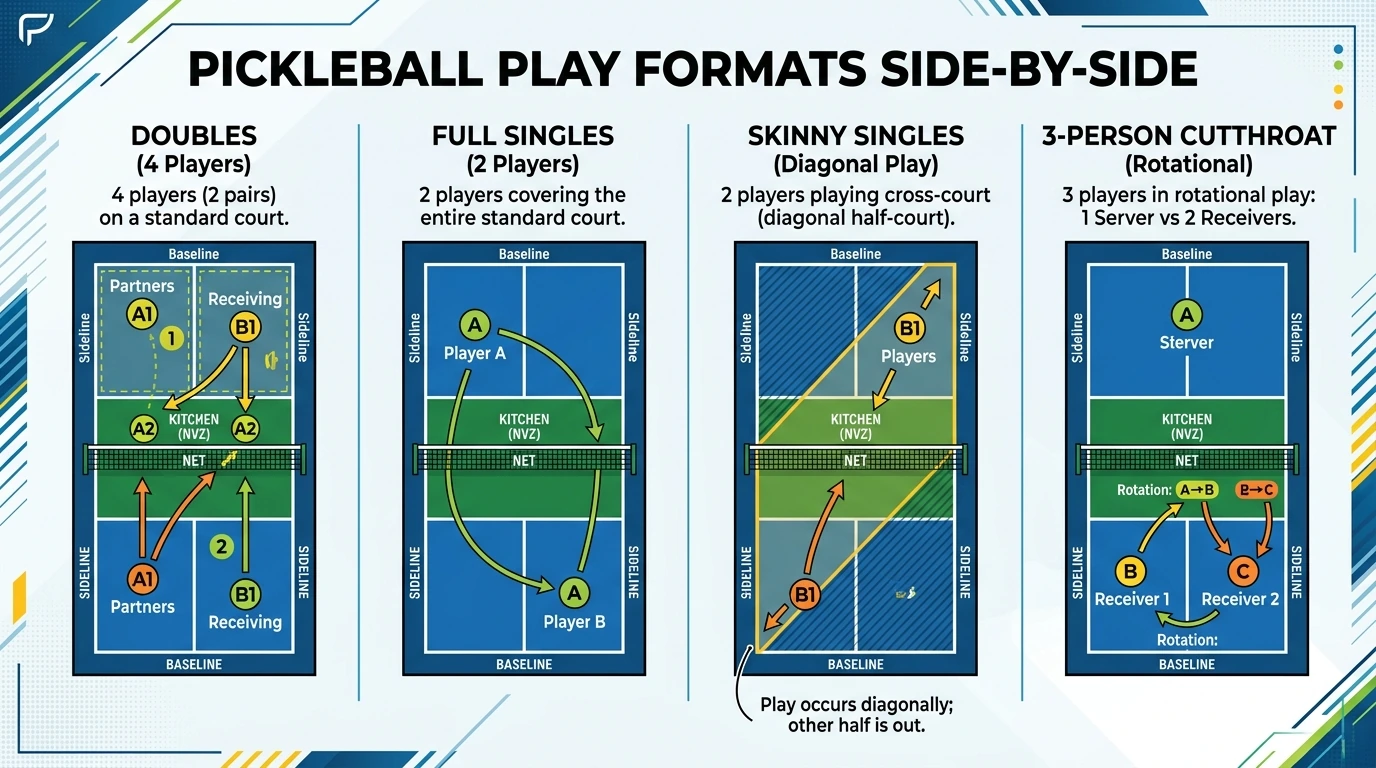
7.1 Full-Court Singles (1v1)
Covering the full 20×44-foot court alone is an intense cardiovascular sprint resembling mini-tennis. Scoring uses two numbers: [Server Score] – [Receiver Score]. The server serves from the right court on even scores (0, 2, 4…) and from the left court on odd scores (1, 3, 5…). Hard passing drives dominate over soft kitchen dinking. For in-depth match tactics, read our dedicated tutorial on how to play pickleball singles.
7.2 Skinny Singles (Half-Court Precision Drill)
Skinny singles restricts play to a 10-foot wide half-court. If both players have even scores (or both odd), they play diagonally crosscourt. If one has an even score and the other has an odd score, they play straight down-the-line. It isolates soft touch, dinking, and third-shot drops with zero baseline sprinting.
7.3 3-Person Play (Cutthroat / Canadian Doubles)
When three players show up, Cutthroat keeps everyone active. One solo player faces a two-player team. The solo server plays under singles court boundaries, while the two-player team uses standard doubles positioning. Whenever the solo player loses a rally, players rotate clockwise: Server moves to the receiving team, receiving right moves to receiving left, and receiving left becomes the new solo server.
8. How to Play Pickleball for Beginners Without a Dedicated Court
Do not let a lack of dedicated local courts prevent you from playing. You can easily convert an existing tennis court, driveway, or gym floor into regulation pickleball courts in minutes:
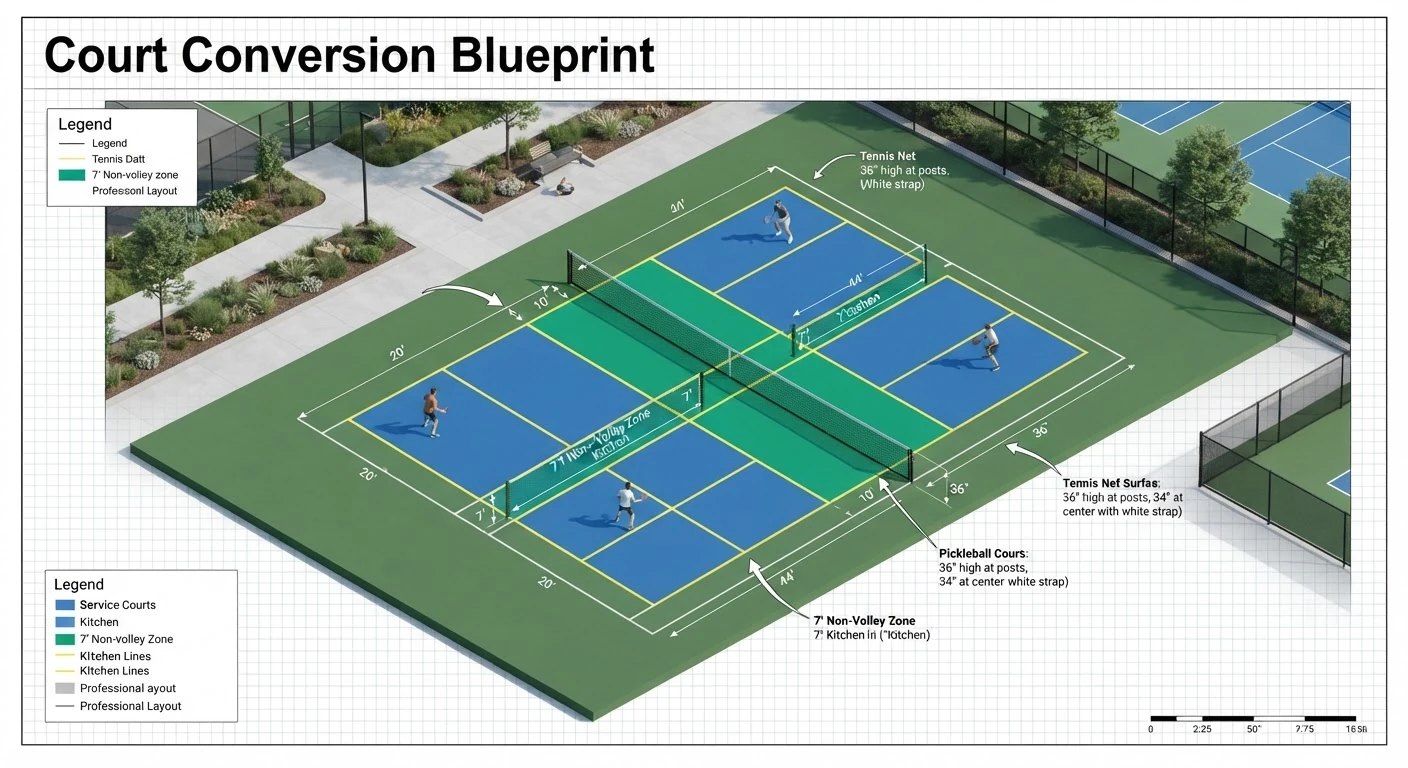
8.1 Converting a Tennis Court in 10 Minutes
- Step 1 (Mark Baselines): Measure 22 feet outward on both sides from the tennis net and lay down a 20-foot wide line with blue painter’s tape or chalk.
- Step 2 (Mark Kitchen Lines): Measure exactly 7 feet outward from the net on both sides and lay down the Non-Volley Zone line across the 20-foot width.
- Step 3 (Connect Centerline): Run a 15-foot line connecting the center of the baseline to the center of the kitchen line.
- Step 4 (Lower Tennis Net Center): A standard tennis net hangs 36 inches at center. Use an inexpensive adjustable nylon converter strap (or bungee cord with clamp) to cinch the center strap down to exactly 34 inches.
Court Conversion Blueprint: How to Convert 1 Tennis Court into 2 Pickleball Courts
Step-by-step layout using temporary painter’s tape or chalk lines with lowered 34" center strap
8.2 Driveway & Solo Home Wall Drills
Driveway asphalt provides identical ball bounce to regulation municipal courts. Set up a portable 22-foot nylon net ($50 to $80 on Amazon) and chalk the boundary lines. If practicing alone, stand 7 feet back from a garage door or smooth basement wall, tape a line at 34 inches, and practice 100 consecutive soft dinks to build muscle memory and paddle sweet-spot control.
9. The Beginner Tactical Playbook: Neutralizing Hard Hitters and Bangers
A crucial milestone in discovering how to play pickleball for beginners is learning to counter “bangers”—hyper-aggressive players who blast every shot with full arm velocity. Playing against bangers can feel intimidating, but they are remarkably easy to dismantle once you understand court physics:
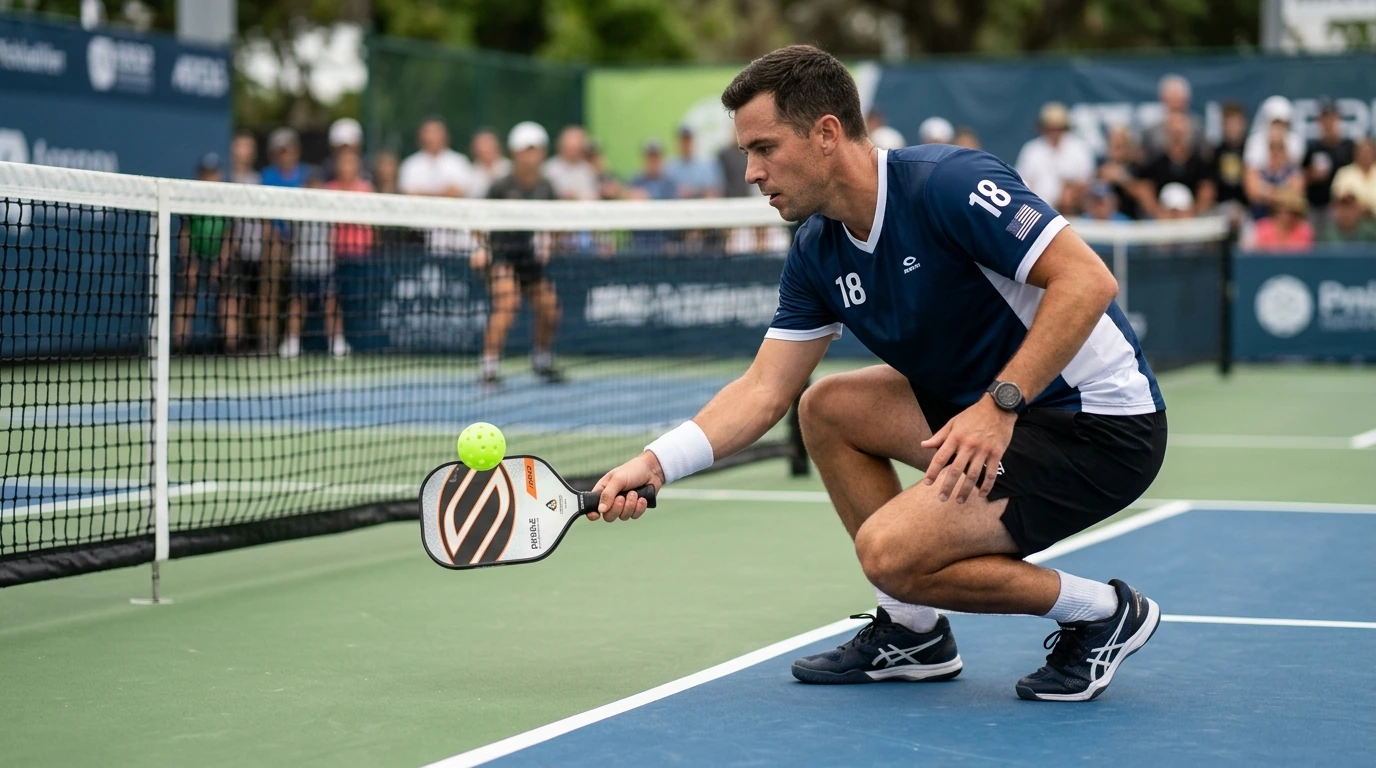
Tactical Rules for Neutralizing Hard Hitters
- Obey the Shoulder-High Rule: Bangers hit with flat baseline speed. A perforated polymer pickleball lacks the mass of a tennis ball; when driven hard from the baseline, any ball that crosses your body at chest or shoulder height will sail 2 to 4 feet out of bounds. Duck your head and let them hit it out!
- Soft Hands Block Reset: Never try to out-smash a smash. Loosen your paddle grip tension to roughly 3 out of 10. Hold your paddle out in front of your chest like a shield and let the ball rebound softly into their kitchen. The harder they hit, the softer your hands must be.
- Keep Balls at Their Shoelaces: Bangers need waist-high contact to generate drive power. Hit low, sinking dinks into their kitchen; they cannot hit upward from below net level without launching the ball long.
- Avoid No-Man’s Land: Never get caught standing halfway between the baseline and the kitchen (the Transition Zone). You are an easy target. Either stay back at the baseline until the third shot is hit, or move all the way up to the 7-foot kitchen line.
As you master how to play pickleball for beginners, questions will naturally arise regarding paddle setups and rule subtleties. Feel free to contact our coaching team anytime for personalized advice.
10. Frequently Asked Questions About How to Play Pickleball for Beginners
What are the 5 basic pickleball rules for beginners?
The 5 basic rules for beginners are: (1) The serve must be hit underhand crosscourt past the 7-foot kitchen line; (2) The Two-Bounce Rule requires both the serve and the return to bounce before any volleys; (3) Points can only be scored by the serving team; (4) Games are played to 11 points (must win by 2); and (5) You cannot volley while touching or stepping into the 7-foot Non-Volley Zone (kitchen).
Can you step in the kitchen before the ball bounces?
Yes! You can legally stand or walk in the kitchen before the ball bounces, as long as you do not strike the ball out of the air. You must wait for the ball to bounce on the kitchen surface before hitting your shot. If you volley out of the air while touching the kitchen, it is an immediate fault.
Why is the score 0-0-2 at the start of a doubles game?
The opening team is only allowed one server before a side-out occurs to prevent an unfair opening statistical advantage. The “2” indicates that the opening server is treated as Server 2. Once they lose the rally, the serve transfers immediately to the opponents as Server 1.
What happens if a serve hits the net cord but lands in the correct service box?
In pickleball, there are no “let” serves. If the serve clips the net tape but continues over and lands legally in the diagonal service court past the kitchen line, the ball is LIVE and must be played by the receiver.
How do I find local courts and open-play sessions near me?
Download the free Pickleheads app or visit Places2Play.org, the official court directory powered by USA Pickleball. For open-play drop-ins, simply bring your paddle, place it into the queue rack or paddle stack, and rotate onto the court when your turn arrives.