
⚡ Quick Summary: How to Play Pickleball at a Glance
- Player Counts: Play with 4 players (doubles) or 2 players (singles / skinny singles) on a 20×44 ft court.
- The Serve: Underhand swing contacting the ball below the navel, hit diagonally crosscourt into the opponent’s service court.
- Two-Bounce Rule: The serve must bounce once on the receiving side, and the return must bounce once on the serving side before airborne volleys.
- The Kitchen (NVZ): You cannot volley out of the air while touching the 7-foot kitchen line or zone.
- Scoring: Play to 11 points (win by 2); points can only be scored when your team is serving.
📖 Table of Contents
- How to Play Pickleball in 5 Minutes: The Rapid Quick-Start
- Equipment, Costs & Player Prerequisites: What Do You Need?
- How to Play Pickleball for Beginners Step by Step
- Gameplay Formats: Doubles, Singles, Skinny Singles & 3-Person Play
- How to Play Pickleball Without a Court: Tennis, Grass & Home
- Advanced Strategy: How to Play Better Pickleball & Defeat Bangers
- Scoring System & Video Demonstrations: Visualizing the Game
- Finding Courts & Community: How to Learn Near You
- Frequently Asked Questions: How to Play Pickleball
If you have ever asked ‘how to play pickleball?’ or typed into a search bar ‘how to play pickleball.’ because you were curious about America’s fastest-growing obsession, you have arrived at the ultimate masterclass. Often searched as pickleball how to play, learning how to play pickleball is the single most accessible, fun, and socially rewarding athletic activity available today. Whether you are searching for how to play pickleball for beginners, how to play pickleball on a tennis court, how to play pickleball with 4 people, or how to play pickleball doubles, this complete guide provides every detail. We cover how to play pickleball in 5 minutes, how to play pickleball instructions, how to play pickleball for beginners step by step, and how to play pickleball easy so that even if you feel like you need how to play pickleball for dummies, you can walk onto any court and play with confidence.
1. How to Play Pickleball in 5 Minutes: The Rapid Quick-Start
How to Play Pickleball in 5 Minutes: The 5 Core Pillars
The essential foundations to step onto any pickleball court and play immediately.
Must contact ball below navel with an upward arc, hit crosscourt past the opponent’s kitchen line.
The serve must bounce once before returning, and the return must bounce once before being hit. No early volleys!
You cannot volley out of the air while standing in or touching the 7-foot kitchen or its 2″ boundary line.
You can only score points while your team is serving. Receivers win the right to serve, not points.
Standard matches play to 11 points with a mandatory 2-point winning margin.
If you are on the way to the courts right now and need someone to ‘show me how to play pickleball’ instantly, here is the distilled essence of pickleball rules and how to play in under 5 minutes:
The 5-Minute Quick-Start Rulebook
- 1. The Underhand Serve: The game starts with an underhand serve struck below the navel (or dropped to bounce naturally). The serve must travel diagonally crosscourt and clear the 7-foot kitchen zone.
- 2. The Two-Bounce Rule: The receiver must let the serve bounce, and the serving team must let the return bounce. After those two bounces, both teams can hit groundstrokes or volley out of the air.
- 3. The Kitchen Rule (Non-Volley Zone): You cannot step in or touch the 7-foot kitchen line while hitting a ball out of the air. You can only enter the kitchen after the ball has bounced inside it.
- 4. Serving Team Scores Only: Points are scored strictly by the team currently serving. If the serving team faults, the serve passes to the second server or side-outs to the opponent.
- 5. Game to 11, Win by 2: Games are played to 11 points (must win by at least 2). In doubles, scores are called as three numbers: [Server Score] – [Receiver Score] – [Server 1 or 2].
That is the entire foundational blueprint! If you know these five principles, you understand how to play pickleball rules and can step onto any court, join open play, and enjoy a legal, competitive game immediately. Many players look up how to play pickleball video for beginners or search for how to play pickleball youtube tutorials, but having these five rules etched in your mind gives you instant court readiness.
2. Equipment, Costs & Player Prerequisites: What Do You Need?
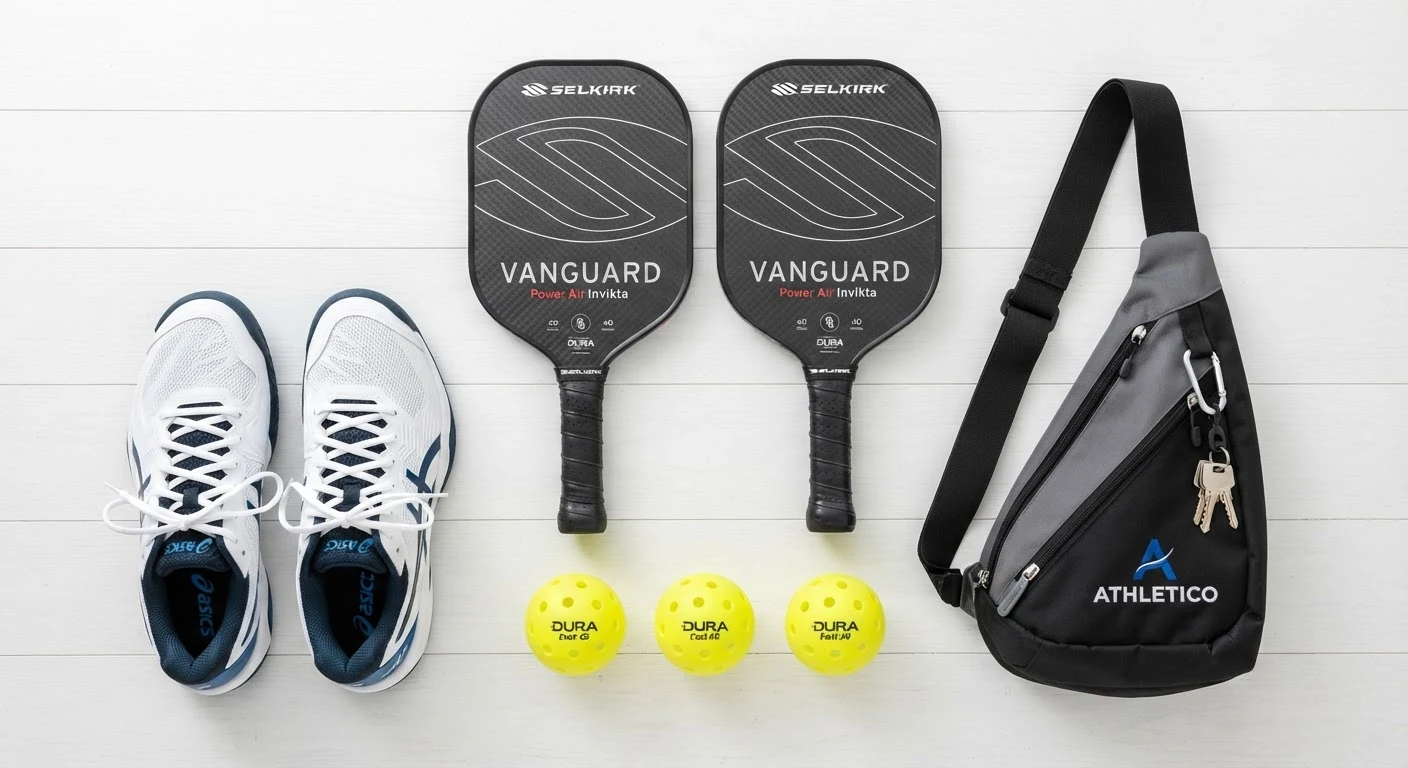
Before hitting the court, many newcomers wonder: how many people do you need to play pickleball, how many players do you need to play pickleball, how much does it cost to play pickleball, and how fit do you need to be to play pickleball?
2.1 How Many Players Do You Need?
How many people do you need to play pickleball? The standard game is designed for either 4 players (how to play pickleball with 4 people, known as doubles, which accounts for over 85% of all court play) or 2 players (how to play pickleball singles). However, versatile variants also allow 3 people to play (Cutthroat) or solo drill practice against a wall.
2.2 How Much Does It Cost to Play Pickleball?
Wondering how much does it cost to play pickleball near me? One of the greatest virtues of pickleball is its remarkably low financial barrier to entry:
Entry-Level Kit: • Beginner Starter Sets ($35–$60): Includes two composite paddles, four outdoor balls, and a carrying bag.
Performance Gear: • Intermediate/Advanced Paddles ($90–$220): Carbon fiber or raw carbon face paddles (such as Joola, Selkirk, CRBN, or Vatic Pro) offering superior control and spin.
Footwear: • Pickleball Shoes ($70–$140): Proper court sneakers with lateral support and non-marking herringbone soles. (Never wear running shoes, which lack lateral stability and increase rollover ankle sprains).
Court Access: • Court Access Fees ($0–$15): Public parks, tennis court conversions, and community recreation centers are usually 100% free. Dedicated indoor climate-controlled clubs (like The Picklr or Chicken N Pickle) charge small drop-in open-play fees ($10–$25 per session).
2.3 Fitness, Age & Accessibility: How Old or Fit Do You Have to Be?
How fit do you need to be to play pickleball? You do not need to be an elite athlete! Because a pickleball court is only one-third the size of a tennis court and underhand serving eliminates high-impact shoulder strain, how to play pickleball for seniors and how to play pickleball beginners of all fitness levels is exceptionally gentle on joints.
How old do you have to be to play pickleball? There is no age minimum or maximum. USA Pickleball tournaments feature competitive brackets ranging from Junior U10 (under 10 years old) all the way to 80+ senior master divisions.
3. How to Play Pickleball for Beginners Step by Step
Anatomy of a Regulation Pickleball Rally: Step-by-Step
How points unfold from the opening serve to the kitchen line dink battle.
Player A serves underhand crosscourt behind baseline into Player C’s service box.
Player C lets the ball bounce once, then hits deep return toward Player A and sprints to kitchen line.
Player A lets return bounce once, then hits an unattackable soft arching drop directly into opponent’s kitchen.
Both teams converge at the kitchen line trading controlled soft dinks waiting for an opponent error or pop-up.
Mastering how to play pickleball for beginners step by step requires breaking down each phase of a point chronologically. Follow this sequential playbook:
Step 1: The Pre-Serve Coin Toss & Score Callout
Before starting, any fair method (flipping a coin, spinning a paddle face, or guessing numbers 1-2 on the paddle butt-cap) determines which team serves first. The team serving first begins on the right side of the court, calling the score as ‘0 – 0 – 2’ (Zero, Zero, Two).
Step 2: Executing the Crosscourt Serve
The server stands with both feet behind the baseline between the imaginary extensions of the centerline and sideline. Striking the ball underhand below the waist (or executing a clean drop serve off the bounce), the server directs the ball diagonally into the opponent’s service court, ensuring it clears the 7-foot kitchen line.
Step 3: The Deep Return of Serve (The Second Shot)
The diagonal receiver MUST let the ball bounce once. The receiver aims to hit a deep, controlled groundstroke into the back third of the serving team’s court. As soon as the receiver strikes the ball, they aggressively sprint forward to take their position at the 7-foot kitchen line.
Step 4: The Critical Third Shot (Drive vs. Drop)
Because the serving team must also allow the receiver’s return to bounce (the Two-Bounce Rule), the serving team is stuck back at their baseline while both opponents are already parked at the kitchen line. The third shot is the most critical tactical shot in pickleball:
Option A: • Third-Shot Drop (Recommended): A soft, arcing shot that lands gently inside the opponent’s kitchen, forcing them to hit upward and allowing the serving team to run forward to the net.
Option B: • Third-Shot Drive: A hard, flat, fast ball aimed at the receiver’s paddle-side hip to provoke a pop-up.
Step 5: The Kitchen Dink Rally & Attack Acceleration
Once all four players reach the kitchen line, open play begins. Players trade controlled, soft shots (‘dinks’) that bounce safely in the kitchen. The instant an opponent accidentally pops the ball up above chest height, a player executes a put-away speed-up or smash into an open court gap to win the rally.
4. Gameplay Formats: Doubles, Singles, Skinny Singles & 3-Person Play
Pickleball Formats: Doubles vs Singles vs Skinny Singles vs Cutthroat
How court boundaries, player positioning, and scoring rules adapt across player counts.
Standard Doubles
Full 20×44 court used. Both teammates serve per side-out. Most popular social format in the world.
Full Singles (1v1)
Full 20×44 court used by 2 players. High-intensity cardio workout testing passing shots and footwork.
Skinny Singles
Play strictly crosscourt or down-the-line (10′ half-court). Doubles dinking simulation without running baseline.
3-Person Cutthroat
1 server vs 2 receivers. Solo player plays singles court; doubles team plays full court. Rotates on side-out.
While how to play pickleball doubles is the standard social format, pickleball features versatile variants to fit any group size:
4.1 How to Play Pickleball Doubles (4 Players)
In doubles, each player works in tandem with a partner. Both teammates get a turn to serve before a side-out is declared (except on the opening game score of 0-0-2). When serving, partners switch courts on points won; when receiving, players never switch courts.
4.2 How to Play Pickleball Singles (1v1)
Wondering how to play pickleball singles, how to play singles pickleball, or pickleball how to play singles? In how to play pickleball 1v1, two players cover the entire 20×44-foot court. Watching a how to play singles pickleball video reveals that singles is an intense athletic workout requiring crisp groundstrokes, passing shots, and deep serves. Scores are called simply as two numbers: [Server Score] – [Receiver Score]. The server serves from the right court on even scores (0, 2, 4…) and from the left court on odd scores (1, 3, 5…).
4.3 How to Play Skinny Singles in Pickleball
If you want the aerobic benefits of singles without running across the entire 20-foot baseline, how to play skinny singles pickleball (or how to play skinny singles in pickleball) is the ideal drill. In skinny singles, players utilize only half the court width (10 feet wide):
Format A: • Crosscourt Variant: Players align diagonally based on their scores (even score on the right, odd score on the left) and play exclusively into the crosscourt diagonal half-court.
Format B: • Straight-Ahead Variant: Players always play down-the-line directly opposite each other, switching sides as scores change.
4.4 How to Play 3 Person Pickleball (Cutthroat / Canadian Doubles)
When three players show up to the court, how to play 3 person pickleball (popularly known as Cutthroat) ensures everyone plays continuously. One solo player faces a two-player team:
Solo Player Rules: • The solo player plays with singles court rules (serving from right on even, left on odd).
Team Rules: • The two-player team plays with standard doubles positioning.
Rotation Cycle: • Rotation: Whenever the solo player loses a rally or faults, players rotate clockwise: Server moves to the receiving team, receiving right moves to receiving left, and receiving left becomes the new solo server.
5. How to Play Pickleball Without a Court: Tennis, Grass & Home
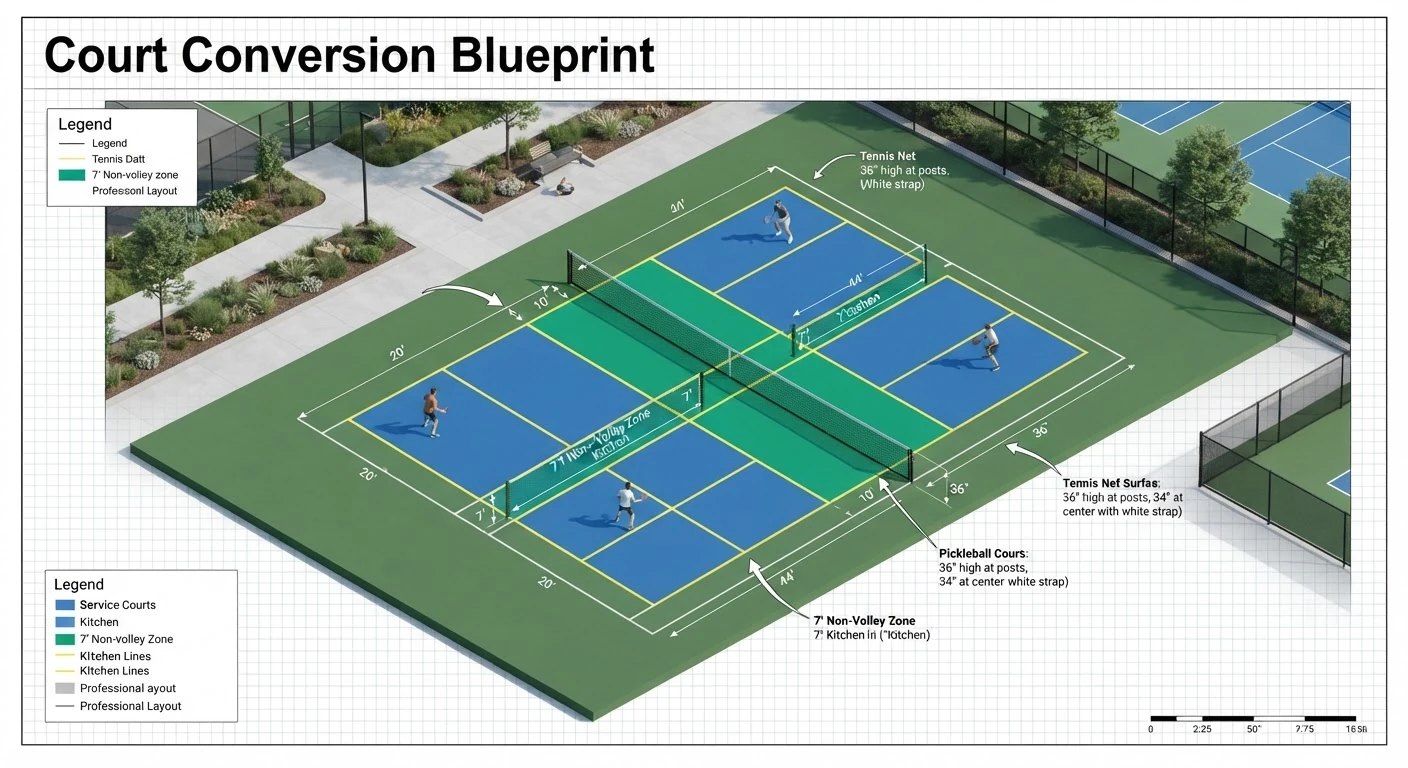
If you do not have dedicated pickleball courts nearby, learning how to play pickleball without a court is simple. You can easily adapt tennis courts, driveways, or lawns using these step-by-step instructions:
5.1 How to Play Pickleball on a Tennis Court
Converting a standard tennis court into a pickleball court takes less than 10 minutes with temporary painter’s tape or chalk:
Step 1: 1. Measure Baseline: Measure 22 feet out on both sides from the tennis net and mark the 20-foot wide baseline.
Step 2: 2. Measure Kitchen: Measure exactly 7 feet out from the net on both sides and lay down the Non-Volley Zone line across the 20-foot width.
Step 3: 3. Centerline: Connect the midpoint of the baseline (10 feet) to the midpoint of the kitchen line.
Step 4: 4. Lower Net Center: Tennis nets hang 36 inches at the center. Use an inexpensive pickleball net converter strap (or bungee cord) to pull the center strap down to 34 inches.
5.2 How to Play Pickleball on Grass or Driveway
Can you play pickleball on grass? Learning how to play pickleball on grass is possible for casual fun. While standard perforated plastic pickleballs do not bounce as crisply on turf, cutting the grass very short and using a firmer outdoor ball enables enjoyable family rallies. For driveways, asphalt provides true concrete bounce matching official tournament courts.
5.3 How to Play Pickleball at Home (Solo Wall Drills)
Learning how to play pickleball at home does not even require an opponent. Stand 7 feet away from a garage door or basement wall, draw a line with painter’s tape at 34 inches (net height), and practice 100 consecutive wall dinks. This builds lightning-fast hand speed and muscle memory.
6. Advanced Strategy: How to Play Better Pickleball & Defeat Bangers
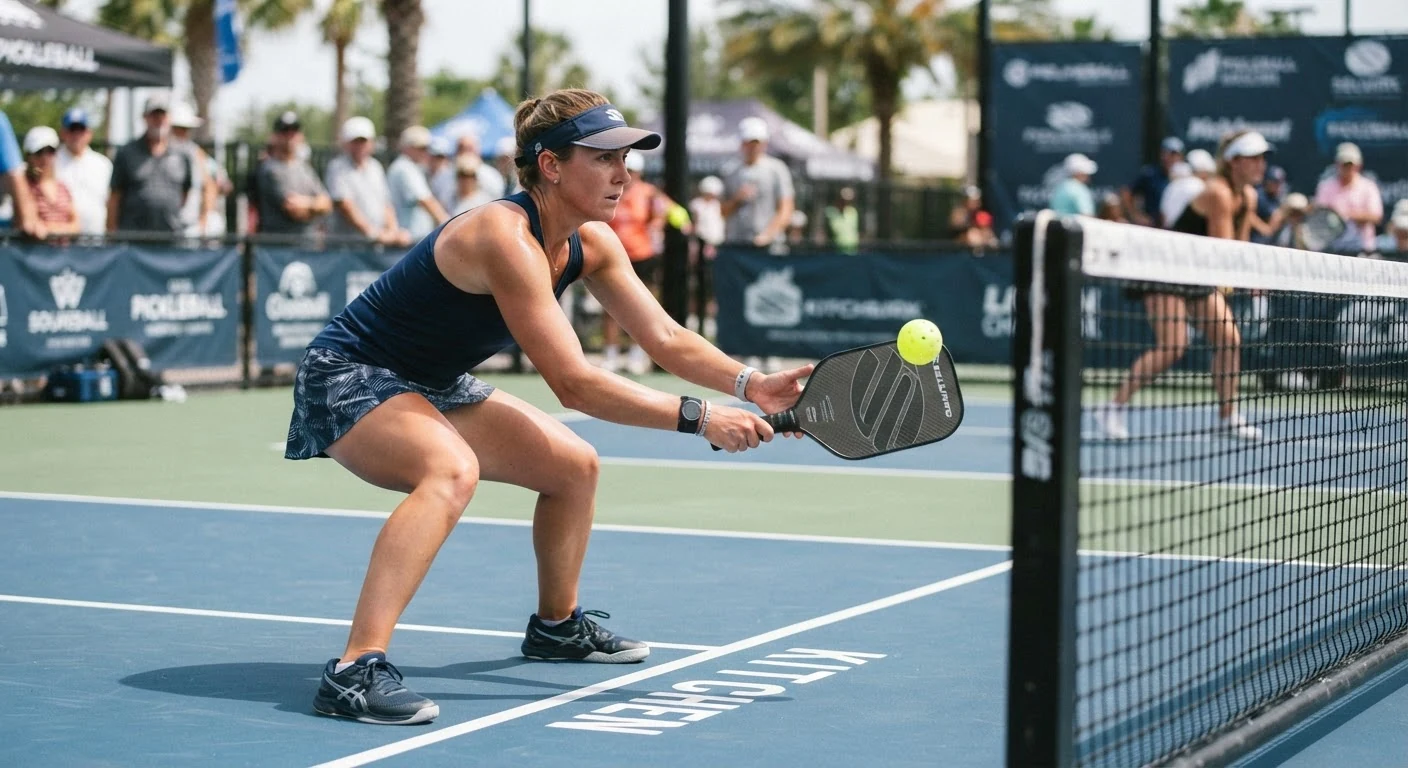
Once you know the basics, the next challenge is learning how to play better pickleball and how to play pickleball better. In intermediate open play, you will inevitably encounter ‘bangers’—players with tennis backgrounds who drive every single ball as hard as possible. Here is how to play against bangers in pickleball and elevate your rating from 3.0 to 4.0+:
Tactical Playbook: How to Neutralize Hard Hitters (Bangers)
- 1. Let the Out Balls Fly (The Shoulder-High Rule): Bangers hit with immense velocity from the baseline. In pickleball, balls hit hard from the baseline that pass you above chest or shoulder height will land OUT 90% of the time. Duck and let them sail long!
- 2. Soft Hands Block Reset: Never swing hard against a hard drive. Loosen your paddle grip tension to 3 out of 10. Hold your paddle out in front of your chest and simply cushion the impact like a pillow, dropping the ball dead into their kitchen.
- 3. Keep the Ball Low at Their Feet: Bangers rely on hitting waist-high balls. Hit soft, sinking dinks into their kitchen; they cannot smash upward from below net height without launching the ball out of bounds.
- 4. Establish the Net Early: The player who controls the kitchen line controls the game. Do not get trapped in ‘no-man’s land’ (the transition zone halfway between baseline and kitchen).
7. Scoring System & Video Demonstrations: Visualizing the Game
Understanding how to play pickleball scoring is often the final hurdle for beginners. Remember: the score in doubles is called as three numbers: [Serving Team Score] – [Receiving Team Score] – [Server 1 or 2]. Points are only scored when you serve, and games are played to 11 (win by 2).
If you are a visual learner, searching for how to play pickleball video, pickleball how to play video, or how to play pickleball videos on platforms like YouTube offers immediate visual reinforcement. Channels like Briones Pickleball, Pickleball Kitchen, and PrimeTime Pickleball provide excellent demonstrations of third-shot drops and kitchen dinking.
8. Finding Courts & Community: How to Learn Near You
Wondering ‘how do i find people to play pickleball with?’ or looking to ‘learn how to play pickleball near me’? Pickleball has the friendliest open-play community in all of recreational athletics:
Court Locators: • Places2Play.org & Pickleheads App: The official court locator engines that show every public and private court, open-play schedule, and lighting status by zip code.
Open Play Etiquette: • Open Play Paddle Stacks: At most public parks, you do not need a partner. Simply show up, place your paddle into the queue rack or paddle stack, and rotate in with players of your skill level.
International Play: • Global Communities (How to Play Pickleball Australia, UK & Beyond): If you are looking up how to play pickleball australia, governing bodies like the Pickleball Australia Association (PAA) and Pickleball England host nationwide introductory leagues and social nights following standard USA Pickleball rules.
9. Frequently Asked Questions: How to Play Pickleball
How to play pickleball for beginners step by step?
Begin with an underhand serve crosscourt past the kitchen line. The receiving team lets it bounce once before returning deep. The serving team lets the return bounce once before playing their third shot. Both teams advance to the 7-foot kitchen line and trade controlled dinks until someone commits a fault. First to 11 points (win by 2) wins the game.
How long to play pickleball matches?
Wondering how long to play pickleball? A standard game played to 11 points typically takes between 12 and 20 minutes. A full best-of-three match takes approximately 45 to 60 minutes.
Can you play pickleball without a court?
Yes! You can mark temporary 20×44-foot boundaries on a driveway, cul-de-sac, or parking lot using sidewalk chalk or painter’s tape, and set up a portable 22-foot regulation nylon pickleball net in 5 minutes.
How much does it cost to play pickleball near me?
Playing on public outdoor courts at parks and community recreation centers is almost always 100% free. Dedicated indoor clubs charge around $10 to $20 for open play drop-ins or monthly memberships around $50 to $120.
Is pickleball hard on the knees or back?
Pickleball is significantly gentler on joints than tennis or basketball because court dimensions are compact, eliminating full-sprint stops and overhead shoulder strain. Wearing proper court shoes with lateral arch support protects against twisting injuries.